
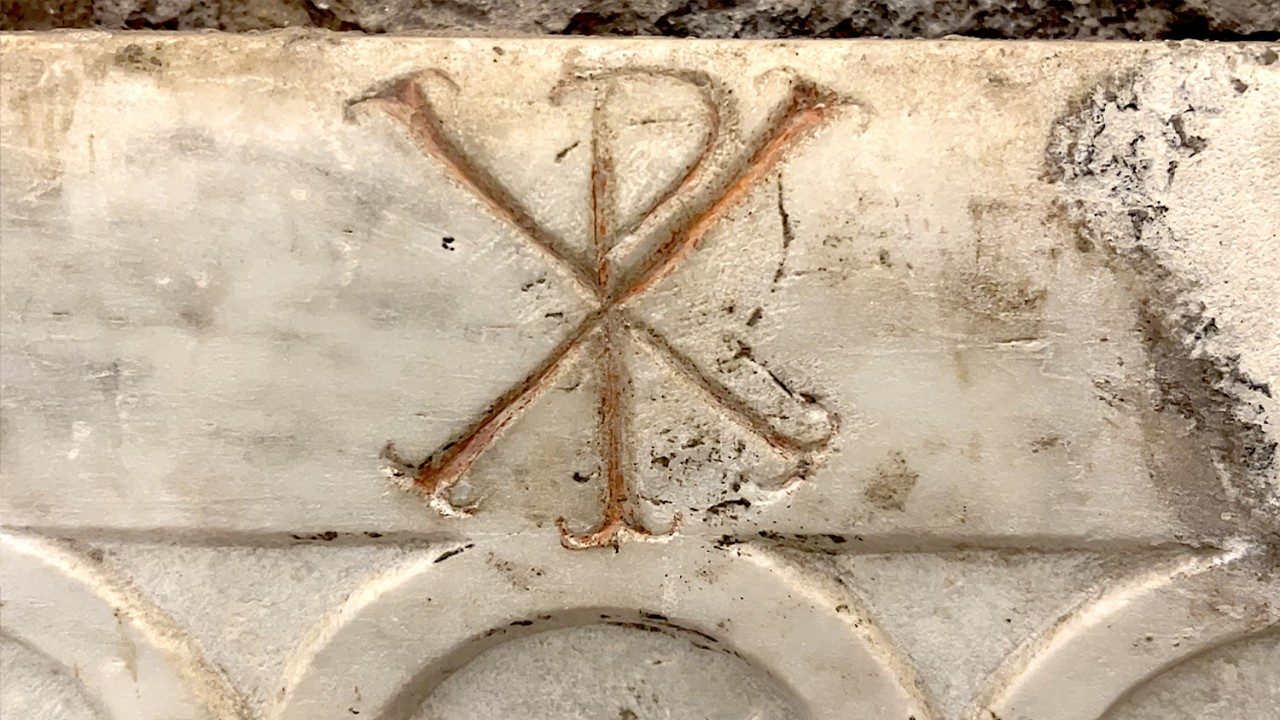
In a new Apostolic Letter commemorating the centenary of the foundation of the Pontifical Institute of Christian Archaeology, Pope Leo XIV highlights the importance of archaeology, noting that this academic discipline bears witness to the fact that God became flesh.
By Benedetta Capelli
Excavation, physically handling the ruins, rediscovering the vitality of time—the work of the Christian archaeologist involves not only material things “but extends to what is truly human”: the hands that forged the artifacts discovered, “the minds that conceived them, and the hearts that loved them.”
This is one of the characteristics of Christian archaeology that the Pope highlights in his Apostolic Letter on the importance of archaeology on the occasion of the centenary of the Pontifical Institute of Christian Archaeology, published Thursday, 11 December 2025.
Making visible the Mystery
Matter and mystery are the two intersecting threads in Christian archaeology, Pope Leo says, precisely because “Christianity was not born from an idea, but through flesh… through a womb, a body, and a tomb.”
“At its most authentic core,” the Pope explains, the Christian faith is historical, grounded in specific events, faces, gestures and words spoken in a particular language, era and environment. This is what archaeology uncovers and makes tangible.”
He then recalls that “God chose to speak in a human language, to walk the earth and to inhabit places, houses, synagogues and streets.”
This is why, “in an age marked by artificial intelligence and by the exploration of countless galaxies, Christian archaeology can still be a fruitful field of study for society and for the Church.
“Christian theology,” Pope Leo says, “cannot be fully understood without understanding the places and material evidence that bear witness to the faith of the early centuries.”
‘Nothing touched by faith is insignificant’
Archaeology and theology are thus intertwined in the work of the Christian archaeologist, underpinning it with a keen sensitivity to carefully handle “physical traces of faith.”
“By examining stones, ruins and other artifacts, it teaches us that nothing touched by faith is insignificant,” the Pope says. “Archaeology … teaches us that even the smallest piece of evidence deserves attention, that every detail has value and that nothing can be discarded.”
Archaeology, then, can be seen as “a school of cultural sustainability and spiritual ecology” teaching us to respect “matter, memory, and history.”
Nothing is cast aside; instead the monuments of history, even the smallest items, are preserved and deciphered, because behind every find lies “the spirit of an era, the meaning of faith and the silence of prayer.”
The “gaze” of the archaeologist, the Pope says, “is a gaze that can teach us a great deal about pastoral care and catechesis today.”
Archaeology and theology
“At the same time,” Pope Leo continues, “modern technological tools can enable us to glean new information from findings once considered insignificant.”
In this sense, he writes, “archaeology is also a school of hope.”
Recalling Francis’ apostolic constitution Veritatis gaudium, Pope Leo insists that “archaeology, along with church history and patrology, should be numbered among the fundamental disciplines of theological formation.”
Archaeology, in fact, speaks not only about the things of the past, but about people, helping us to understand “how Revelation became incarnated in history, how the Gospel came to be expressed and formulated within cultures.”
A theology that embraces archaeology, therefore, “theology listens to the body of the Church, assesses its wounds, reads its signs and is touched by its history.”
At the same time, it is also “a form of charity because it gives a voice to the silence of history, restoring dignity to the forgotten and bringing to light the anonymous holiness of many faithful who have contributed to building up the Church.”
The evangelizing mission
The “mission of Christian archaeology” is also to evangelize, “to help the Church remember its origins, preserve the memory of its beginnings and recount the history of salvation not only through words, but also through images, forms and spaces.”
“In an era when culture often loses sight of its roots,” Pope Leo writes, “archaeology becomes a valuable instrument for an evangelization that builds on historical truth to inspire Christian hope in the newness of the Spirit.”
Looking at how the Gospel was received in the past provides an incentive to spread it today, speaking not only to the faithful, but also to non-believers “who question the meaning of life,” as well as to young people “who often seek authenticity and significance.”
Pope Leo emphasizes that archaeology can also be “a powerful tool for dialogue, helping to build bridges between distant worlds, cultures and generations. It can bear witness to the fact that the Christian faith has never been a static reality, but is a dynamic force, capable of permeating the deepest layers of human history.”
Living and reconciled memory
One of the strengths of archaeology is its ability to offer a glimpse into “the power of an existence that transcends time and surpasses matter.”
This also accounts for its particular relevance to the theology of Revelation. Christian archaeology “illuminates the texts with material evidence … examines, completes and scrutinizes written sources. In some cases, it confirms the authenticity of traditions. Other times, it places them in their proper context, or even raises new questions.”
So, the Pope says, “if theology is to be faithful to Revelation, it must remain open to the complexity of history,” with its challenges and conflicts, “moments of darkness as well as of splendour.”
“It is no coincidence,” Pope Leo adds, “that a deeper understanding of the mystery of the Church goes hand in hand with a return to its origins … The Church awakens and renews itself by studying how it was born and what most deeply defines it.”
This does not involve “reducing ecclesial life to a cult of the past” but is instead a question of “living memory … the ability to make the past speak to the present, and the wisdom of being able to recognize the role of the Holy Spirit in guiding history. It is creative fidelity, not mechanical imitation.”
Christian archaeology, the Pope says, can thus offer “a common language, a shared foundation, and a reconciled memory” helping us to recognize “the unity that exists within diversity” and thus become “a place of listening, a space for dialogue, and an instrument of discernment.”
Not elitist knowledge
Pope Leo notes that Pius XI founded the Pontifical Institute of Christian Archaeology in 1925 during the Jubilee of Peace, while the centenary of its establishment occurs during the Jubilee of Hope—a coincidence that can offer new horizons to humanity shaken by so many wars.
The Institute was founded, in the context of the uncertain post-war climate, “with courage and foresight”; a gesture, the Pope affirms, that challenges us today to understand that being faithful to the spirit of its foundation means not “confining oneself to elitist knowledge” but “sharing, communicating, and involving others.”
In this regard, communion with other institutions involved in archaeology, such as the Pontifical Roman Academy of Archaeology, the Pontifical Commission for Sacred Archaeology, the Pontifical Academy Cultorum Martyrum, and the Pontifical Institute of Christian Archaeology is fundamental, the Pope says.
“Archaeology can also provide opportunities for fruitful cooperation with the Christian East,” Pope Leo says, adding, “Shared catacombs and churches, as well as similar liturgical practices and converging martyrologies all constitute a spiritual and cultural heritage that are to be valued together.”
A ministry of hope
The Church, Pope Leo writes, “is called to educate people in memory, and Christian archaeology is one of its most noble tools for doing so — not in order to take refuge in the past, but consciously to live in the present and work towards an enduring future.”
In this sense, he says, Christian archaeology “is also a ministry of hope,” because “it shows that the faith has already survived difficult times and resisted persecutions, crises, and changes … has been renewed and regenerated … that the Gospel has always had a generative force, that the Church is always reborn, and that hope has never faded.”
Finally, Pope Leo appeals to bishops and leaders of culture and education, to encourage young people, lay people, and priests to study archaeology.
And to those engaged in the practice of Christian archaeology, the Pope expresses his appreciation, saying, “Your work is of immense value.”
“Christian archaeology is a service, a vocation and a form of love for the Church and for humanity,” Pope Leo says in conclusion.
He invites those who undertake this service to “remain faithful to the true and profound purpose of your commitment: the endeavour to make visible the Word of life, bearing witness that God became flesh, that salvation has left its mark, and that this Mystery has become a historical narrative.”
