
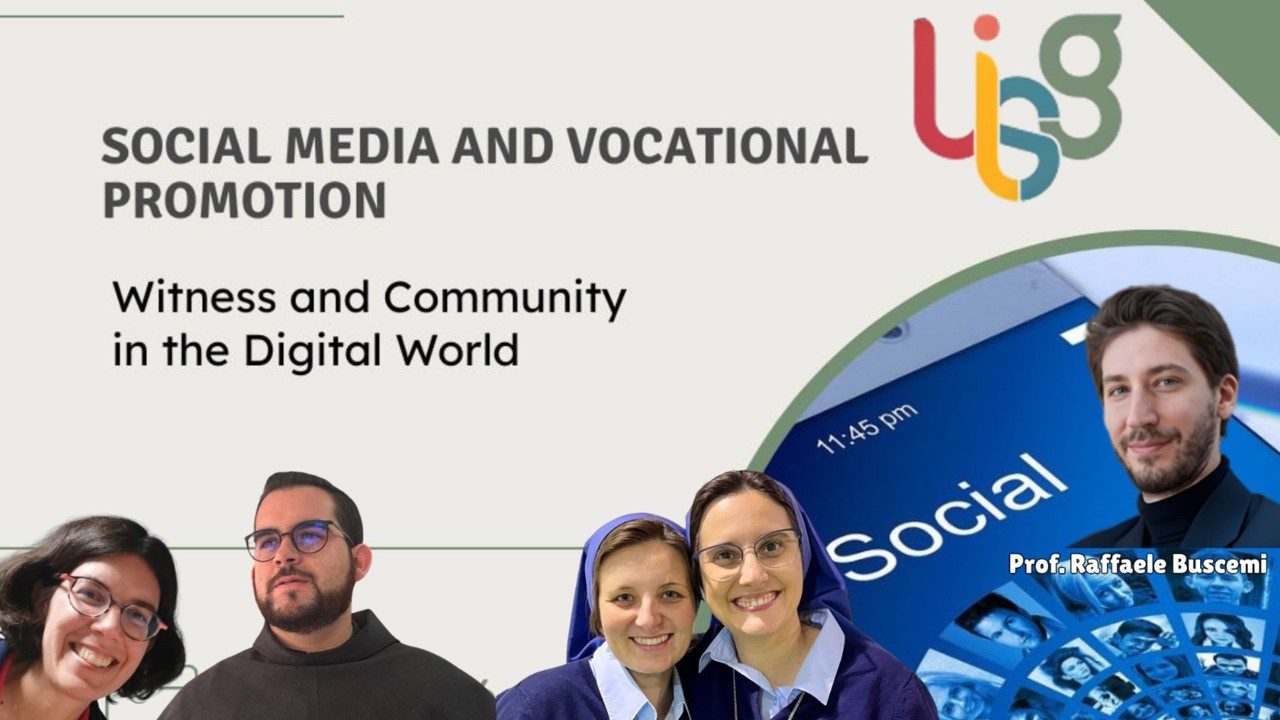

Coping with the digital environment, a recent international webinar explored how social media can become an authentic space of witness, accompaniment, and community discernment.
By Fr Mark Robin Destura, RCJ
Today, being present online is no longer optional; it is a place of encounter. To be present on social media means to inhabit a space where young people search, question, and hope. It is there that they build relationships, express their doubts, and discover new horizons.
It is in this spirit that an international webinar entitled “Social Media and Vocational Promotion: Witness and Community in the Digital World” was organized by Multimedia International in collaboration with the International Union of Superiors General (UISG) and the Union of Superiors General (USG).
Held online on Friday, February 27, 2026, the event gathered approximately 548 participants from different parts of the world. It was offered especially for formators and communicators involved in vocation promotion.
The moderator of the webinar was Sr. Thérèse Raad, SDC, Communication Director of UISG.
“The virtual is real”
The input on Social Media was delivered by Raffaele Buscemi, a professional journalist, Head of Communications at Opus Dei since 2017, and faculty member at the Pontifical University of the Holy Cross.
Buscemi began with three foundational premises: “The virtual is real. Beauty is real. What makes something real is not the tool, but the person and the intention behind it.”
Challenging the idea that digital encounters are less authentic than face-to-face ones, he insisted that reality is not determined by the medium, but by the authenticity of persons.
He urged religious communities to clarify their intentions before entering social media platforms: “Before opening accounts on Instagram, TikTok, Facebook, or elsewhere, we must ask ourselves: What do I want to do online? What do I want to achieve? Who do I want to reach?”
He warned against generic goals such as “reaching everyone” or simply “evangelizing,” stressing the need to define a concrete audience and objective.
Buscemi also emphasized interaction as essential to social media: “Social media is not television.” If one publishes content without responding or engaging, he said, one risks “doing television on the Internet,” missing the dialogical potential of digital platforms.
Regarding vocations, he made a clear distinction: “I do not believe there are ‘digital-born’ vocations. A vocation comes from God. Social media can be the first contact, the first announcement. But the vocation matures in community.”
Social media as a place of mission
Sr. Amélie Jarrousse, a religious of the Sacred Heart of Jesus, shared the experience of her province’s communications team (Belgium-France-Netherlands). Reflecting on their long discernment before entering social media, she said: “From the beginning we asked ourselves: What do we want, and what do we not want to live on these networks?”
She explained that they did not want “to fall into seduction,” nor to present an idealized or artificial image of their congregation. For them, social media is not self-promotion: “We insisted on one point: being on social media is not about selling ourselves; it is a place of mission.”
She noted that young people are already living their discernment questions online, and religious communities are called to accompany them there with authenticity.
An “open cloister” in the digital continent
Fray David Jesús Velásquez Cardona, OFM Conv., National Vocational Promoter in Colombia, described social media as an opportunity to extend Franciscan fraternity into the digital sphere.
He explained: “We want our presence online to be recognizable as the presence of brothers.”
He described digital platforms as “a kind of ‘open cloister’, a space where the joy of the Gospel can reach people who are searching for meaning, consolation, and fraternity.”
He emphasized that their communication is rooted in daily life: “We are not online to ‘be seen,’ but to serve.” Through Instagram, Facebook, YouTube, and WhatsApp, they foster initial contact that can later lead to personal accompaniment and vocational journeys.
Community discernment and digital prudence
Sr. Marta Arici and Sr. Anita Sberna of the Suore Operaie della Santa Casa di Nazareth shared their congregational approach.
They described their desire: “to stay close to people, to be part of what they live, and to share what is alive within us and ultimately to share the Gospel.”
They chose to operate through community pages rather than centering communication on one individual: “We do not want to become ‘TV on the internet,’ nor to build a story around a single personality.”
All content is discerned together before publication to maintain coherence and avoid unnecessary risks.
They also acknowledged the limits and dangers of social media: time consumption, overexposure, and the temptation to seek gratification through likes and visibility.
Authentic witness in the digital world
Throughout the webinar, a common thread emerged: social media must be a space of authenticity, credibility, and community..
As Buscemi affirmed: “Be present online. Be authentic. Be credible. Be dialogical. Be intentional.”
In a time of decreasing vocations, the Church is challenged not simply to occupy digital spaces, but to inhabit them as places of mission where the Gospel can be encountered, questions welcomed, and discernment gently accompanied.
