
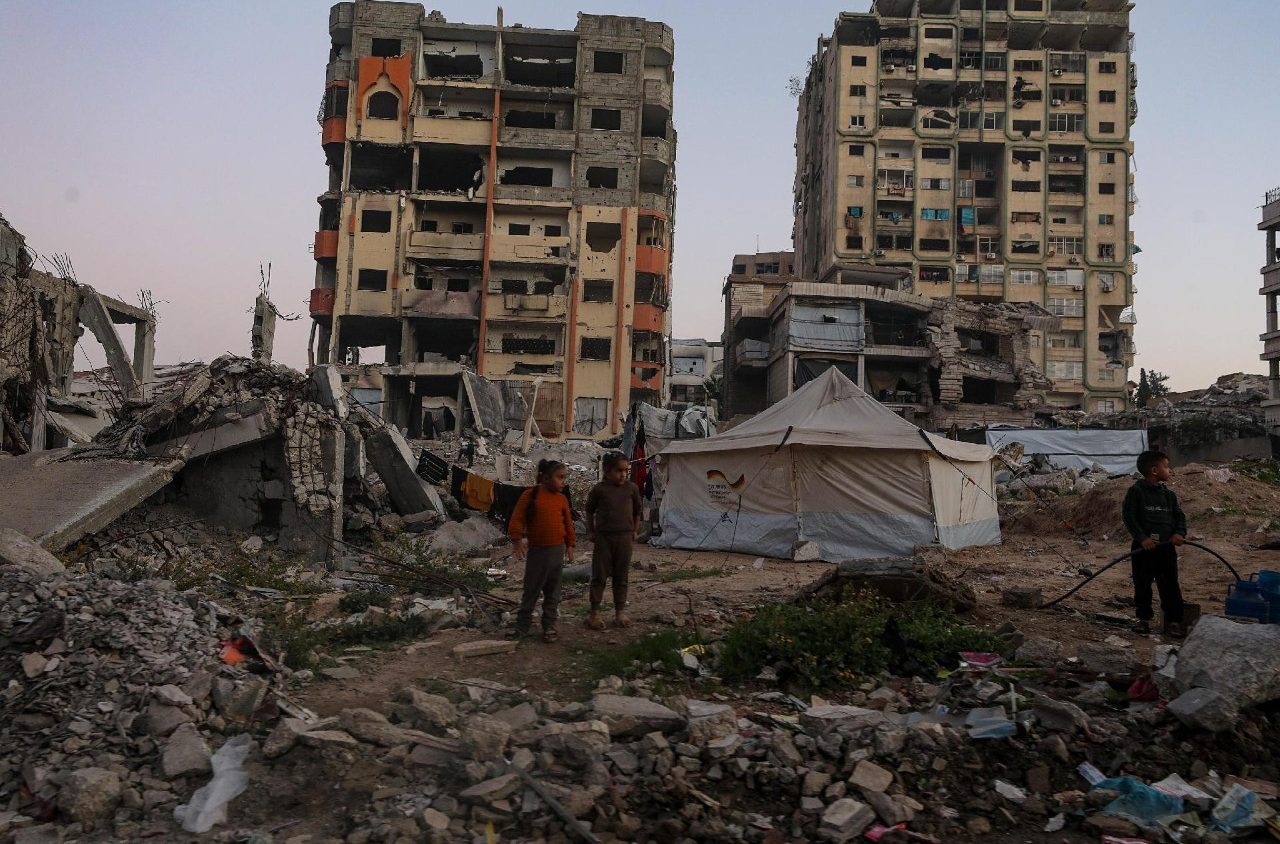
Two months after the ceasefire in the Gaza Strip took effect, UNRWA’s Communications Director describes the ongoing humanitarian emergency and the need for a lasting political solution.
By Beatrice Guerrera
Five children gather around a mobile phone as one of their mothers reads WhatsApp messages and distributes homework. In Gaza, this is a scene of ordinary life where all sense of normalcy has been lost.
Tamara Alrifai, Director of External Relations and Communications for the UN Relief and Works Agency for Palestine Refugees in the Near East (UNRWA), knows the daily reality of the Strip’s more than two million residents well. She spoke to Vatican News during an institutional visit to Italy.
Education, a lifeline for refugees
In an enclave devastated by more than two years of war, children continue their lessons in any way possible. UNRWA schools – 180 before the latest conflict – have become shelters for a population that has been displaced multiple times. At night, mattresses cover classroom floors; during the day, they are stacked aside so children and their teachers can gather in a circle for math, science, and Arabic.
“Education is a pillar in the lives of Palestinian refugees,” Alrifai explains. “They see it as a passport out of vulnerability and poverty. It is probably the one thing that has not been taken away from them.
Since the ceasefire, more than 300,000 children have accessed UNRWA’s online learning, with nearly a thousand new registrations each day.

UNRWA’s Tamara Alrifai
“They need everything”
Needs, however, continue to multiply, “the people of Gaza need everything,” Alrifai explains. Food and medicine remain in short supply after famine was declared in August. Over 80% of housing units have been destroyed, leaving most of the population displaced.
“Above all, people need to feel safe. They need to know that the ceasefire has truly halted hostilities, and that is not the case. Almost 400 people have died since it was declared,” she notes.
UNRWA has continued to provide assistance through more than 12,000 staff members, despite Israeli restrictions on the entry of supplies, medicines, tents, blankets, and infant food. Staff still administer vaccinations distributed by other UN agencies, including the World Health Organisation, and continue to transport drinking water.

Displaced Palestinians shelter in a UNRWA school in Khan Younis, Gaza Strip (q)
A crucial role in building lasting peace
Reconstruction remains a decisive issue for both Gaza’s population and the international community. “Rebuilding must be linked to a political process that ensures stability in Gaza,” Alrifai says.
While the UN has welcomed the 20-point peace plan as a vital step toward ending active hostilities, UNRWA also refers to the New York Declaration, “which outlines a path toward establishing a Palestinian state that includes the West Bank and Gaza, and confirms UNRWA’s role until a fully functioning state exists.”
In Gaza, UNRWA previously provided nearly half of all public services; the Palestinian Authority administered the remainder. “Today we are witnessing concrete attempts to prevent UNRWA from operating in Gaza,” Alrifai warns. “This would remove half of the public-service sector and create a dangerous vacuum.”
At a time when the international community calls for tolerance and seeks to transform the ceasefire into lasting peace, “this is the worst time to create a vacuum within a traumatised population. That is why UNRWA’s role is crucial during a political transition,” the UNRWA official affirms.
Unacceptable raid on East Jerusalem offices
UNRWA also faces growing obstacles in the West Bank and East Jerusalem, beginning with a law enacted in January banning its activities in areas “considered by Israel under its control.” Israel has also revoked entry visas for all UNRWA staff.
On 8 December, Israeli police entered the agency’s East Jerusalem compound in Sheikh Jarrah, reportedly seizing computers and equipment in relation to alleged unpaid taxes.
“It is absolutely unacceptable,” Alrifai says. The incident triggered international reactions in support of UNRWA and reminded Israel that UN premises are protected under an international convention to which it is a party.
Rising violence in the West Bank
Conditions in the West Bank have deteriorated sharply. “What we saw in 2025 is the highest level of settler violence against Palestinians, especially during the olive harvest, along with the highest number of Israeli security operations inside Palestinian cities,” Alrifai says, adding that residents of the Jenin and Tulkarem refugee camps have been displaced as a result.
“UNRWA quickly admitted these displaced refugees into our programs in nearby cities,” she says, “but the fact remains that they were forced from their homes.”
Seventy-five years of UNRWA
Across the Middle East, regional tensions persist, and Palestinian refugees – around 5.9 million – remain among the most vulnerable populations. “We are almost a ‘government’ for Palestinian refugees in five areas: Gaza, the West Bank, Syria, Jordan, and Lebanon,” Alrifai says.
Seventy-five years after the agency’s founding, the refugees’ situation shows no sign of improvement. Last week, the UN General Assembly voted overwhelmingly to renew UNRWA’s mandate for another three years.
“It is encouraging to know that most of the world supports UNRWA. But it is also painful to realise that every three years, a temporary agency created in 1950 must be renewed because the original problem remains unresolved,” she notes.
The agency now faces a 25% budget loss due to cuts in U.S. funding and the withdrawal of several major donors, partly driven by unverified accusations of links to terrorist organisations.
“Some false claims do not help governments already dealing with multiple crises,” Alrifai concludes. “For many, it is easier to cut funding than to look deeper into the reality, and this is profoundly unfair to the Palestinians.”
