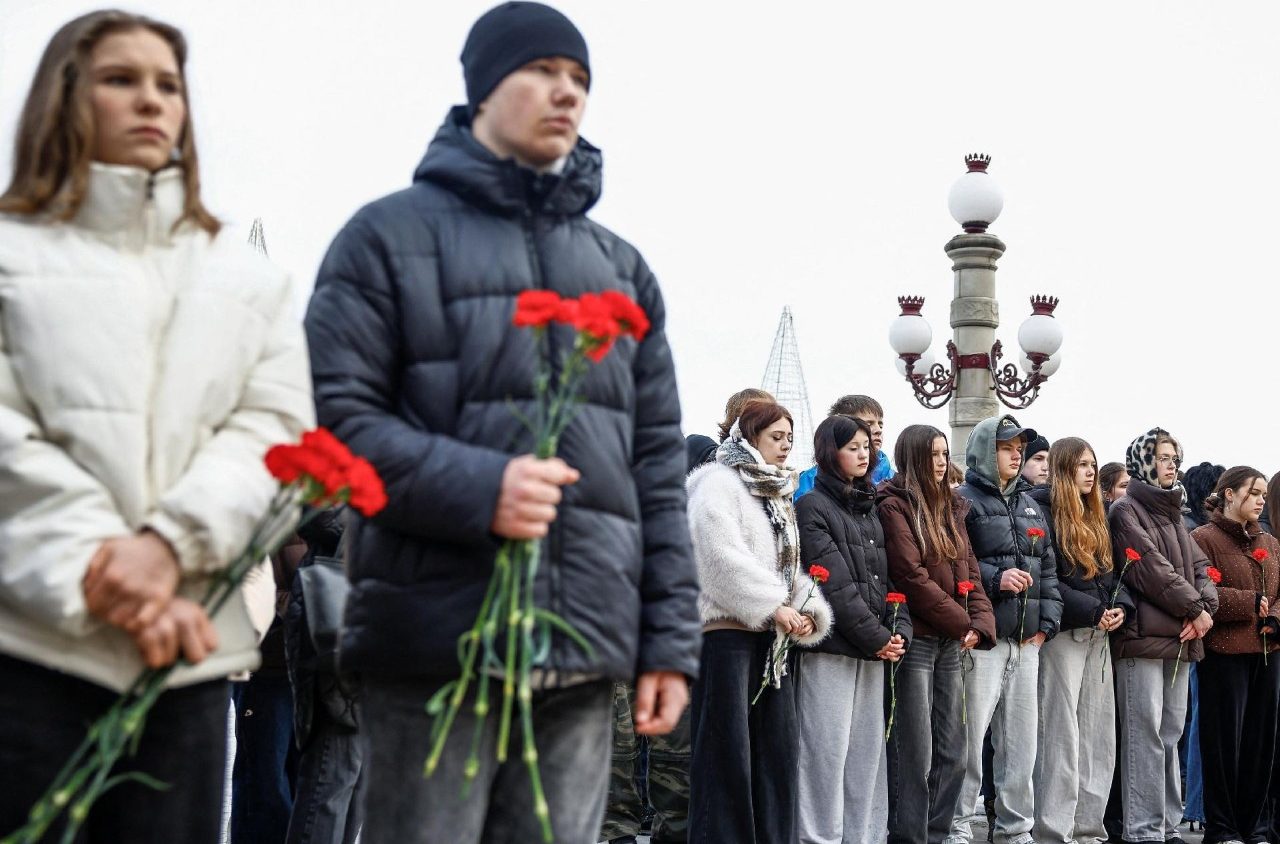
On the fourth anniversary of Russia’s full-scale invasion of Ukraine, Vatican News speaks to the Archbishop of Philadelphia of the Ukrainian Greek Catholic Church about the perseverance, faith, and courage of the Ukrainian people, even in the midst “of great suffering.”
By Kielce Gussie
Four years ago on February 24, Russia launched a full-scale invasion of Ukraine—scaling up on an already intense conflict that had begun eight years prior.
In the last four years, the number of causalities and the destruction have risen. The UN High Commissioner for Refugees estimates that some 5.9 million people have emigrated from the country. Relief Web reports that more than 15,000 civilians have been killed. About one quarter of the pre-war population of 42 million people has been lost.
Speaking to Vatican News, Metropolitan Borys Gudziak, Archbishop of Philadelphia of the Ukrainian Greek Catholic Church, shares how in the midst of this challenging time, the Ukrainian people have been able to foster identity and strengthen relationships, which he says are “the instruments to withstand this kind of assault.”
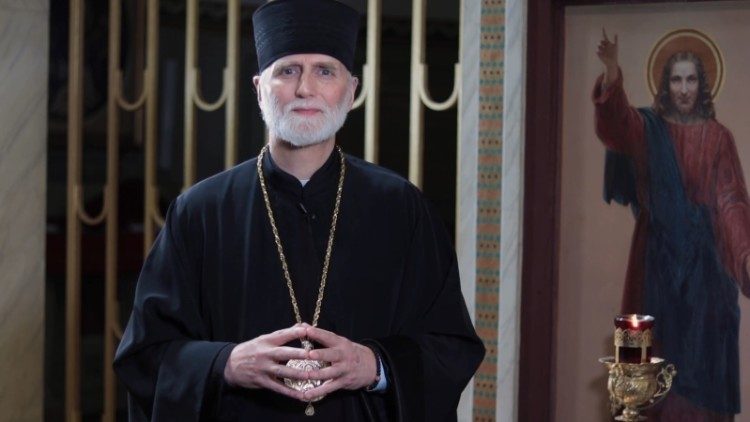
Metropolitan Borys Gudziak, Archbishop of Philadelphia of the Ukrainian Greek Catholic Church, has made about 55 trips to Ukraine during the last 12 years of conflict
Despite the lack of heating, electricity, and the ongoing bombings, Metropolitan Gudziak explains how important global support is for the people in Ukraine. Whether it be the voice of the Pope or the collections gathered in countries around the world, the archbishop stresses that Ukrainians are still “standing, tired and exhausted, but faithful and full of faith that God’s truth will prevail.”
The following transcript has been edited for clarity and length.
February 24 marks the tragic anniversary of the Russian full-scale invasion of Ukraine. What is something you would like to say to people?
I just returned from a two-week trip to Ukraine visiting around a dozen towns, cities, and about 40 humanitarian projects or other church institutions. There was a great contrast.
On the one hand, there is the trauma, death, destruction, and on the other hand, the Church is demonstrating great evangelical love and heroic service. The Church is really with the people that are suffering. The bishops are there, the priests are there, the religious are there, and the laypeople are involved.
Over the last month, the aggressors have been trying to terrorize the population by freezing it: knocking out energy hubs and electrical grids so that there would be no electricity. So, the hot water could not be pumped, and there would be no heat.
They’ve largely been successful, particularly in the city of Kyiv, which is the capital city that had four million people. Between 200 and 1,000 buildings—big apartment buildings—were without electricity, which often meant no heat. Yet the people prevailed.
Many people left the city for a time. Others helped as they could and the repair people were heroic. Every day after another attack of Russian drones or rockets, they would be at work repairing these systems. So, there’s great suffering, but there’s also great valor, great faith.
It’s been four years. What’s the morale like? What’s the environment like?
After 12 years of the war and four years of the full-scale invasion, the population of Ukraine is exhausted. The population right now is about 55% of what it was 35 years ago. Many, many people have left the country because there is such great danger. The constant bombing, the bomb alerts, the air raid sirens going off at night, the need to rush to bomb shelters, it wears on you.
Psychologists say there are tens of millions of people with post-traumatic shock. Children haven’t had normal schooling in most of the country for six years because these four years were preceded by two years of COVID. So, there are very marked effects of this war.

People visit a memorial dedicated to fallen Ukrainian defenders, in Kyiv
People are suffering. But they also realize that, for example, every time there’s a Russian occupation of Ukrainian land, the Ukrainian Catholic Church is extinguished, whether that was in the 18th or 19th centuries, whether under the czars, the communists, or now under the present administration.
People also know the history that during the 20th century, 15 million Ukrainians were killed or lost their lives naturally because of war, because of purges or genocidal famines—one of which was purposely caused. The one in 1932-1933, where 4 million people died, after a very plentiful harvest.
People know that history. If anybody didn’t know it or forgot it or says that was the past, when they saw the mass graves that the occupiers left after they were pushed out, people realized if they come, we’re dead.
You are one of the founders of the Ukrainian Catholic University. What has it been like for the students? How are they responding to the conflict?
[Last week], we received news of another fatality. The 38th member of our community was killed, and the university is mourning. About 60 members of the university family are out on the front. The students and faculty are in touch with the people there, and back at home at the university, people stay together. There’s an intense sense of communion and community.
Only a certain part of the students is Catholic. The country is about 12% Catholic, mostly Eastern Catholic, and so there are students of different confessions. But all of the students value Catholic social doctrine and the manner in which the university has fostered community life where students, faculty, and staff support each other.
Basically, they hug each other—whether it’s literally or figuratively—at a time when the aggressor is trying to isolate people.

Students attend classes at the A.I. Kuindzhi Mariupol State University in Mariupol, Donetsk region (ANSA)
War is diabolical. It’s the accumulation of all sin. And the devil, “diabolos”, comes from the word “diabolene” in Greek which means to divide. This aggression is meant to divide people and make people doubt: doubt their faith, doubt their identity, doubt their relationships. A community that fosters identity and strengthens relationships offers the instruments to withstand this kind of assault.
The university has an Institute of Mental Health, which actually is now being used by the First Lady of Ukraine, Olena Zelenskaya, to offer the anthropology for a country-wide campaign called “How Are You?” This is a program that encourages people to come together and to not fall over the edge in terms of mental health issues because there will never be enough psychologists and therapists to accompany the tens of millions of people with problems, especially the children.
Whether it’s prayer, community life, psychological accompaniment, activities, or volunteering, it helps students and faculty stay together and be integrated as persons and as members of a community.
You’re based in the United States currently, in the Archeparchy of Philadelphia. What do you encourage your parishioners in the United States to do for people in Ukraine?
I think this was maybe the 55th trip that I’ve made [to Ukraine] in these 12 years and the 15th in the last four years. Both our community and the bishops’ conference are very open to and count on first-hand information from those of us who travel there often.
The fact of the matter is that most of our parishioners have some connection with Ukraine. They have relatives there. About 60% of our churchgoers are from Ukraine and there’s 350,000 new refugees in the United States in the last three or four years. People are on online or use social media, so they are aware of the situation.

Rally and march mark four year anniversary of Russia’s full-scale invasion of Ukraine in Washington D.C. (ANSA)
But there is something particular about first-hand testimony and expert testimony about the state of people’s souls, their psyches, their bodies, what is being done to address the spiritual, psychological, and physical trauma, and how are people holding up.
We ask for three things, and we’ve been doing that systematically from the beginning. [The three things] are to pray, to inform and to be informed, and to inform others and to help inform partnerships.
Ukraine is suffering. Ukraine in one sense is poor, but it’s also very rich. It is living a paschal story. It’s the way of the cross.
People in Ukraine are risking and giving their lives to defend democracy, religious freedom, freedom of the press, God-given human dignity—not only of Ukrainians but of Europeans and people at large.
Ukrainians need help, but not because they’re pitiful and miserable. We should be in partnership with them because they are doing, one could say, our dirty work at an inestimable cost. Therefore, we encourage everyone to pray, to inform and to help by entering into partnership with people who are making a heroic stance.
During these last four years—and on a greater scale, over the last 12 years—has there been a shift in the West’s view of Ukraine?
Well, there’s been a great[er] awareness that developed almost immediately. If you asked many people [before], they would have not known who Ukrainians were or where Ukraine was.
I just saw a poll that placed President Zelensky as the most respected global leader, and that’s not a personal thing. It’s the fact that he represents this country. I would also say that he became a leader because he followed the people. As president, he has represented them. It is clear that he and the people of Ukraine are much more in the global spotlight than they were 20 years ago.
Yet at the same time, the war in Ukraine is not news and there are many problems in the world. The priority of Ukraine has declined in the eyes of many run-of-the-mill people and governments, even though I believe it’s an epicenter of global change and what happens in Ukraine has global impact.
If Ukraine becomes occupied by these aggressors, their aggression will spread towards the Baltic countries, towards Poland, towards other parts of Europe. So the freedom of religion, the freedom of democracy, the freedom of press, all of that is at stake, not only in Ukraine.
Ukraine is in a sense carrying the weight of the world on their shoulders, and doing it for one year, let alone for 12 years, is a miracle.
The Lord is at work—even with all the suffering in the community and with those who have daily contact with all of the pain, the suffering. There are over 50,000 amputees. There are probably 100 Ukrainians being killed every day and many more maimed. Seeing these cities that are scarred, you cannot but feel that weight and that pain. Yet you see the Lord at work.
In the first days of this full-scale invasion, nobody gave Ukraine a chance. The idea that all leaders were in harmony with the aggressor, the thought was, “Well, three days, three weeks, and it’ll be over. Ukrainians will capitulate and that will be the end.”
In fact, that has not happened, and it’s a biblical story. It’s David standing up to Goliath. That is a story that shows God’s presence and God’s strength. There’s a lot of paradox and people ask, “Lord, why are you allowing this? Why do we suffer? Why was my son killed? Why was the father of my children maimed? Why did I have to leave my home?” Fourteen million people have left their homes.

A person stands at a makeshift memorial to fallen Ukrainian and foreign soldiers in Independence Square in Kyiv (AFP or licensors)
They ask, “Why am I separated from my husband who is at the front and I am a refugee in Italy or Germany or Scandinavia?” Many, many very difficult questions. I believe the Lord’s truth will prevail. His justice is a justice that will endure. So, we pray. We pray and try to witness.
My parents were World War II refugees. They endured six years of war as teenagers. They were 13 when the war began and 19 when it ended. Then they were refugees for five more years. They had lost everything. My mother lost her mother and her sister, who was in the Ukrainian resistance. My father was the only one to leave the country. His parents had buried eight children before the war.
So, [my parents] came to the United States which welcomed migrants. They made a great contribution to the country. My father was a dentist who had the greatest number of welfare patients in Syracuse, New York for a number of years in a row.
They gave life. They lived despite the fact that during World War II, six million Ukrainians were killed. Nobody gave the country a chance in the 1980s. The Soviet Union was a superpower armed to its teeth with nuclear weapons, and then it fell. This is something St. John Paul understood.
He knew that God’s truth in the end will prevail and he witnessed to the world, and especially to the people suffering, the Church’s solidarity, which was key for Poland but eventually for so many other countries that were freed.
Freedom will come back and it will be strengthened. We need to really be faithful to our call. It could be the case that we won’t see it in our lifetime, but there’s no stepping back from what is the truth.
What has the relationship been like between the Holy See and Ukraine—providing aid and offering moral and spiritual support?
I don’t know the exact count, but I think Pope Francis spoke about Ukraine about 400 times, at almost every Wednesday audience and Sunday Angelus. He called the world to pray for the martyred Ukraine, the suffering Ukraine.
That is very important. Prayer moves mountains. Those calls kept the story of the suffering before the eyes of the world.
Pope Francis also worked to free prisoners of war. The Holy See has been working on the return of children [taken during the conflict]. Officially over 20,000 children have been abducted, but the number is significantly higher. The Holy See is not a power with divisions or tanks. It is a place of mercy with the message of the Gospel, prayer and blessing. These spiritual instruments do their job.
Pope Leo, in the first days of his papacy, welcomed Eastern Catholics at the first Wednesday audience after his election. Special attention was given to Eastern Catholics because we had our Jubilee in those days.
President Zelensky was the first head of state with whom the Pope had a telephone call and the first head of state with whom he met. Pope Leo has pointed out the injustice and has called for justice and a just peace in Ukraine.

Pope Leo met with President Zelenskyy at Castel Gandolfo in summer 2025 (AFP or licensors)
The Holy Father and his dicasteries also work quietly behind the scenes to help where they can—which is very much appreciated. I’ll give you an example. Cardinal Grzegorz Ryś from Krakow, spontaneously responding to a message from his Beatitude Sviatoslav Shevchuk, announced a collection for generators to address this energy crisis created by the attacks of the aggressor on the energy grid.
The Pope commended that project, and then the entire Polish bishops’ conference launched a collection. A word from the Holy Father commending the initiative of one Archbishop led to a nationwide act of solidarity that probably saved many lives.
When you visit Ukraine, do you hear people comment on the Pope’s words? How important is it for them to continue to hear a Pope talking about their situation?
It’s very important. There is a strong sense of the solidarity of global Catholics. I know that when I am headed back to the United States from Ukraine, people ask me to thank the Catholics in America. Catholic media is quite clear on what is happening, and the different Caritas, dioceses, individuals, parishes have, in many different ways, helped the suffering people of Ukraine, and that is truly appreciated.
People always tell me to thank people. So, I want to thank all of you for your prayer, for staying informed, and for your partnership with the people of Ukraine, the Christians of Ukraine, the believers of Ukraine. They appreciate it and know that they are standing, tired, exhausted, but faithful and full of faith that God’s truth will prevail.
What people can do during this season of Lent for people in Ukraine?
Lent is a time to return to the principal exercises of this penitential time: prayer, fasting, and almsgiving. It’s a good time to participate in collections for the poor. [For example,] the Ash Wednesday collection in the United States is for the Church in Eastern Europe. I think during Lent in many Catholic countries there will be opportunities to show the solidarity of our Catholic faithful globally with the people that suffer.

Lviv vigil honors fallen Ukrainian soldiers on Eve of 4th anniversary of Russia’s invasion (ANSA)
There are people suffering many places. Ukraine is not the only place, and we Ukrainians also pray for and try to help, when we can, those who suffer elsewhere. In that mutual awareness of our joint pilgrimage in the Lord, we support each other.
