
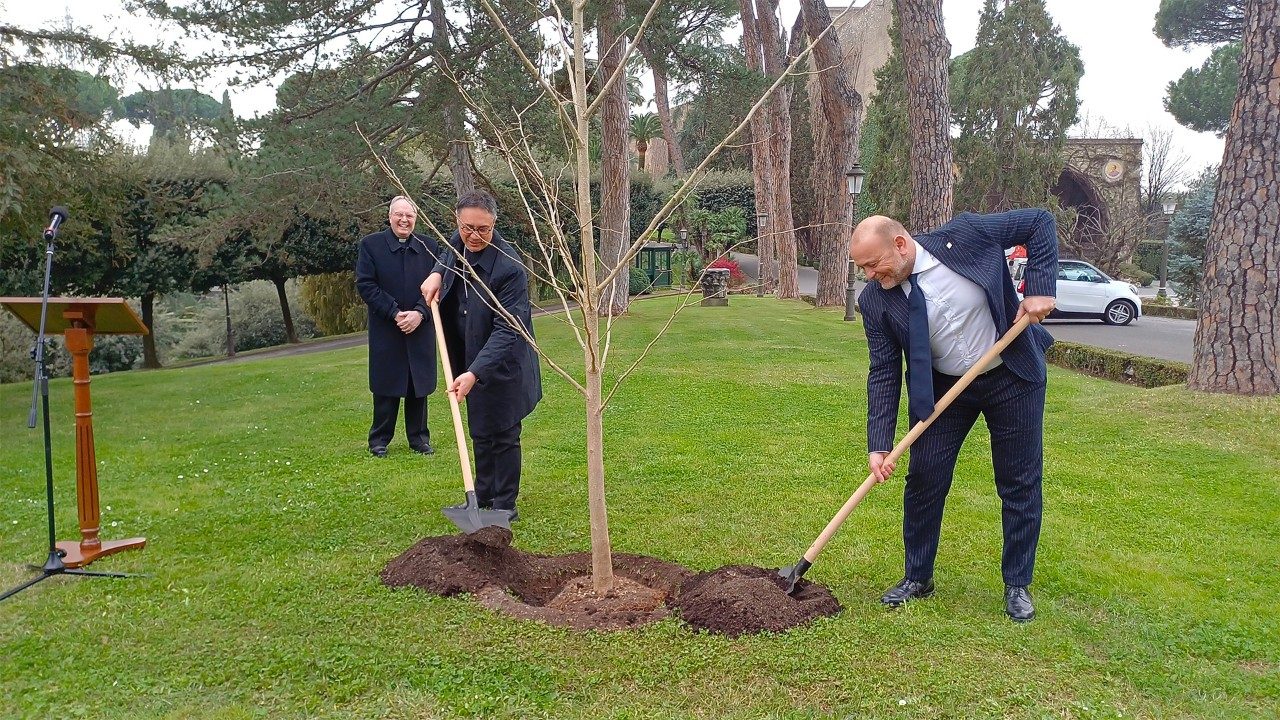
The National Order of Agronomists and Foresters gifts a gingko biloba tree to Pope Leo, which has been planted in the Vatican Gardens. At the planting ceremony, the Holy See’s permanent observer to the FAO stresses that “in the ecological evils, humanity must always be the solution, never the problem.”
By Daniele Piccini
On March 6, a ginkgo biloba tree—one of the oldest medicinal plants from the Far East—was planted in a corner of the Vatican Gardens. The tree was planted on Via della Radio, just a few meters from the Lourdes Grotto, by the National Order of Agronomists and Foresters (CONAF), who donated it to Pope Leo XIV.
The Pope had received the organization in an audience on November 5. During that meeting, he reaffirmed the perspective from which to view agriculture: “A concrete form of charity towards our Mother Earth and future generations: the Earth is not a possession but a gift! It precedes us and will be taken from us. It is a mother that nourishes, not a resource to be exploited. Those who cultivate it with respect and wisdom participate in God’s creative work and contribute to peace among men.”
The short-sightedness of financial interests that degrade nature
Archbishop Emilio Nappa, Secretary General of the Governorate of Vatican City, spoke at the tree planting ceremony, saying that “every time a tree is planted, especially here in the Vatican, it is a sign of a bond. In this case, it’s between national agronomists and the Holy Father, the Vatican, and the Church.”
“Trees growing in a garden, respect for nature and for fellow human beings living in harmony with it and with one another, and a sense of responsibility toward Creation – all stand in stark contrast to the many violations of environmental protection occurring in Italy and around the world,” he said.
Originally from Naples, Archbishop Nappa described having a deep connection with nature, particularly because he comes “from a land devastated by selfishness and shortsightedness, for the financial and economic interests of those who exploit and pollute the land.”
The Secretary General of the Governatorate stressed the importance of thinking of future generations. “To those who come after them, these people leave – not the life that the trees represent and embody, but death and pollution, as in the ‘Land of Fires’ in Campania, and, as numerous studies now show, also in northern Italy,” he concluded, referring to the area of the Campania region between the provinces of Caserta and Naples, where Pope Leo will visit on 23 May.
Man must be the solution, not the problem
Also speaking during the ceremony, the Holy See’s permanent observer to the FAO, IFAD, and WFP, Archbishop Fernando Chica Arellano said, “You have chosen to honour the Holy Father Pope Leo XIV with this precious gift. Planting a tree means to fight against deforestation and desertification.”

From left: Mauro Uniformi, President of CONAF; Archbishop Emilio Nappa, Secretary General of the Governorate; Archbishop Fernando Chica Arellano, Permanent Observer of the Holy See to the FAO.
“While many destroy the planet,” he continued, “here life is rising. The tree is a lung of pure air that invites each of us to always be on the side of the solution and never the problem, always on the side of good and never evil. Planting a tree, though small and bare now,” concluded Archbishop Arellano, “is above all an initiative that values the virtue of patience.”
A commitment to creation supported by Pope Leo XIV
“Last year,” recalled Mauro Uniformi, President of CONAF, “the meeting in the Vatican concluded with our commitment to translate the Pope’s words into concrete actions of protection, education, and sustainability, aware that taking care of the Earth means taking care of humanity.”
From this, he pointed out, the Rome Charter was born. It is a guiding document outlined in the acts of the 19th National Congress of CONAF, titled ‘Roots in the Future.’ The CONAF President highlighted that “the program indicates the future direction for the agronomic and forestry profession, which must combine technical expertise with a moral attitude aware of its responsibility towards Creation and future generations.”
“This Charter sets the course for the profession of agronomists and foresters in the coming years,” added Uniformi, “translating into operational commitments the responsibility of taking care of natural capital, productive systems, and territories.”
The Ginkgo Biloba tree embodies a program
The ginkgo biloba tree already embodies this program with its form: firmly rooted in the earth, yet with a trunk and canopy extending elegantly upward. The plant is a spiritual archetype, well-suited to represent Creation for two reasons.

The tree, described as a “living fossil” because it descends from a species that existed over 200 million years ago, survived the Hiroshima explosion
On one hand, its ancient origins—often called a “living fossil” because it descends from plant species over 200 million years old—make it a legitimate “guardian of the memory of the Earth.” On the other hand, its resilience shown by surviving the explosion at Hiroshima, Japan—ginkgo biloba specimens regenerated from the radioactive trauma within months of the devastating explosion—makes it an ideal bridge between nature and the city, capable of withstanding pollution and water scarcity, a combination increasingly common in contemporary urban contexts.
“Symbolizing balance, memory, resilience, and transformation,” concluded the President of CONAF, “the ginkgo biloba is the image of a soul that crosses the centuries without breaking, that integrates polarities, and that, even after destruction, finds the strength to bloom again.”
