
The proclamation of the faith, and the conscience of a Church that knows it does not shine with its own light.
By Andrea Tornielli
In a memorable homily delivered on 11 May 2010 in Lisbon, Pope Benedict XVI noted: “We often worry about the social, cultural and political consequences of the faith, taking for granted that this faith exists—and unfortunately, that is becoming less and less realistic.”
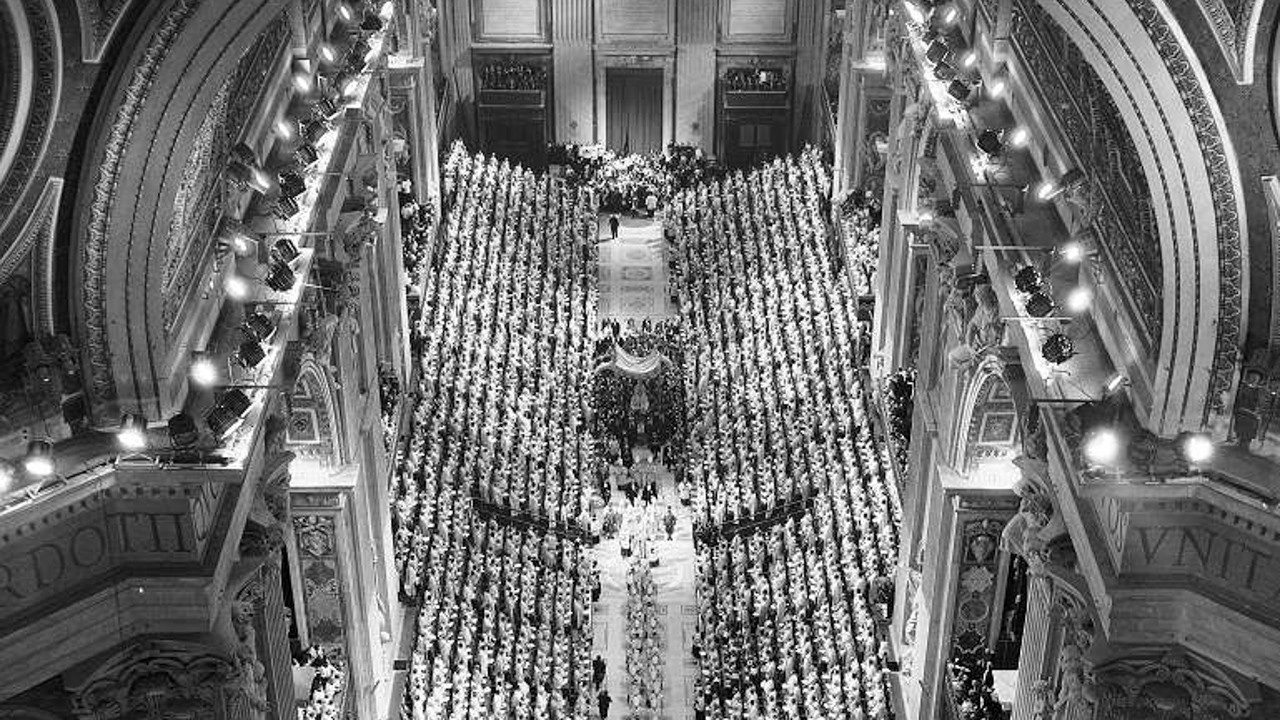
It is precisely this observation—an honest reckoning with the reality of secularization and dechristianization—that lay behind the Second Vatican Ecumenical Council, whose sixtieth anniversary we have just celebrated. Already in the early decades of the twentieth century, many within the Church had sensed the growing difficulty of transmitting the faith in the so-called “Christian world.” The difficulty did not stem from overt hostility toward Christianity, but rather from indifference.
This was acutely felt by Archbishop Giovanni Battista Montini when, in the mid-1950s, he arrived in Milan and found himself confronting social environments increasingly impermeable to the Gospel message: the world of factory workers, of finance, of high fashion. The great question behind John XXIII’s bold decision to convene the Council—and behind Paul VI’s skillful leadership in bringing it to a virtually unanimous conclusion—was therefore a simple one: how can the Gospel be proclaimed anew to the men and women of today? It was already evident that the “age of Christendom,” in which societies were steeped in Christian culture, was coming to an end, and that transmitting the faith required new languages capable of recovering what is truly essential and bearing witness to it before the world.
In the decades following Vatican II, its effects have been the subject of ideological debate and controversy—many of them still unresolved—between those who blame the Council for the Church’s crisis and for dechristianization, and those who believe the answer lies in adapting to the world. The former fail to see that the crisis began long before 1962 and continue to chase the dream of an impossible restoration, projecting the image of a beleaguered Church whose only defense is to seal itself in a fortress. The latter imagine reforms crafted at expert roundtables to match societal shifts but disconnected from the daily experience of God’s holy people.
What the Council taught—and what has been echoed in the magisterium of every Pope since 1965—is well summed up in the opening lines of the Dogmatic Constitution Lumen gentium: “Christ is the Light of nations. Because this is so, this Sacred Synod gathered together in the Holy Spirit eagerly desires, by proclaiming the Gospel to every creature, to bring the light of Christ to all men, a light brightly visible on the countenance of the Church.” Here lies a central insight that can never be taken for granted. The Church does not shine with its own light; it does not radiate a light of its own; it is not the source of the proclamation. The Church can only seek to be transparent—allowing the light of Christ to pass through and shimmer. It is Christ’s light that shines upon the face of the Church.
This awareness, so clear in the teaching of the Church Fathers, carries profound consequences. A Church that knows it is neither the source nor the “owner” of the faith shuns self-sufficiency and self-reference. It does not live with its gaze fixed nostalgically on the past; it does not seek the support of the powerful; it does not impose the faith, reduce it to rules or traditions, or trust in strategies and human plans. It knows how to acknowledge its inadequacies and ask forgiveness. It engages in free dialogue with all, seeks the face of its Lord, allows itself to be evangelized by those far away, and recognizes Him wherever He freely reveals Himself.
It lives out mercy, welcome, closeness to the poor, and commitment to peace and justice as ways of being the salt of the earth—allowing Christ’s light to shine in the world and bearing witness to the logic of a God who, as Pope Leo XIV reminded us in Istanbul’s cathedral on 28 November, “chose the path of smallness in order to come down among us,” and therefore does not require our proclamations, our denunciations, or our strategies to make Himself known.
Speaking of the Kingdom of God and of how it becomes manifest in Jesus Christ, the Bishop of Rome said at the Angelus on 7 December: “The prophet Isaiah compares it to a shoot: not an image of power or destruction, but of birth and newness. On the little shoot that springs from an apparently dead stump, the Holy Spirit begins to breathe with His gifts. Each of us can think of a similar surprise in our own lives. It is the experience the Church lived through with the Second Vatican Council, which concluded sixty years ago: an experience that renews itself when we walk together toward the Kingdom of God, striving to welcome it and serve it. Then not only do realities that seemed weak or marginal begin to sprout, but what humanly seemed impossible comes to pass.”
This Church—living out the mystery of Christ in the world—is already alive in countless individuals and communities, as shown by the stories of hope that emerged during this Jubilee Year. Sixty years on, we are still at the beginning of the path the Council set before us, a path we are all called to help bring to life.
