
Consecrated Time
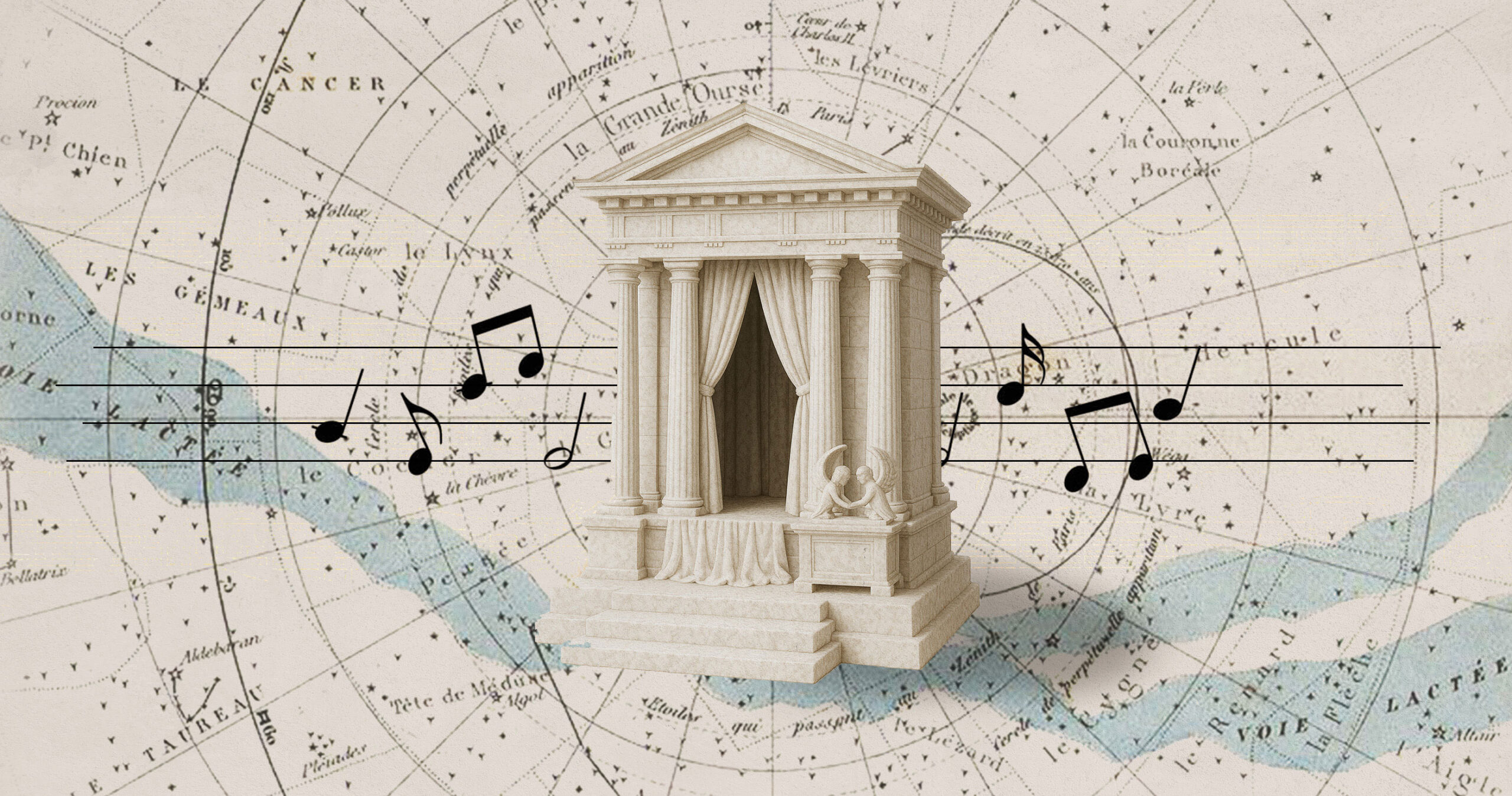
“Liturgy” (from the Greek leitourgia) is any form of orderly, corporate religious service. It involves speech and actions structured by consecrated time and space as occasions for fellowship with God. Churches gather on Sundays because they reflect this order, and many churches name the order of their services (or parts of it) as the “liturgy.” In part, liturgy reflects the church’s corporate sense that they are all partaking in an act of service to God that is bigger than individual members of the church body, and especially bigger than anyone’s personal preferences. Since peace is “the tranquility of order,” worship should be orderly because it responds to the God of peace (1 Cor. 14:33, 40).1 The hexaemeron (Greek for “six-day account”) offers us a liturgy of creation in at least two ways: (1) in its shape as a hymn and (2) in its temple imagery.
The Hexaemeron’s Shape as a Hymn
First of all, liturgical interests saturate the hexaemeron’s form as poetic hymn. In the most significant places where Scripture teaches about creation, it does so in the context of praise and doxology. Examples abound:
Let all the earth fear the Lord;
let all the inhabitants of the world stand in awe of him!
For he spoke, and it came to be;
he commanded, and it stood firm. (Ps. 33:8–9)O Lord, how manifold are your works!
In wisdom you have made them all;
the earth is full of your creatures. (Ps. 104:24)Worthy are you, our Lord and God,
to receive glory and honor and power,
for you created all things,
and by your will they existed and were created. (Rev. 4:11)
Even Paul’s statement about creation taking place through and for Christ is in the form of a hymn (Col. 1:15–20).

This volume in the Short Studies in Systematic Theology series explores the doctrine of creation, inviting readers to delight in the Creator and respond in worship.
The creation week is not much different in this regard. Before there is a congregation to respond to, God utters his own Word and its response—which is to say, before there is any choir, the conductor raises his own voice. Space for creaturely response arrives in the climax of all the other days, the seventh, which God sanctifies and blesses as the model for enjoying his creation’s fruitfulness and for returning it to him in praise. When creation was completed,
the morning stars sang together
and all the sons of God shouted for joy. (Job 38:7)
The liturgical response of the stars and angels is a model for our own. All creatures are summoned to praise the Creator, beginning with angels, the sun and moon, the waters and mountains and others, leading all the way finally to humans (cf. Ps. 148). Hence, God brings about a “sung world—a song not only sung, but a song giving rise to new singers.”2
As a song or a hymn, the hexaemeron invites its readers to confess the Creator’s majesty, order their lives by creation’s doxological rhythm and order, and praise God for his mighty works. We find this in the great psalm of creation, which begins with confession:
O Lord my God, you are very great!
You are clothed with splendor and majesty. (Ps. 104:1)
This leads into a hymn of creation’s order and artistry, concluding with a vision of creation inhabited only by those who praise God:
I will sing to the Lord as long as I live;
I will sing praise to my God while I have being. . . .
Let sinners be consumed from the earth,
and the let the wicked be no more! (Ps. 104:33, 35)
The reminder that the “way of the wicked will perish” (Ps. 1:6) restates that sin was not part of God’s created order and has no proper place within it. The Creator’s song began without dissonance and will end in pure harmony, when it blends with the “new song” that completes the first: the song of the Lamb slain to reclaim his creation in all its resonance (Rev. 5:11–13; 14:3).
The Hexaemeron’s Temple Imagery
Second, the hexaemeron uses imagery that is evocative of the temple, where Israel would gather to worship God in his presence. Attuning our ears to the hymn’s rhythm and imagery, we discover that the stories of creation and the construction of the tabernacle strike several common notes. For instance, in each account the “Spirit of God,” full of wisdom and knowledge, is present and active before the work begins.3 More importantly for creation’s doxological character, the number seven and its association with the climax of the hexaemeron loom large. Before Moses receives instructions for the tabernacle, he waits for six days until the Lord finally appears on the seventh (Ex. 24:16). As in the hexaemeron, there are seven commands and acts of response in which God issues a command and then it is done.4 Later in Leviticus, instructions for sacrificial activities are reported in seven speeches, and rituals such as the ordination of priests last for seven days (Lev. 1–7; 8:33).5 Each account includes signal acts of beholding, completing, blessing, and sanctifying the work, and each notably concludes with Sabbath rest.6
Creation is, from the beginning, built for worship, and it will be consummated in worship.
Many of these parallels between creation and the tabernacle or temple are allusive and gather their force cumulatively.7 Just as God stretches out the heavens like a tent, so Israel makes “curtains of goats’ hair for a tent over the tabernacle” (Ex. 26:7; Ps. 104:2). God makes the “firmament” to separate the waters from one another, and Israel hangs a veil to “separate” the “Holy Place from the Most Holy” (Gen. 1:6–8; Ex. 26:33). Corresponding to the waters under the firmament on day 2 is the bronze basin filled with water, in which the priests wash their hands and feet before approaching the altar or entering the tabernacle (Gen. 1:7; Ex. 30:17–21). There are “lamps” in the heavens and lampstands in the tabernacle (Gen. 1:14–15; Ex. 25:31–40), birds flying across the heavens and winged cherubim spread across the mercy seat (Gen. 1:20; Ex. 25:20). As there are priests to lead in the tabernacle’s liturgy, so there are Adam and Eve to lead creation’s liturgy (Gen. 1:27; Ex. 28:1). Acts of “separating” also draw an analogy between the creation and the liturgy around the tabernacle.8 And in imitation of God finishing his work and blessing it, Israel finishes the tabernacle’s construction and Moses blesses it (Gen. 2:1–3; Ex. 39:32, 43). These allusions fuel an analogy between creation and the temple, for which reason creation is compared to a tabernacle (Job 9:8; Ps. 104:2; Isa. 40:22; 66:1–2), or a house in which the heavens, supported by pillars (Job 26:11), have windows and doors (Gen. 7:11; Ps. 78:23). This is perhaps nowhere more explicit than in John’s vision of the new heavens and the new earth as a garden-like city functioning like the temple (Rev. 21–22).
While these parallels strongly point to creation’s doxological character, many of them fall short of strict one-to-one comparisons, so we should not equate creation and the temple. The temple is like a small cosmos; and the world, like a cosmic sanctuary (Ps. 78:69). The analogy between the two highlights a similarity within a dissimilarity. The creation bends toward the temple; the temple shows what the creation will become: a place where God’s glory resounds with reasonable praise. God intends that the temple’s sacred space expand to include the whole cosmos.9 Creation is not that yet; but, Jesus reminds us, “My Father is working until now, and I am working” (John 5:17). One way we see the importance of registering the difference between creation and the temple is in the distinction between God’s “rest” on the seventh day (Gen. 2:2) and God’s “rest” upon entering the temple (Ex. 20:11; Ps. 132:8). They are closely related but nonetheless distinct. The latter rest is tied to Israel’s God-given rest from their enemies.10 But of course, there are no enemies from whom God would need rest on the seventh day of creation. The point of comparison between the two is that they both are related to God’s peace, which he grants to creation in the beginning and will secure indestructibly in the end. The movement from cosmos to temple moves from one participation in God’s peace to another, and the vehicle of this movement is God’s covenant. Creation is, from the beginning, built for worship, and it will be consummated in worship. Its character is doxological.
Notes:
- Augustine, City of God 19.13 (Babcock, WSA I/7:368). A similar vision animates Gregory of Nazianzus’s Oration 6.
- William Desmond, God and the Between (Blackwell, 2008), 253.
- Gen. 1:2; Ex. 31:3, 35:31; cf. Prov. 3:19–20.
- Gen. 1:3, 6, 9, 14, 20, 24, 26; Ex. 25:1; 30:11, 17, 22, 34; 31:1, 12.
- Balentine, The Torah’s Vision of Worship, 64.
- Acts: Gen. 1:21; 2:1–3; Ex. 39:32, 43; 40:9–11, 33–34. Rest: Gen. 2:2–3; Ex. 31:12–17.
- For all the correspondences that follow and more, see the collection of essays “Cult and Cosmos: Tilting Toward a Temple-Centered Theology,” ed. L. Michael Morales, Biblical Tools and Studies 14 (Peeters, 2014).
- Separating in creation: Gen. 1:4, 6, 7, 14, 18. Separating in liturgy: Ex. 26:33; Lev. 1:17; 5:8; 10:10; 11:47; 20:24–26; Num. 8:14; 16:9. See G. Geoffrey Harper, “I Will Walk Among You”: The Rhetorical Function of Allusion to Genesis 1–3 in the Book of Leviticus (Eisenbrauns, 2018), 128.
- G. K. Beale and Mitchell Kim, God Dwells Among Us: Expanding Eden to the Ends of the Earth (IVP Academic, 2021).
- 2 Sam. 7:1; cf. Deut. 12:9; 1 Kings 5:3–4; 8:56.
This article is adapted from Creation: An Introduction by Tyler R. Wittman.

Related Articles
What Do Fire and Water Tell Us About Creation?
Since God is the Alpha and Omega, the beginning and end of everything, who holds it all together and for whom all things exist, then we can only understand creation theologically in this light.
Given that liturgy concerns the order of worship elements in a church service, it’s not whether a church has a liturgy; it’s just which liturgy the church has.
Tolkien Understood That Creation Is a Song
What is creation? If asked, many Christians would start listing things that populate our world: birds and bees, lizards and longhorns, fields and forests. What makes something a creation?
Podcast: A Metaphor That Helps Us Understand the Creation Account (Tyler Wittman)
Dr. Tyler Wittman addresses some of the common theological questions about the creation account and shows how it’s doxological nature captures our imagination and teaches us about God.
