On the occasion of the solemnity of December 8, we look back at several reflections from Popes throughout the years—a Marian path that connects to the dogma proclaimed by Pope Pius IX.
By Amedeo Lomonaco
Each year on the Advent journey, the Solemnity of the Immaculate Conception invites the Church to turn its gaze toward Mary. The historical roots tied to this feast lead back to the 19th century. 171 years ago, on December 8, 1854, Pope Pius IX proclaimed this dogma of the Catholic faith in the Apostolic Constitution “Ineffabilis Deus”.
It reads: “The doctrine which holds that the Most Blessed Virgin Mary, in the first instant of her conception, by a singular grace and privilege of almighty God, in view of the merits of Jesus Christ, the Savior of the human race, was preserved immune from every stain of original sin, has been revealed by God and therefore must be firmly and inviolably believed by all the faithful.”
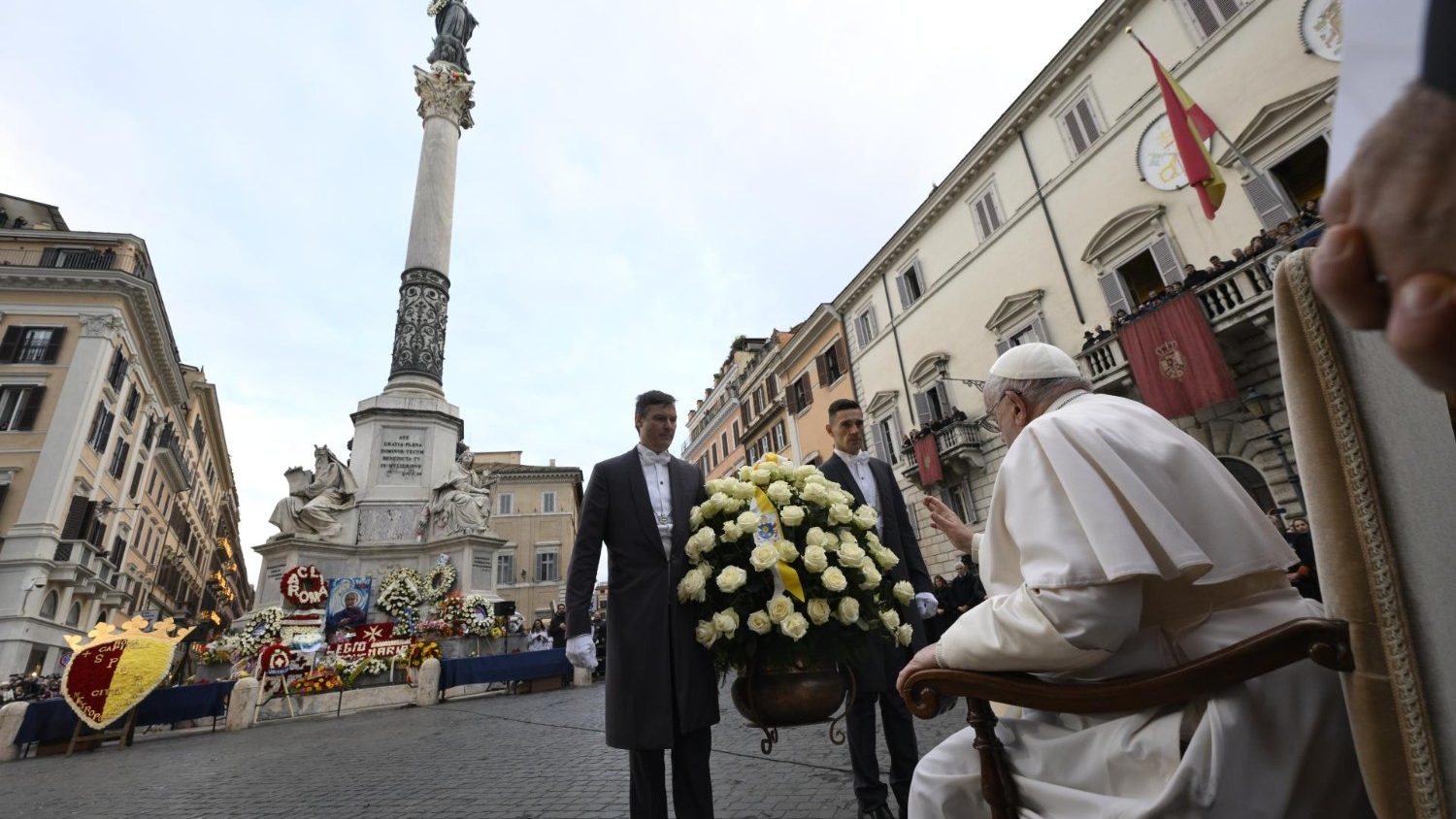
Three years later, in 1857, the Pontiff blessed and inaugurated the monument of the Immaculate in Piazza di Spagna, near the Spanish Steps in Rome.
Mary preserved from Original Sin
Fifty years after the publication of “Ineffabilis Deus”, Pope Pius X recalled in the encyclical “Ad diem illum laetissimum” that Pius IX “declared and proclaimed, as a divine revelation by the authority of the apostolic magisterium, that Mary was, from the first instant of her conception, entirely free from original sin.”
The encyclical explains that “if peoples believe and profess that the Virgin Mary was preserved from every contamination, then they must also acknowledge original sin, the restoration of humanity accomplished by Jesus Christ, the Gospel, the Church, and finally even the very law of suffering.”
The Immaculate Conception and Mary’s Assumption into Heaven
In the Apostolic Constitution “Munificentissimus Deus” (1950), Pope Pius XII defined that “the Immaculate Mother of God, the ever-Virgin Mary, having completed the course of her earthly life, was assumed body and soul into heavenly glory.”
This dogma of the Assumption—celebrated on 15 August—is closely linked to that of the Immaculate Conception. “By an entirely unique privilege,” the 1950 Constitution states, “she conquered sin with her immaculate conception; therefore, she was not subject to the law of remaining in the corruption of the tomb, nor did she have to await the redemption of her body until the end of the world.”

The coloumn of the Immaculate Conception in Rome
Pope John XXIII and roses for the Virgin
In 1958, Pope John XXIII went to Piazza di Spagna and laid a basket of white roses at the foot of the monument to the Virgin—a tradition that his successors continue. On the feast of the Immaculate Conception, 8 December, 1960, the Pontiff called Mary Immaculate the morning star that scatters “the darkness of the dark night.”
The Catholic doctrine concerning Mary’s immaculate conception and exalting her splendor is familiar to every good Christian: a delight and enchantment for the noblest souls. It is found in the liturgy, in the voices of the Fathers of the Church, in the longing sighs of many hearts eager to honor her…
The promise of Pope Paul VI
On the first anniversary of the conclusion of the Second Vatican Council, Pope Paul VI emphasized during his homily during December 8, 1966, Mass that the Immaculate Conception is “the mystery of privilege, the mystery of uniqueness, the mystery of the perfection of Most Holy Mary.”
“Mary, the only human creature who, by divine design (how much wisdom and love it contains!), by virtue of Christ’s merits—the sole source of our salvation—was preserved from all imperfection,” he continued.
Later that same day, during the Angelus, the Pontiff’s words took the form of a promise:
This time it is a promise we must offer Our Lady with our Angelus: the promise to renew our devotion to her, as Mother of Christ and our Mother, according to the theological criteria of the Council.
Criteria that give Mary “an exceptional place in doctrine and in devotion, according to the plan of Redemption—thus Christological and ecclesiological.”
Pope John Paul II and entrusting the Church to Mary
In 1978, at the beginning of his episcopal ministry as the Successor of Peter, Pope John Paul II entrusted the Church in a special way to Mary. At the Angelus on 8 December of that year, his words on the Immaculate Conception intertwined with the life of Jesus:
Christ, who is the author of divine life—that is, of grace in each person—through the Redemption he accomplished, must be especially generous with his Mother… This generosity of the Son toward the Mother goes back to the first moment of her existence. It is called the Immaculate Conception.

The Immaculate Conception frescoed by Francesco Podesti in the Hall of the Dogma of the Immaculate Conception in the Vatican Museums
Pope Benedict XVI and the truths of faith in the Immaculate Conception
The mystery of Mary’s Immaculate Conception, Pope Benedict XVI explained at the Angelus of December 8, 2008, reminds us of two fundamental truths of our faith:
First, original sin, and then the victory over it by the grace of Christ—a victory that shines in a sublime way in Most Holy Mary. The existence of what the Church calls “original sin” is, unfortunately, overwhelmingly evident if we only look around us and above all within ourselves… Dearest ones, in Mary Immaculate we contemplate the reflection of the Beauty that saves the world: the beauty of God that shines on the face of Christ. In Mary this beauty is wholly pure, humble, free from every pride and presumption.
Pope Francis and thanking the Virgin
On 8 December, 2015, Pope Francis opened the Extraordinary Jubilee of Mercy, celebrated on the 50th anniversary of the Second Vatican Council. During the act of veneration of the Immaculate in Piazza di Spagna that same day, he offered a prayer of thanksgiving to Mary:
We thank you, Immaculate Mother,
because on this journey of reconciliation
you do not let us walk alone, but accompany us;
you stay close to us and support us in every difficulty.
Blessed are you, now and always, Mother.
Pope Leo XIV and Mary’s path
On 8 December at 4 p.m., Pope Leo XIV will follow in the footsteps of his predecessors and pause to pray at the foot of the statue of the Blessed Virgin in the Piazza di Spagna in Rome.
In his homily on 12 October for the Jubilee of Marian Spirituality, he emphasized that “Mary’s path is behind Jesus, and Jesus’ path leads toward every human being.”
Affection for Mary of Nazareth makes us, with her, disciples of Jesus; it teaches us to return to Him, to meditate and connect the events of life through which the Risen One still visits and calls us.
In Mary, Tota pulchra (You are altogether beautiful), humanity can contemplate the reflection of beauty—one that saves the world.
