
Ahead of Pope Leo XIV’s visit to Monaco, the CEO of the Princess Charlene of Monaco Foundation reflects on its significance and shared values. She highlights the Foundation’s global mission to prevent drowning and promote human development through sport and education.
By Edoardo Giribaldi in Monaco and Linda Bordoni
Ahead of the visit of Pope Leo XIV to Monaco on Saturday, 28 March, Anne Boggio, CEO of the Princess Charlene of Monaco Foundation, reflected on the significance of the moment for the Principality and for the Foundation’s mission.
“We really welcome this visit as a real honour,” she said. “It is a message that resonates far beyond borders,” adding that “It is really something that, considering what is happening in the world, is very welcome.”
Boggio underlined that the Pope’s visit speaks to values shared by the Foundation: “care for the most vulnerable” and “collective responsibility towards future generations.”
She also expressed hope that the visit will have a wider impact: “We hope that this visit is going to shine a greater light on the causes we are working on and inspire others to join our efforts,” she said, adding that it may also “strengthen existing partnerships and open new ones.”
The Foundation
Founded nearly 14 years ago, the Princess Charlene of Monaco Foundation is built on three pillars: drowning prevention, learning to swim, and teaching values through sport. Boggio explained the Foundation’s philosophy in clear terms: “Sport is at the very heart of the Foundation’s mission.”
“Princess Charlene has always believed that sport is one of the most powerful tools,” she said. “But one has to educate, inspire, and you need young people.”
She added that this conviction is shared at the highest level, noting that “This is a conviction that is shared both by Prince Albert and the Princess, and they both believe that it is a truly universal language.”
She explained that the Foundation works with children from a very young age, including in schools and disadvantaged communities worldwide.
“We teach them values like respect, teamwork, healthy habits, (…) We work with kids from a very, very young age.”
We’re not just teaching kids how to swim and how to play sport,” she continued, “We’re helping them build confidence, and that will serve them throughout their lives.”
Drowning prevention
On the issue of drowning prevention, Boggio said the scale of the challenge is daunting. “It’s a disaster,” she reiterated, “Drowning is one of the leading causes of accidental deaths worldwide.”
It also receives very little public attention, she added, noting that, according to the World Health Organisation, it claims “around roughly 240 lives every year,” and children are especially affected.
“In many developing countries, drowning is the number one cause of death for young children,” she said.
The Foundation responds with direct action in communities where access to swimming education is limited, providing swimming lessons and water safety education directly in communities where children have very little or no such training.
The Foundation’s approach to prevention, she explained, is “to first educate kids not to drown and then we teach them how to swim.”

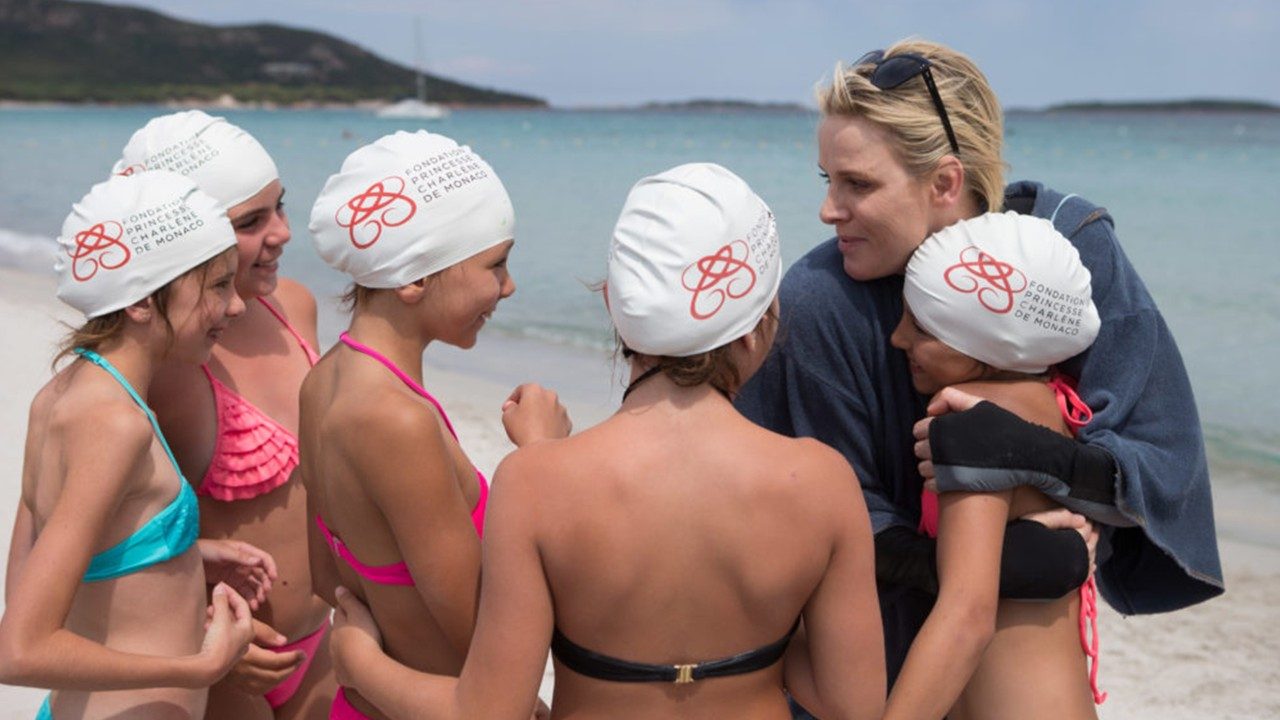
The Princess teaching children to swim (Fondation Princesse Charlène de Monaco)
Creating a culture to protect families and children
“Our goal is not simply just to teach kids to swim,” she added, “it’s to create a culture of water safety that protects the entire family and the communities.”
The Foundation is active across all continents, including Africa, Asia, Europe, Latin America and the Pacific, with dozens of projects each year.
“We are present in every single continent,” she said. “In 2025, we ran 82 projects throughout the world.”
Boggio emphasised that the Foundation adapts its work locally:
“We do not impose a one-size-fits-all model,” she said. “We work closely with local partners, local governments, schools and NGOs.”
“Each territory has its own specificities,” she added. “We have to train local instructors and coordinators who understand their communities the best.”
“Monaco is our home”
Monaco, Boggio explained, remains central to the Foundation’s identity and operations: “Monaco is our home,” and “Collaborating with local institutions and organisations within Monaco is fundamental.”
She highlighted strong cooperation with public authorities and sports organisations: “We work very closely with the Monegasque government, with schools, with local associations, with sports federations.”
Princess Charlene’s vision
Finally, reflecting on Princess Charlene’s personal influence, Boggio said: “She has a very clear vision of where she wants the Foundation to go.”
“As an Olympic swimmer,” she continued, “you can sense her discipline, but also the joy that sport can give to a young person. As a mother, she brings a very deeply personal sense of urgency when it comes to water safety. The thought of any child drowning, which is a tragedy that is almost entirely preventable, is something that she finds intolerable.”
She concluded by reflecting on Monaco’s wider role and noted that “It’s really outstanding to see how many organisations are committed to humanitarian causes.”
