
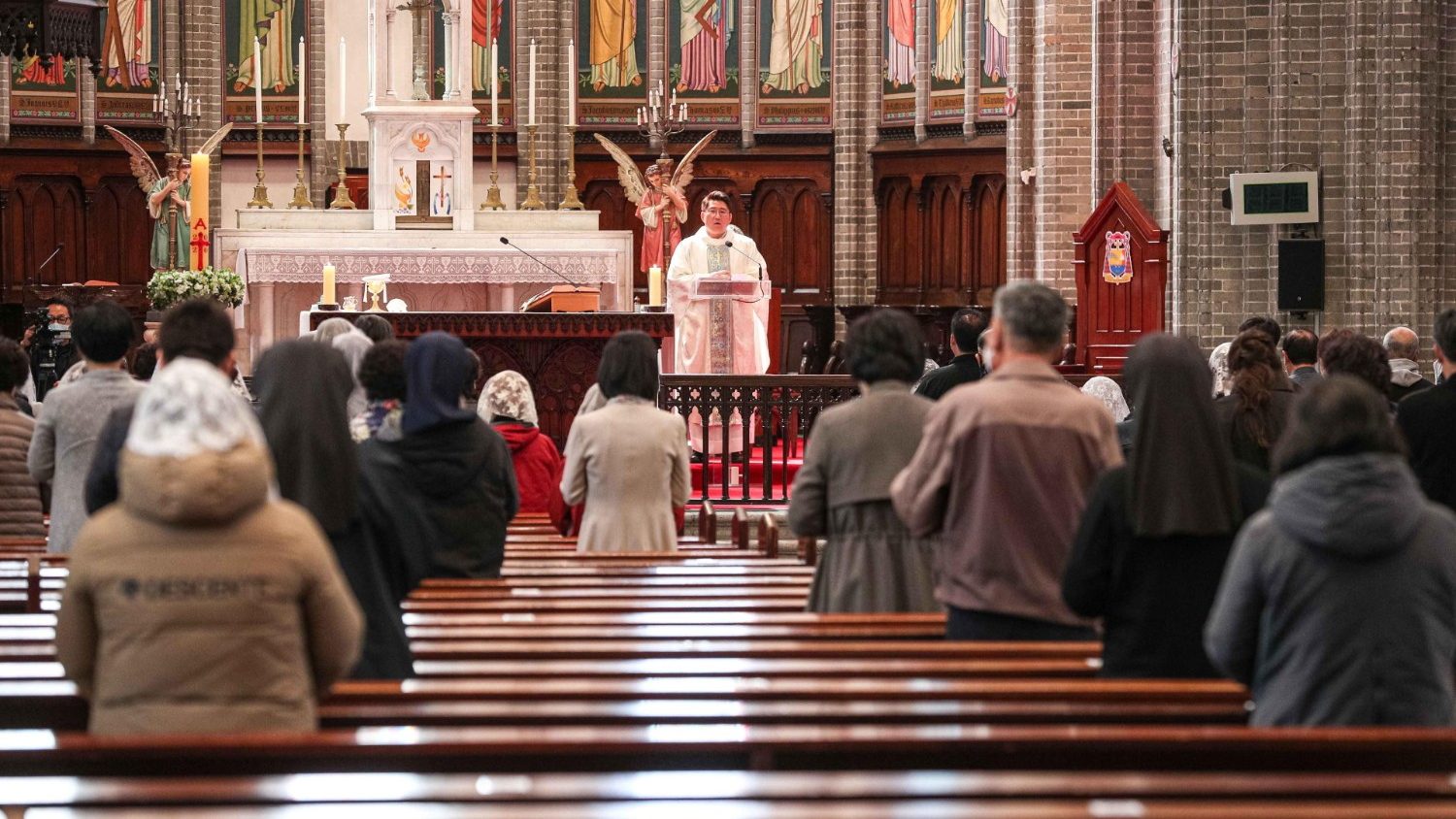
Catholics in Seoul have begun a series of public Masses opposing the extension and expansion of nuclear power plants, ahead of the 15th anniversary of the Fukushima disaster.
By Fr Mark Robin Destura, RCJ
In the southwest of the Korean peninsula, Catholics have launched the “Gwanghwamun Mass Against Nuclear Power Plants,” a series of public Eucharistic celebrations held from February 13 to March 6, leading up to the 15th anniversary of the Fukushima nuclear power plant explosion on March 11.
The opening Mass was celebrated in front of the Sejong Center for the Performing Arts in Jongno-gu, Seoul. The initiative gathers clergy, religious, and lay faithful who are expressing concern over government policies related to nuclear energy.
The intention of the Masses is to pray for the current administration’s decision to halt the extension of ageing nuclear power plants and reconsider projects aimed at constructing new ones.
A prophetic sign
Father Yang Ki-seok presided over the opening celebration. In a symbolic gesture, a drum representing radioactive waste was placed in front of the temporary altar.
“This year marks the 15th anniversary of the Fukushima nuclear power plant explosion, and the current government has chosen a policy of nuclear proliferation,” Father Yang said.
He criticized the extension of the lifespan of the Kori nuclear unit and plans to construct additional plants, warning of long-term risks.
“They say it is to supply massive amounts of electricity to AI data centers and semiconductor industrial complexes,” he noted. “But it takes a long time for nuclear power plants to transmit electricity, 14 to 15 years.”
Instead, he proposed environmentally friendly alternatives.
“Rather, solar and wind power, which can be installed and produce electricity in one to three years, are the power sources that will support our country’s industry,” he said.
A matter of life and death
Among those present was Professor Emeritus Sung Won-ki (Thomas More) of Kangwon National University, who offered a reflection on the dangers of extending the operation of ageing plants.
“The extension of ageing nuclear power plants is my biggest concern,” he said.
He explained that plants nearing the end of their service life are sometimes reduced to 80 percent capacity and later brought back to full operation.
“That is how the Chernobyl nuclear power plant exploded,” he warned, referring to the 1986 disaster at Chernobyl Nuclear Power Plant.
“The extension of ageing nuclear power plants is a matter of life and death for the Republic of Korea,” he added.
He also pointed to policy concerns.
“In a situation where there is no law to support the expansion of renewable energy, which is absolutely necessary to respond to the climate crisis and for our country’s companies, the government is pouring a huge amount of its budget into the nuclear industry,” he said.
Ecological conversion
Addressing those gathered, Professor Sung called for deeper ecological awareness.
“Now we need ecological messengers who will raise awareness of the dangers of nuclear power plants and speak out to protect the dignity of life in the face of a global ecological crisis,” he urged.
He added, “Ecological repentance begins with rejecting new nuclear power plants and opposing the extension of the lifespan of ageing nuclear power plants.”
The movement frames its advocacy not only in environmental terms but also as a moral and spiritual issue tied to the protection of life and creation.
Continuing action
On March 11, the anniversary of the Fukushima explosion at the Fukushima Daiichi Nuclear Power Plant, a Mass for denuclearization will be presided over by Bishop Kang Woo-il.
Organizers have announced that anti-nuclear actions will continue in the Gwanghwamun area. They are also promoting a campaign titled “Seeking 1,000 Apostles of Ecology,” encouraging citizens to commit themselves to ecological advocacy and the protection of human dignity.
As the Church marks the memory of Fukushima, participants say their prayerful protest seeks to unite faith and ecological responsibility, urging a transition toward safer and more sustainable sources of energy.
