
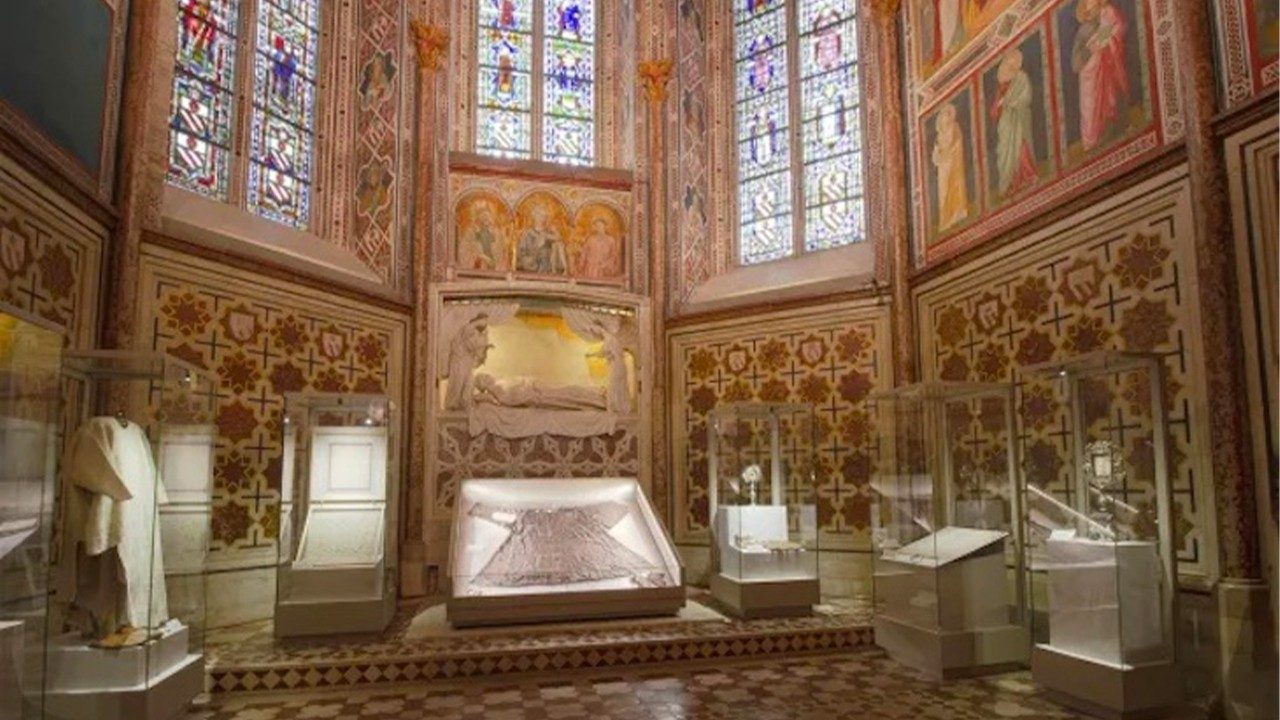
Fr. Giulio Cesareo, director of the Communications Office of the Sacred Convent of Assisi, speaks to Vatican News about the significance of exposing the relics of St. Francis of Assisi and the message he still bears for today’s world.
By Francesco Ricupero
From Sunday, February 22, until March 22, in the lower church of the Basilica of St. Francis of Assisi, pilgrims will be able—for the first time—to pray before the Saint’s remains, as 2026 marks the 800th anniversary of his death.
In a time marked by uncertainty, social tensions, and a search for meaning, the display of St. Francis’ relics is an event that goes beyond simple devotion.
For the Catholic Church, it represents a powerful spiritual call and for the faithful it can be an opportunity for a tangible encounter with the living memory of one of the most beloved and universal saints.
In the city of Assisi, the display of the relics renews a profound bond between history, faith, and community, relaunching St. Francis’ message of peace, fraternity, and simplicity that continues to speak to today’s world. Around 15,000 to 18,000 people are expected daily to come see the remains, meaning around 370,000 visitors in total.
In the following interview with Vatican News, Fr. Giulio Cesareo, director of the Communications Office of the Sacred Convent of Assisi, reflects on what this ancient gesture means for society today.
Q: What is the spiritual and pastoral significance of the display of St. Francis’ relics for the Catholic Church today?
Christians have always venerated relics, because the saints—especially the martyrs—are those who testified with their lives that the love of God fully embraced them, and God’s love is not something abstract; it involves the flesh.
These people served the poor, prayed, fasted, loved others, and allowed themselves to be consumed by love for Christ. Christians have always venerated the lives of the saints because, in them, they saw the action of the Holy Spirit filling their flesh with this love.
This is the context for venerating St. Francis’ relics. We have chosen the Gospel of John, Chapter 12, verse 24, as our interpretative key. In it Jesus, speaking of Himself, says that unless a grain of wheat falls into the earth and dies, it remains alone; but if it dies, it bears much fruit
St. Francis is truly this seed who, in the manner of Jesus, of the saints, of the martyrs—and perhaps of all people of good will—gives himself in daily life. Whoever gives himself is consumed; there is no way around it, but he then bears fruit!
Q: In what way does the exposition of the relics strengthen the sense of belonging and communion among the faithful, both locally and universally?
It strengthens faith. Our faith is not a pre-existing belief, but a relationship with the Lord, who is love. Having faith is inseparable from the experience of being one, united in love.
In this sense, venerating St. Francis’ relics means being strengthened. It means receiving the grace to be reaffirmed in this certainty: that whoever loves, while spending and consuming himself, is in fact nourishing the bonds of unity—those of the Church, those of charity.
The more we live in love and self-giving, the more our humanity becomes our very essence as human beings. What unites us to others is not ideas, but the love we give in our relationships.
Venerating St. Francis is an opportunity to consider how love given authentically bears so much fruit—so much so that 800 years later, he is still spoken of.
Q: What impact does this event have on the local community and on pilgrimages to the basilica?
Certainly, in this month, Assisi and the surrounding area live through this event. Accommodations have been practically sold out for months: hotels, restaurants—everything is booked.
We hope this can be an opportunity of grace, because our society constantly tells us: “Think of yourself. Don’t give yourself. Don’t worry about others. Take care of yourself first.” St. Francis says exactly the opposite, and his bones testify to this.
They are the bones of someone who gave himself, who consumed himself, by walking, kneeling, and living in caves. He tells us in our hearts: do not be afraid to give yourself, because in doing so you bear fruit. I think this is beautiful and deeply beneficial for all of us.
Q: Why does the figure of St. Francis continue to speak to young people and non-believers through concrete signs such as relics?
I believe it is St. Francis himself who speaks. The relics are part of his biological matter. Just as you can hear me because I speak and therefore have a body—if I did not have a body, I would not have a voice.
Our body is the place where relationships happen. In the same way, St. Francis’ relics are also the shell of this seed of Francis that has sprouted, and it is a shell that tells us about him.
Why do people seek him? I am convinced that people seek St. Francis because he is truly the Gospel. In him we see that when the Gospel is welcomed, it is good news for the world, for individuals, and for the community. That is what attracts people.
From the beginning, Francis was called alter Christus—not in the sense of another Christ, but as an icon of Christ, an image resembling Christ.
Q: Is the exposition merely a moment of popular devotion, or does it also represent an ecclesial act with strong theological and cultural significance?
We have provided much information on the website sanfrancescovive.org and on the basilica’s social media pages on Facebook and Instagram. We want to nourish devotion—our love—through an ecclesial experience that is theologically grounded, but not necessarily difficult. Theology was not born to be difficult. It was born to express in words the life that dwells within us.
In this sense, we see in St. Francis the shell of a seed that has germinated in charity, crossing time and space. This is an encouragement for all of us to live our daily lives with love. That is what St. Francis invites us to do.
Q: In a time marked by social crises and conflicts, what universal message can St. Francis of Assisi convey to the faithful?
St. Francis did not live in a time much better than ours. There were religious wars, internal city conflicts, great disputes, family feuds, and much injustice. He did not live in an ideal historical moment. Yet his message is beautiful: if a person truly embraces the Gospel, he creates a different story around himself; he creates new relationships.
We often hear a voice in the background saying: “You can’t do anything. You are alone. You are useless. The powerful rule. We can do nothing.” Yet Francis testifies that it is a lie, because if one person embraces the Gospel, he may not change the whole world, but he may change things around him.
For 800 years St. Francis has continued to touch people’s hearts. I believe the beautiful message is this: we cannot solve every problem, but if each of us takes one step, that step leaves an impact—it has an effect. And it is a lie to say that we can’t do anything.
