
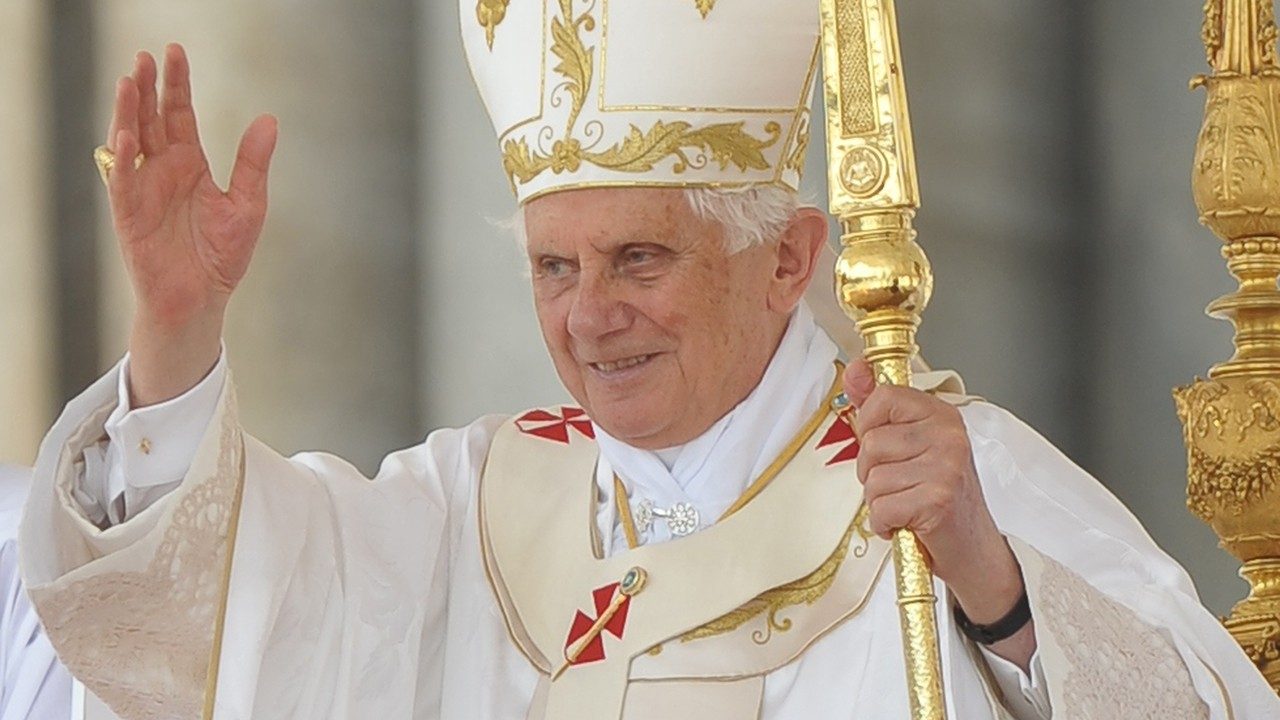
In the book “The Faith of the Future”, a homily by the then Cardinal presents Saint Monica and her attitude toward her son Saint Augustine as the personification of the ecclesial community: a space of life, of welcome, of freedom, where each person’s freedom is respected and faith is never imposed.
By Andrea Tornielli
“Suffering, she learned to let him walk his own road, without constraints. She learned to endure that his road was altogether different” from the one she had imagined for him. This reflection on the mother of Saint Augustine, spoken at the consecration of the parish church dedicated to Saint Monica in the Neuparlach district of Munich by the then-Cardinal Archbishop, Joseph Ratzinger. The date was 29 November 1981, just four days after the announcement of his appointment as Prefect of the Congregation for the Doctrine of the Faith. Once again, we see an image of Ratzinger far removed from the one projected on him by those who use selected passages of the magisterium of Benedict XVI to try to set it in opposition to that of his successors. The homily, until now available only in German, is published in the volume of Ratzinger’s selected texts ‘La fede del futuro,’ (“The Faith of the Future” – ed.), translated by Pietro Luca Azzaro and with a preface by Vatican Secretary of State Cardinal Pietro Parolin.
In this homily, the Archbishop of Munich presents the figure of Augustine’s mother as a living experience of what the Church is in its most profound essence. “In her,” Ratzinger writes, referring to the saint of Hippo, “he experienced the Church as person, the Church personally, so that for him it was not some kind of apparatus, from which one feels something very distant, structures that turn out to be somewhat incomprehensible. In this woman there was personally present what the Church is.” Augustine, the cardinal recalled, wrote of his mother: “She not only gave me this bodily life, but she gave me a space of the heart, she gave me a space of life in which I was able to become a man.” The human being, Ratzinger affirmed, “needs a relational space of trust, of love; and a meaning that allows him to walk toward the future.”
But this “space of life” has little to do with ecclesiastical structures or with identity-based communities of the perfect who isolate themselves from the world, condemning it day in and day out. On the contrary, it admirably sketches the face of a welcoming Church, respectful of everyone’s freedom and of each person’s timing. Just as Monica was with her son, who considered “allowing him to be free” to be “an essential element for the formation of this vital space”: free to make mistakes, free to follow his carnal passions… Monica “knew how to wait. She knew how to accept the conflict between generations. Suffering, she learned to let him walk his own road, without constraints. She learned to endure that his road was altogether different from the one that, in faith, she had imagined for him; and yet she learned to love him, to stand beside him, not to abandon him, while still leaving him the freedom of his being. In this openness while waiting, by which she left him the freedom to become himself—not imposing the faith on him, but simply being there for him as a person, as a mother—precisely in this way she transmitted the faith to him.”
These are enlightening words for parents, for educators, and more generally for those who proclaim the Gospel. A Church as a “space of life, of freedom, of hope.”
The future Pope commented, “I believe that today there is much suspicion and aversion toward the Church… because we experience the Church very little as person, very little the Church personally. We hear it spoken of only as structure, office, and apparatus. But the Church will be able to subsist, and we will be able to take root in her and she will be able to become our homeland, only if she continues to subsist in persons. This space, all spaces—even the halls where we spend our free time and meet—should be spaces that help us to become Church in person for one another; space that for us may be vital space, mother, someone who makes available to us a place of trust and of the possibility of living.”
A Church, a “field hospital,” that accompanies you, where love heals the deepest wounds and one feels at home.
