
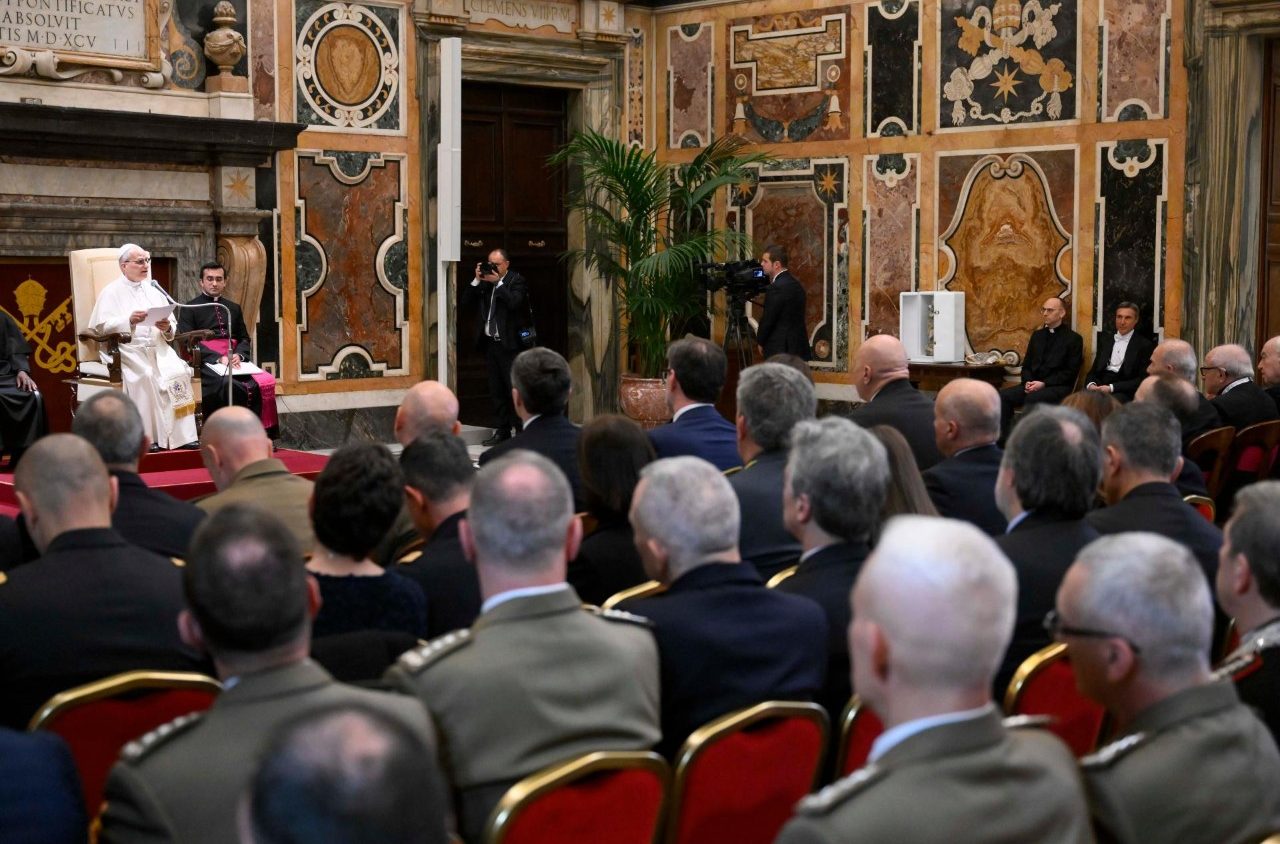
In a speech to the members of the Italian Military Ordinariate, Pope Leo emphasizes the importance of memory and of being at the service of those in need.
By Isabella H. de Carvalho
Pope Leo highlighted the importance of memory and of living one’s service as an act of love and service to all, in an address to the members of the Military Ordinariate of Italy on Saturday, March 7.
“Insofar as men are sinful, the threat of war hangs over them, and hang over them it will until the return of Christ. But insofar as men vanquish sin by a union of love, they will vanquish violence as well,” the Pope said, quoting point 78 of the Second Vatican Council’s Pastoral Constitution, Gaudium et Spes.
He emphasized that this is the context in which the mission of a Christian member of the armed forces should take place: “defending the weak, protecting peaceful coexistence, responding to disasters” and “participating in international missions to maintain peace and restore order.”
“All this cannot be reduced to a mere profession: it is a vocation, a response to a call that challenges the conscience,” the Pope insisted.
Pope Leo explained that the identity of a member of the armed forces is shaped by various values such as generosity, spirit of service and high aspirations, and these need to be founded on the “gift of Grace capable of nourishing charity to the point of total self-sacrifice.”
“It is therefore necessary to inspire the codes, norms, and missions of military life with the lifeblood of the Gospel so that, in the service of security and peace, the common good of peoples always comes first,” the Pope said.

The Pope meets with the members of the Military Ordinariate of Italy (@Vatican Media)
History and memory
The Pope was meeting with the Military Ordinariate of Italy on the 100th anniversary of their founding and, in this regard, he highlighted the importance of memory. He pointed out that today’s society risks losing this faculty, as we live in an age that “has an extraordinary capacity to transmit information, but an increasingly weak capacity to internalize it.”
Pope Leo noted, however, that for the Church memory is a “living conscience,” as it is “not an accumulation of data, but a constant call to responsibility.”
“For Christians, memory has a unique character: it is a celebration of God entering history, because the Christian faith is founded on a historical fact and salvation is not an idea, but the living person of the Lord Jesus Christ,” he insisted.
Service as an act of love towards all
The Pope explained that the 100th anniversary celebrations also fit within this logic, “as the embodied memory of a concrete history” of armed forces members who, walking within the Church, “in the bright days of peace and the dramatic days of war, contributed to the growth of this society with sacrifice, courage, and dedication, sometimes at the cost of their lives.”
In this regard “history is not a reality to be endured, but a place of grace in which to build a civilization of love,” Pope Leo continued.
“Your service is an act of love—towards the country, towards the territories, and above all towards the people—which translates into concrete closeness, especially in places and circumstances where fragility is greatest.”

The Pope meets with the members of the Military Ordinariate of Italy (@VATICAN MEDIA)
Chaplains as mediators between peoples
In his speech the Pope also addressed military chaplains specifically, asking that they live their roles as “a service of love”, and remember the many chaplains that have done so, making “pastoral charity visible to the point of heroic virtue, sometimes even martyrdom.”
He noted the various contexts in which military chaplains work – “in places of peace and conflict, in military bases and operational contexts, in chapels and field tents” – as they bring the Gospel, the Sacraments and spiritual accompaniment to all those who need it.
“In a society marked by human mobility and cultural diversity, the Chaplain also serves as a mediator between peoples, cultures, and religions, bearing witness to a Church that acts as an instrument of unity,” the Pope also explained, adding that his action contributes in this way “to the promotion of the common good and social peace.”
The Church ready to safeguard the universal good
The Pope concluded his speech by underlining how “the Church, following the teachings of the Second Vatican Council and the Apostolic Exhortations Evangelii nuntiandi and Evangelii gaudium, proclaims the Gospel of peace, ready to collaborate with everyone to safeguard this universal good.”
He encouraged the Military Ordinariate of Italy to be “an effective laboratory of God’s action in favor of man” and, citing St Augustine, “a space of formation for the transition from amor sui to amor Dei, the foundation of that Civitas Dei in which the fundamental law is charity.”
Finally, Pope Leo called on his listeners to promote peace that “is not only the absence of conflict, but the fullness of justice, truth, and love.”
