
Pope Leo XIV will make an Apostolic visit to Algeria on Monday April 13th. In the following Interview, Fr. Vincent Kyererezi, a member of the Missionaries of Africa and Vicar General of the diocese of Laghouat-Ghardaïa, explains the importance of the visit and the role of the Church in the predominantly Moslem Algerian society.
By John Baptist Tumusiime, PhD
Q. How big is the catholic community in Algeria and in the diocese of Laghouat-Ghardaïa where you serve?
The Catholic community in Algeria is estimated at 8900 faithful. The diocese of Laghoaut-Ghardaïa where I serve as Vicar General has about 2,240 Christians, served by 14 priests, including the bishop, 19 nuns, and 5 religious brothers. We generally serve in a “Church of encounter and dialogue with Muslims” that endeavors to foster fraternity, mutual understanding and harmonious co-existence with one another. With a surface area of 2,381,741 square kilometres, Algeria is the largest country in Africa. It has a population of almost 50 million people, more than 99.5% of whom are Muslims. The Catholic Church exists officially as an Association, and has four dioceses: Oran, Constantine, Laghouat-Ghardaïa and Algiers which serves as the Ecclesiastical Province.
Q. What are the major apostolic activities in which the diocese of Laghouat-Ghardaïa and the Church in Algeria in general are engaged?
Ours is a Church centred on the Kingdom of God. “Seek first the kingdom of God and His righteousness, and all these things will be added to you” (Matthew 6:33). Seeking the kingdom of God first through encounter and dialogue with our Muslim brothers and sisters among whom we live, is our major apostolic activity. This is done in many different forms through the services we render to the local population. Before and shortly after independence, the dioceses used to run schools and health centres, among other apostolic activities, until a time (the late 1970’s) when the country was equipped enough to take over those facilities through the nationalization process. Currently, the Church runs cultural centres, libraries which are hubs of intellectual and cultural enrichment for the Algerian populations and beyond, welcoming pilgrims more especially those following the footsteps of Saint Charles de Foucauld, canonized in 2022. He lived, served and died in the diocese of Laghouat-Ghardaïa, where he is buried in El Menea near the Church of St. Joseph, the only Church building the diocese possesses. The rest are simply chapels for our smaller gatherings. We also care for the most vulnerable, such as people living with a handicap, promote women through activities like tailoring, handcrafts, cake baking, etc. The pastoral activity of visiting and comforting the sick more especially prisoners (Matthew 25) is also one of our significant apostolic outreaches.
The diocese of Laghouat-Ghardaïa is under the care of the congregation of Missionaries of Africa, formerly known as the White Fathers, and the Missionary Sisters of Our Lady of Africa, MSOLA, since its inception in 1868 as an Apostolic Prefecture. In fact, our very own founder, Cardinal Charles Lavigerie, was the first Apostolic delegate. As per his charism, which we still follow up to today, the apostolic presence among local populations, especially Muslims, was his priority. That original vision remains vital and is still a priority in our pastoral endeavours. Our vocation as a congregation and henceforth as a diocese is deeply rooted in the encounter and dialogue with Muslims while humbly serving the entire humanity amidst us. Other religious congregations have since joined in the mission, and some were even founded here, such as the Little Sisters and the Little brothers of Jesus. This shows how the Church in this land has not only received missionaries, but has also given birth to new forms of consecrated life.
Q. Pope Leo XIV chose the motto for his Apostolic visit to Algeria as: Peace be with you, translated in Arabic as Assalamu Alaykoum. What message does this motto convey about the Pope’s visit?
Precisely, Pope Leo XIV comes as an apostle of peace. No wonder the motto that was intentionally chosen is the Arabic greeting “As-salam aleykum,” peace be with you, which is the one used on a daily basis in the Algerian Arabic language and culture. Here in Algeria, it is the one we receive often and the one we are called to transmit. Fortunately, in a double folded manner it is also the same greeting that the Lord Jesus Christ greeted his apostles with upon his resurrection. Thus, the Holy Father is coming as a messenger of peace, peace that disarms as he put it himself the evening of his election as Pope. As the prayer composed particularly for his visit says: “Lord Jesus, on the evening of your Resurrection you said to your apostles, Peace be with you! (John 20). Following in your footsteps, the Servant of servants comes to meet your people in Algeria, like a visitor bringing us your Peace, as a disciple of Saint Augustine, a child of this land. Bless his journey and stay among us.” These were the very first words that the risen Lord used to soothe his afraid disciples enclosed behind locked doors. The Pope’s historic visit, moreover in the Easter period, will hopefully leave behind a soothing message of peace not only for the Catholic Church but also for the entire Algerian society. His visit as a pilgrim of peace, more especially at a time when our world is in dire need of peace particularly in the middle East and other parts of the world living in day-today conflicts and tensions, will enkindle the spirit of peacemakers in all who will meet him, see him, hear him, touch him, ‘read him’ from both far and near. It’s my prayer and hope that after his historical visit, peace may reign in our world today, stemming from Algeria where he will have set foot as its pilgrim, across the neighbours and beyond.
Q. How has the diocese of Laghouat-Ghardaïa prepared the faithful for the Pope’s visit?
The diocese has been praying since the official announcement of the visit. Being far away from the capital city geographically and not being one of the two cities that the Pope will visit, we are not so directly involved in all the preparations, though a handful of us are in some commissions. For example, the bishop heads the commission of communication and I head the spiritual and prayers commission. Only a small percentage of the faithful will physically represent the diocese.
Q. Pope Leo will be meeting the faithful in only two cities of Algeria, and these are: Algiers, the capital, and Annaba. Why exactly these cities and not others?
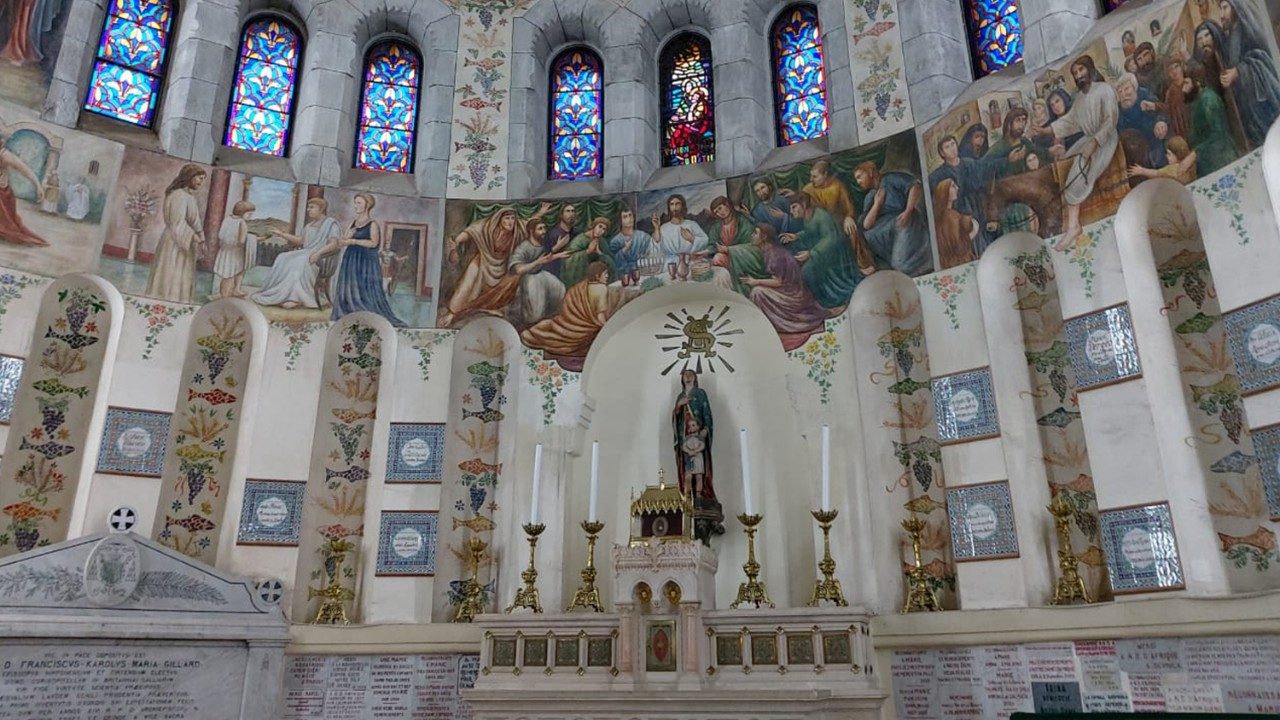
Firstly, Algiers, the capital city, is where the president of the Republic resides. He is the one who invited the Pope and has to welcome him as well. The second reason for visiting Algiers is because of the historical importance of the Basilica of Our Lady of Africa. The pope will meet the Christian community with the Algerian Muslim friends in the basilica where a visible inscription on the main fresco behind the Altar reads, “Our Lady of Africa, pray for us and for the Muslims”, exhibiting an interfaith message of tolerance and mutual co-existence this place holds in the heart of Algeria. It’s also here, that the Missionaries of Africa made their first vows, set off to Africa on 15th November 1878, arriving in Uganda on 17th February 1879. They had been founded in Algiers by Cardinal Charles Lavigerie and were sent to East Africa following a formal request by Pope Leo XIII. In that manner Algiers became the gateway to the rest of Africa; no wonder, therefore, Pope Leo XIV has chosen to start his apostolic pilgrimage to Africa here. Secondly, the visit to the city of Annaba is most likely related to Pope Leo himself belonging to the Augustinian order. He was present in the Basilica of St. Augustine in 2013 at its inauguration after renovation, when he was the Prior General of the Augustinian Order. The Augustinians are still present here, and is scheduled to meet them during the visit. Annaba city, located in the eastern part of Algeria at the border with Tunisia, is the 3rd most important town of the country, renowned as an industrial hub. Formerly known as Hippo Regius during the Roman era, it is where Saint Augustine lived and served as bishop and wrote many of his scholarly works (396-430 A.D). The Basilica of St. Augustine, where the Pope will celebrate the official Mass, was constructed between 1881 and 1900. It sits on a hill, overlooking the Mediterranean Sea and the ancient roman ruins of Hippo, and houses the relic of St. Augustine’s right arm bone. This makes it special to host the Pope.
