
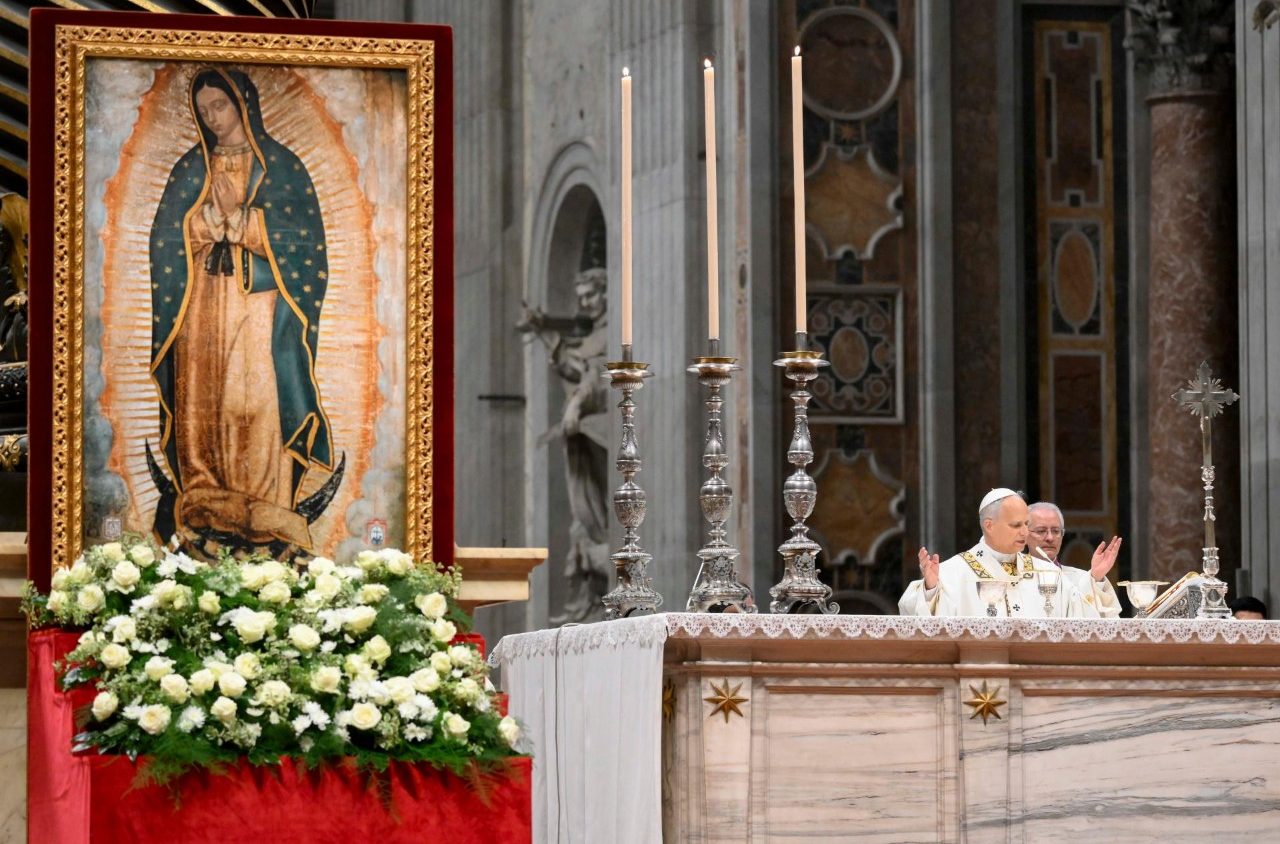

In a message to the Theological-Pastoral Congress on the Guadalupan Event, held in Mexico City from 24 to 26 February 2026, Pope Leo XIV presents Our Lady of Guadalupe as a model of authentic inculturation and a lasting criterion for the Church’s evangelising mission.
Vatican News
The Theological-Pastoral Congress, promoted by the Pontifical Commission for Latin America, the Mexican Episcopal Conference, the Knights of Columbus, and the Pontifical International Marian Academy, seeks to renew reflection on the Guadalupan event in preparation for the Jubilee of 2031, marking 500 years since the apparitions to Saint Juan Diego on Tepeyac Hill.
In his message, dated 5 February, Pope Leo XIV reflects on the manner in which God reveals Himself in history, not as an abstract idea imposed from without, but by entering into human experience and engaging freedom. Evangelisation, he explains, means making Jesus Christ present and fostering a living relationship with Him that shapes personal and communal life.
Guadalupe: A model of encounter with Christ
Referring to the Virgin of Guadalupe, the Pope notes that authentic inculturation neither absolutises nor dismisses cultures. Rather, it assumes and purifies them so that they may become places of encounter with Christ. The event of Tepeyac, he indicates, offers a paradigm for proclaiming the Gospel without coercion while preserving the integrity and newness of Christian revelation.
Inculturation is a demanding process
Pope Leo emphasises that inculturation is a demanding and purifying process. It involves recognising the “seeds of the Word” present in cultures, while ensuring that every human reality is illuminated and transformed by the grace flowing from Christ’s Paschal Mystery. No culture, however rich, can serve as the ultimate measure of faith.
He also observes that in contemporary urban and pluralistic contexts, the transmission of faith can no longer be presumed. For this reason, he calls for renewed commitment to catechesis as a central task of the Church, in continuity with the 2007 Aparecida Document, fostering mature and conscious discipleship capable of engaging today’s cultural challenges.
