
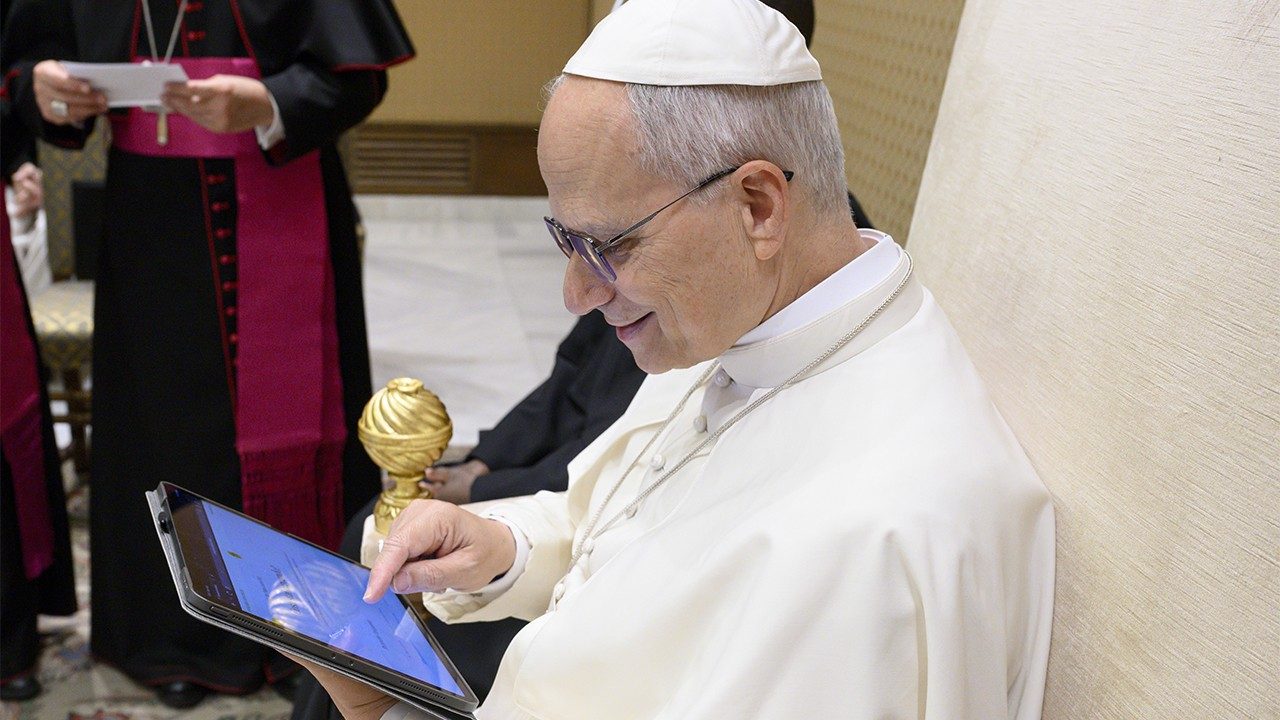
The Holy See’s official Pontifical Yearbook is now available online, providing up-to-date information on the Catholic Church’s institutions across the globe.
By Salvatore Cernuzio
From December 8, the Solemnity of the Immaculate Conception, the Annuarium Pontificium—the Holy See’s official Pontifical Yearbook—is available in a fully digital version, accessible via web browser and mobile app.
The new platform offers data on the Dicasteries of the Roman Curia, Dioceses, Religious Institutes, and Apostolic Nunciatures.
The project was jointly developed by the Secretariat of State and the Dicastery for Communication, and was presented recently to Pope Leo XIV.
Accompanied by Archbishop Edgar Peña Parra, Substitute of the Secretariat of State, and Msgr. Lucio Adrián Ruiz, Secretary of the Dicastery for Communication, together with other representatives of the two Dicasteries, Pope Leo effectuated the first login and navigated the platform himself.
“Thank you for this work, which will be of great use for many who work in the service of the Church,” said the Pope to those present at the launch event.
He encouraged them “to continue with this spirit of service, so that what is born with care and attention may, in time, become an even greater help.”

Msgr. Ruiz and Archbishop Peña Parra present the Pontifical Yearbook to Pope Leo
Heir to the medieval Liber Pontificalis (the collection of papal biographies), the Pontifical Yearbook took shape in the mid-twentieth century as an essential reference for anyone needing official information on the Catholic Church throughout the world.
Now that same corpus can be searched online, marking a significant step in updating and modernizing the information tools at the service of the universal Church.
According to a statement from the Secretariat of State, access from any device—via browser or app—overcomes the logistical limits of the printed volume and makes the informational patrimony of the Holy See consultable.
The digital Yearbook is explicitly designed as a service tool for a broad range of users. It is intended first of all for the Dicasteries of the Roman Curia, which rely on constantly updated data to exercise their functions.
It offers Apostolic Nunciatures a strategic resource for their diplomatic and pastoral work, and it enables Bishops’ Conferences to deepen their understanding of ecclesial realities in different territories.
Religious Institutes, Pontifical Universities, research centers, and other academic institutions gain access to data aligned with the Holy See’s official communications.
Journalists and Church communications professionals can also rely on the platform as an authoritative reference, with certified content and reliable, verified information.
Information such as new appointments, changes in office, and modifications to ecclesial structures no longer has to wait for the next printed edition of the Yearbook; those variations can now be reflected online in short order.
The system also introduces advanced search functions, allowing users to filter data by name, by diocese, by office or role, by country, or by institutional area.
“In a time when communication is ever faster and more global, offering immediate and reliable access to information on the life of the Church—with certified data—means putting technology at the service of the ecclesial mission,” Archbishop Peña Parra emphasized. “It is a sign of attentiveness, transparency, and responsibility towards the Catholic community and towards all those who seek to understand the reality of the Church in the world.”
The Secretariat of State assumed overall coordination for the digital Pontifical Yearbook, defining institutional requirements, identity-related aspects, and principles of user experience.
The Dicastery for Communication, and in particular its Technology Office, was responsible for the technical development of the digital infrastructure, for the creation of the database, and for the processes of normalizing the data prepared by the Central Office of Church Statistics.
The project also benefitted from the contribution of young professionals trained in service design and user experience, ensuring that the platform’s technical robustness is matched by usability and clarity.
Conceived from the outset as an evolving project, the digital Yearbook will be progressively enriched in both depth and breadth.
Future developments include the recovery and integration of historical information from archives and from earlier printed editions, as well as new releases that will expand the platform’s functionalities and analytical potential over time.
In this perspective, the Secretariat of State invites all those who will use the platform to contribute actively to its refinement, by sending observations and suggestions to improve the service to the address: [email protected]
The platform is available at https://www.annuariopontificio.catholic/
It can also be accessed via a dedicated app for iOS and Android. Users must either register on the web version or download the app through the App Store or Google Store.
The digital Pontifical Yearbook operates on a subscription system with two plans, both of which guarantee continuous access to the database and the daily data updates.
