
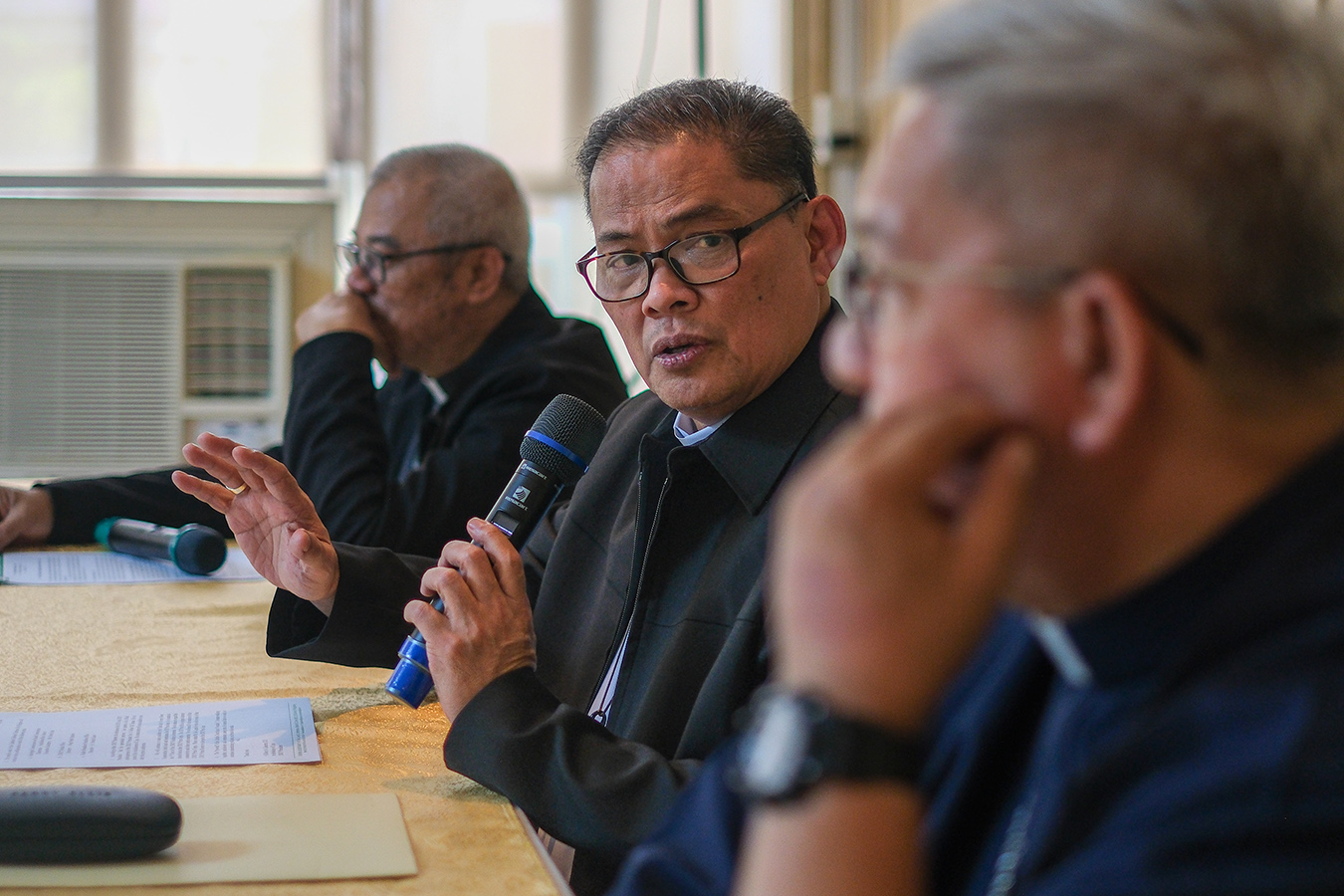
Philippine bishops opened to dialogue with President Ferdinand Romualdez Marcos Jr. amid ongoing impeachment proceedings and corruption scandals while frankly acknowledging deep internal Church struggles during their 131st plenary assembly held in Manila from Jan. 21–26.
Archbishop Gilbert Garcera of Lipa, president of the Catholic Bishops’ Conference of the Philippines, told reporters at a Jan. 26 press conference that the Church is willing for “dialogue, not monologue” with government officials.
The biannual assembly gathered more than 97 bishops at the Pope Pius XII Catholic Center.
“We will talk to the president if it helps Filipinos,” Garcera said, while noting he has not scheduled any formal meetings with government officials since assuming the CBCP presidency on Dec. 1, 2025.

Bishops attend Mass at the Immaculate Conception Cathedral of Cubao on Jan 22, 2026 | Credit: Cubao Diocese
The bishops’ assembly unfolded against the backdrop of impeachment proceedings against Marcos and widespread infrastructure corruption scandals that have gripped the nation. Church leaders said they would continue to stress the formation of conscience, collective action, and open channels with the government and its agencies.
Collaboration on tackling corruption
The bishops said they were willing to work with the government and civil society to improve services for the poor and marginalized communities.
The CBCP said it is eager to collaborate with the government to monitor public projects and improve accountability and transparency in utilizing public funds.
“We are ready to assist in overseeing the execution of public projects,” said Bishop Gerardo Alminaza of San Carlos, who also serves as Caritas Philippines president.
Given the corruption scandal that has gripped the country, the Church is eager to collaborate with others in addressing the menace, the prelate said.
“We cannot just expect one sector of society or the government alone to do it. That’s why we need collective action to respond to systemic corruption,” Alminaza added, noting the Church is “increasingly aware of the extensive and widespread corruption.”
Pope’s message to bishops
Pope Leo XIV urged the bishops to work for unity in the Church and care for overseas Filipino workers, sending a message asking that the Holy Spirit guide their deliberations.
Archbishop Charles Brown, the apostolic nuncio to the Philippines, conveyed Leo’s message to the bishops on Jan. 24.

Archbishop Charles John Brown, apostolic nuncio (papal ambassador) to the Philippines, addresses the bishops on Jan 24, 2026, at the apostolic nunciature in Manila. | Credit: CBCP News
Leo expressed confidence that bishops’ discussions would foster unity among the faithful in dioceses and communities. The Holy Father added that such unity should reflect “the inner life of love of the Holy Trinity.”
Leo said that overseas and local Filipino workers must “take care of one another” and help the Church.
The Church’s call for unity and care is a significant concern for Filipino families and churches worldwide, with about 10 million Filipinos employed abroad.
“As a local Church, we remain united with our shepherds in prayer, asking the Holy Spirit to guide them with wisdom, unity, and fidelity,” said Bishop Marcelino Antonio Malabanan Maralit of San Pablo.
Two-year agenda
In his address, Garcera outlined a two-year agenda focusing on caring for bishops, strengthening coordination and care, and deepening synodality.
“Before tending the flock, we must care for the shepherds,” Garcera said, stressing the need to care for retired and newly ordained bishops.
He also urged ongoing formation for bishops, especially in emerging concerns such as artificial intelligence and the defense of human dignity.
Garcera, who was elected CBCP president in July 2025, said he accepted the responsibility amid national challenges and growing demands on Church leadership.
“The presidency of the CBCP is not about one person but about walking together on a mission,” he said.
His second priority would be the role of episcopal commissions, with CBCP commissions to aid bishops who “do not act independently,” emphasizing clearer communication and better collaboration.
“In a truly synodal spirit, we seek clearer communication, shared direction, and closer collaboration so that our programs genuinely respond to the pastoral needs of our dioceses,” he added.
Mental health crisis
When asked by media, Garcera said one of the pressing needs of the Church in the Philippines is to address mental health, especially among youth.
So many people, particularly young people, are facing mental health issues, suicidal tendencies, and stress following the proliferation of media, technology, pressures of education, workplace burnout, and other personal and society-related concerns.
“We need to address mental health for all of our pastoral programs and interventions,” Garcera said.
According to a Social Weather Station survey conducted in September 2025, 34% of Filipinos reported experiencing frequent stress.
According to data cited by the bishops, about 77% of screened employees showed depressive symptoms, with nearly half needing intervention. Youth, namely 1 in 3 students aged 18–24, experienced mental health issues, with over 40% of young people reporting problems.
In the first half of 2025, more than 2,000 suicides occurred, and the National Center for Mental Health crisis hotline received over 36,000 calls by August 2025, with most calls related to suicide, according to data cited by the bishops.
The bishops cited estimates that about 7 million to 12.5 million Filipinos may have mental health conditions such as anxiety or depression.
Bishops examine AI role
The bishops discussed AI, its moral issues and risks, and how to use it in pastoral ministry during a Jan. 20 seminar.
Archbishop Rex Andrew Alarcon, head of the Episcopal Commission on Social Communications, addressed the necessity of having moral responsibility and discernment when using AI.
Edwin Lopez, the executive secretary of the commission who also serves as EWTN’s longtime regional manager for Asia-Pacific, said digital tools should not replace real-life interactions.
“Technology serves. Communion saves,” Lopez said. “Having a good relationship is the rarest way to communicate in a world of constant connectivity.”

At a Jan. 23 joint gathering of bishops and major religious superiors at De La Salle University in Manila, Church leaders made unusually frank acknowledgments of internal struggles.
Garcera said the Church continues to struggle to live out its mission.
“The journey toward becoming a true Church of the poor remains wounded,” Garcera said, citing “fragmented communion” and “socially indifferent ministry.”
He also pointed to “entrenched clericalism and patriarchy, weak accountability and evangelical witness” as problems undermining the Church’s credibility.

Archbishop Gilbert Garcera, president of the Catholic Bishops’ Conference of the Philippines, addresses the members of the Conference of Major Superiors in the Philippines, a unified body of religious, priests, and consecrated persons, along with bishops at the De La Salle University in Manila on Jan 23, 2026. | Credit: CBCP News
Bishop Elias Ayuban Jr. of Cubao, chairman of the CBCP Episcopal Commission on Mutual Relations Between Bishops and Religious, said participants openly acknowledged challenges in collaboration.
“A tree that falls makes more noise than a forest that grows in harmony,” Ayuban said, noting that tensions often receive more attention than cooperation.
The bishop, a Claretian, said genuine collaboration requires humility, dialogue, and listening.
Dominican Sister Cecilia Espenilla, co-chairperson of the Conference of Major Superiors in the Philippines, said the gathering showed growing unity.
“Our oneness is very much needed,” she said, citing national concerns including corruption.
