
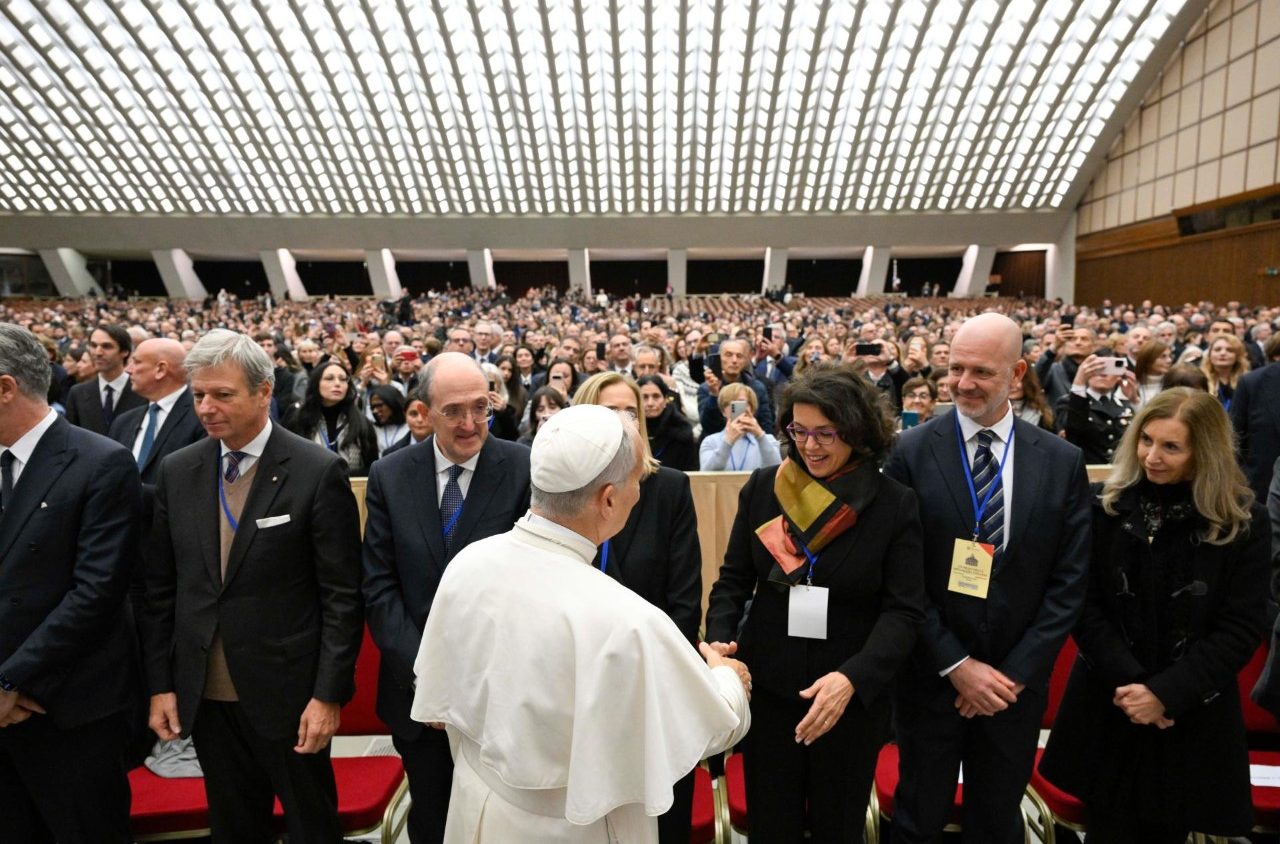

Speaking at the Jubilee for Italian Diplomacy, Pope Leo repeats the appeal of Paul VI for an end to war, and calls on diplomats to be men and women of dialogue.
By Christopher Wells
Pope Leo XIV highlighted the virtue of hope as “the name the will takes on when it firmly strives for the good and the justice it feels as lacking.”
In an address to Italian diplomats on the occasion of their Jubilee pilgrimage, the Pope stressed the importance of hope in diplomacy, saying “only those who truly hope always seek and support dialogue between parties, trusting in mutual understanding even in the face of difficulties and tensions.”
The Holy Father said that authentic diplomacy is distinguished from “self-interested calculations” or a “balance between rivals who hide their respective differences” precisely by the ability to reach sincere agreements.
In this respect, he urged diplomats to follow Jesus’ example of reconciliation and peace, which “shines as a hope for all peoples.” Jesus’ mediation between God and humanity, the Pope said, allows us to “experience in dialogue… the fundamental relationships of our existence.”
Pope Leo insisted on the importance of honesty in dialogue, both in keeping one’s word and in ensuring that one’s actions are consistent with one’s words. This involves “educating” language “in the school of listening and dialogue.”
“To be authentic Christians and honest citizens,” the Pope said, “means sharing a vocabulary capable of expressing things as they are, without duplicity, cultivating harmony among peoples.”
Recalling the famous appeal of Paul VI at the United Nations sixty years ago, Pope Leo repeated, “No more war, war never again! Peace, peace must guide the destinies of the Peoples and of all humanity!”
Peace, he continued, “is the duty that unites all humanity in a common search for justice… peace is the definitive and eternal good that we hope for everyone.”
Pope Leo concluded his address by calling on diplomats to be “men and women of dialogue, wise in reading the sings of the times according to that code of Christian humanism that is at the root of Italian and European culture.”
