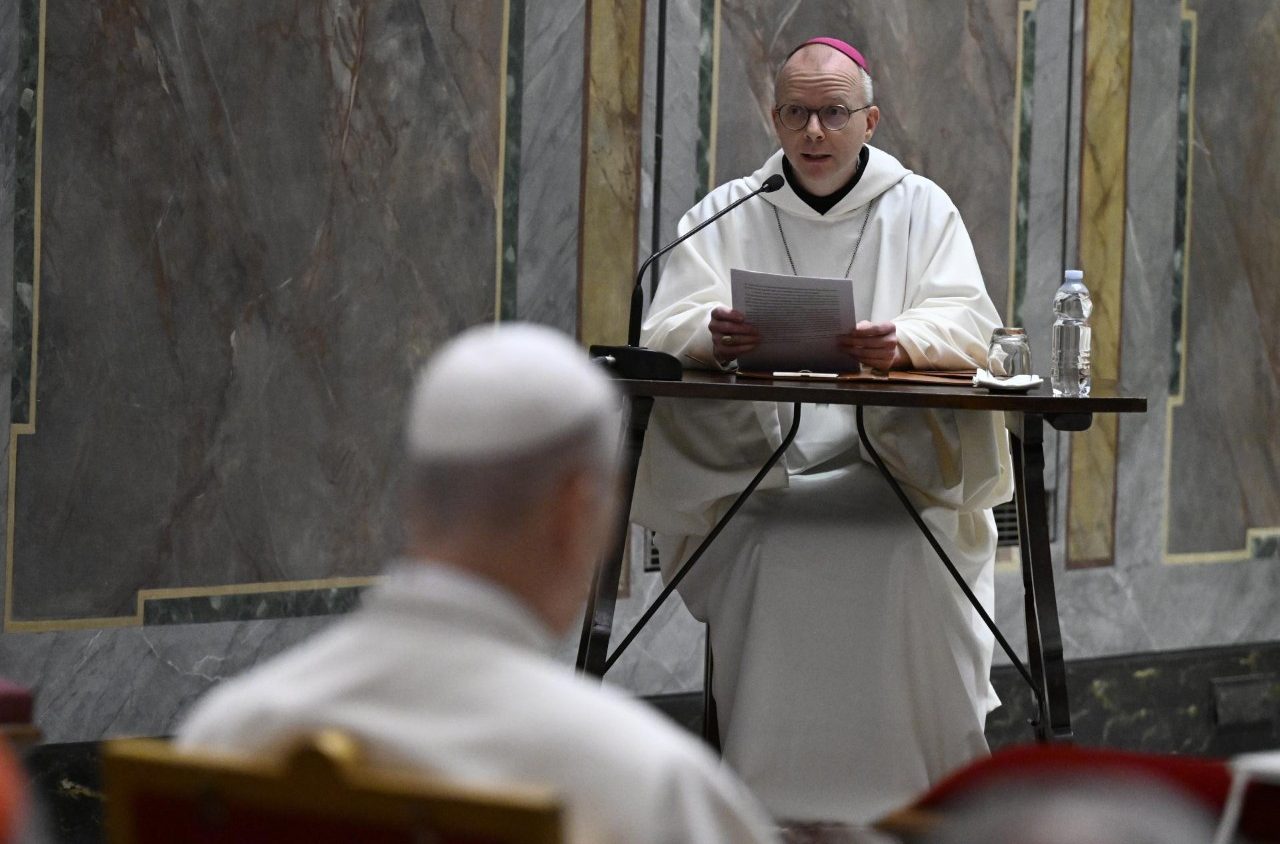

Bishop Erik Varden delivers his fifth reflection at the Spiritual Exercises in the Vatican for Pope Leo XIV, Cardinals residing in Rome, and heads of Dicasteries, focusing on the theme: “ The Splendour of Truth”. The following is a summary of his reflection.
By Bishop Erik Varden, OCSO*
Bernard keeps us on our toes. He states: ‘I would have you warned: no one lives on earth without temptation; if one is relieved of one, let him surely expect another’. We must nurture the correct balance between assurance in God’s help and distrust of our frailty, dreading temptations while we accept their inevitability, remembering that God submits us to them because they are useful.
Useful in what sense?
As we resist arrows launched by the Father of Lies, our commitment to the truth will be strengthened. We shall be fit, having turned away from weakening falsehood, to strengthen our brethren.
Ambition represents a particular form of capitulation to untruth. Ambition is a not very subtly sublimated form of cupidity. Describing it Bernard, always eloquent, surpasses himself. Ambition, he says, is ‘a subtle ill, a secret virus, an occult pest, an artisan of deceit; it is the mother of hypocrisy, the parent of envy, the origin of vices; it is kindling for crimes, causing virtues to rust, holiness to rot, hearts to be blinded. Remedies it turns into illnesses. From medicine it extracts apathy’. Ambition springs from an ‘alienation of the mind’. It is a madness that comes about when truth is forgotten. The fact that ambition is a form of insanity makes it ridiculous in any instantiation, but especially so when it occurs in persons given to a state of selfless service. Not for nothing does the figure of the ambitious clergyman haunt literature and cinema as a comic, but not very funny, trope — from the fawning parsons in Jane Austen to the tart courtier priest in Patrice Leconte’s notable film Ridicule.
‘What is truth?’
People of our time ask this question earnestly, often with remarkable good will, notwithstanding their confusion, fear, and the rush they are always in. We cannot let it go unanswered. We have no energy to waste on the silly temptations of fear, vainglory, and ambition. We need our best resources to uphold substantial, essential, freeing truth against more or less plausibly shining, more or less fiendish substitutes.
In our predicament, rich in opportunity, it is imperative to see and articulate the world in Christ’s light. Christ, who is truth, not only shields us; he renews us, impatient to reveal himself through us to a creation increasingly aware of being subject to futility.
It is tempting to think we must keep up with the world’s fashions. It is, I’d say, a dubious procedure. The Church, a slow-moving body, will always run the risk of looking and sounding last-season. But if she speaks her own language well, that of the Scriptures and liturgy, of her past and present fathers, mothers, poets, and saints, she will be original and fresh, ready to express ancient truths in new ways, standing a chance, as she has done before, of orienting culture.
This work has an important intellectual dimension. It also has an existential dimension. As Cardinal Schuster said on his deathbed: ‘It seems that people no longer let themselves be convinced by our preaching, but in the presence of holiness, they still believe, they still kneel and pray.’
Was not the universal call to holiness, the call, that is, to embody truth, the strongest note struck by the Second Vatican Council? It resounded splendidly like a gong throughout its deliberations. The Christian claim to truth becomes compelling when its splendour is made personally evident with sacrificial love in sanctity, cleansed of temptations to temporise.
* Bishop Erik Varden, Bishop of Trondheim, Norway, was asked to preach the 2026 Spiritual Exercises for Pope Leo XIV, Cardinals residing in Rome, and the heads of Dicasteries of the Roman Curia, which runs from Sunday, February 22, to Friday, February 27. Here is the link to his website.
