
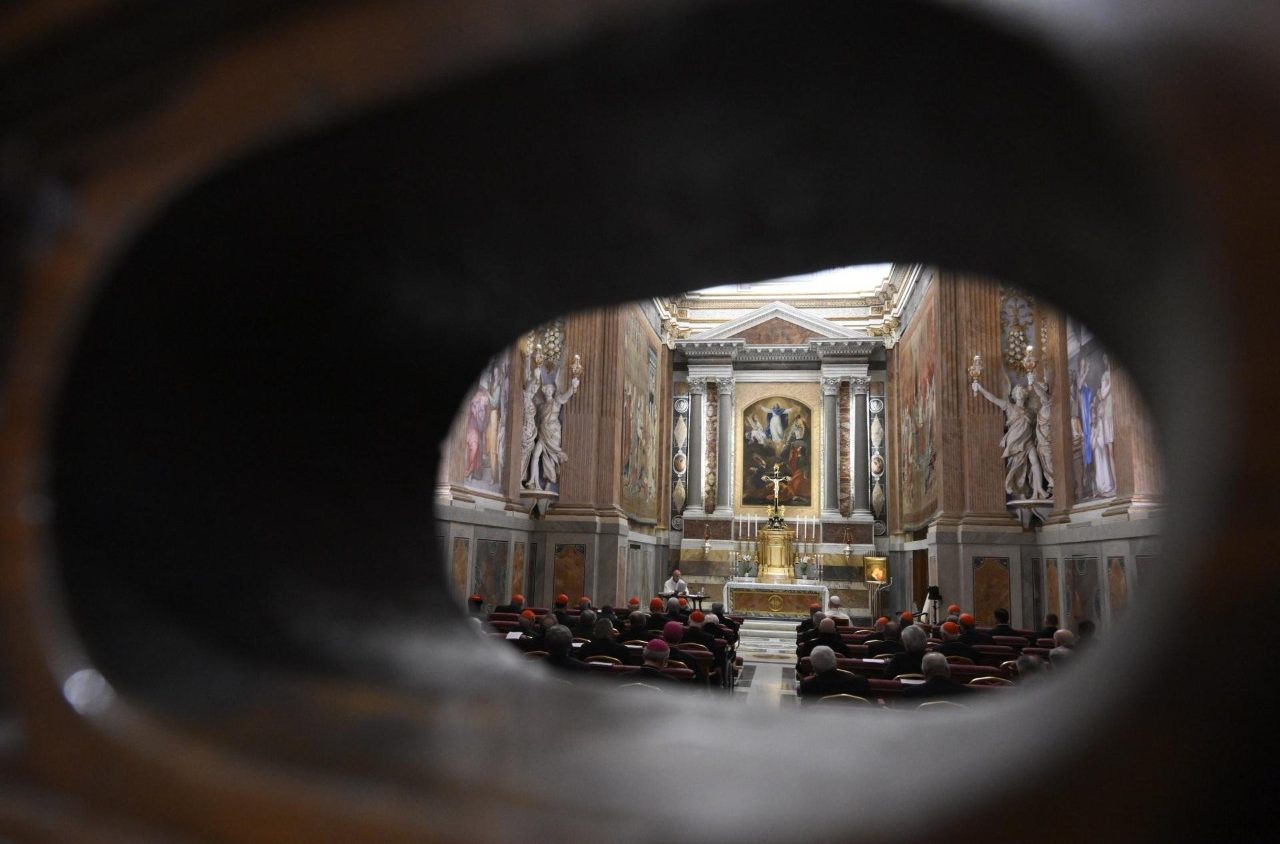

Bishop Erik Varden delivers his eighth reflection at the Spiritual Exercises in the Vatican for Pope Leo XIV, Cardinals residing in Rome, and heads of Dicasteries, focusing on the theme of ‘God’s Angels’. The following is a summary of his reflection.
By Bishop Erik Varden, OCSO*
During Christ’s forty-day sojourn in the desert Satan came to him citing Psalm 90, specifically two verses about the angels. ‘The devil’, we read in St Matthew, ‘took him to the holy city and placed him on the pinnacle of the temple.’ He challenged Christ to prove himself Son of God by throwing himself down, ‘for it is written: “He will command his angels concerning you” and “On their hands they will bear you up, so that you will not dash your foot against a stone”’.
God alone may invite us to jump from a pinnacle. His call, however, will be, ‘Jump into my arms’, not, ‘Throw yourself down’.
Angelic interventions are not always reassuring. The angels are not there to humour us in our caprices. In a popular prayer traceable to Bernard’s contemporary Reginald of Canterbury we ask our guardian angel to ‘enlighten, keep, govern, and guide’ us. These are hefty verbs. An angel is a guardian of holiness.
The monastic life was early understood and advertised as angelic on account of its finality of praise; but also in so far as the monk is called to be aflame with God’s love and to be an emissary who brings that love to others.
Christ’s one ‘canticle of praise’ of which Sacrosanctum Concilium speaks in a beautiful paragraph, resounds from the ends of the earth to heaven’s heights through a pulsating chain of mediation. The angels are essential to that chain, as we affirm in the final section of each preface within the canon of the Mass.
Bernard stresses the angels’ role as mediators of God’s providence. Mediation is not always called for. God can touch us immediately, but he delights in letting his creatures be channels of grace to one another.
He admonishes us to look at what an angel does and do likewise: ‘Descend, and show mercy to your neighbour; next, in a second movement, letting the same angel elevate your desires, use all the cupiditas of your soul to rise towards the most high and eternal truth’. Cupid is rarely referred to, these days, in the same breath as ‘most high and eternal truth’. Bernard’s choice of vocabulary is telling. It tells us that all natural human yearnings, including those that are embodied, are drawn towards fulfilment in God, so must be guided towards it.
The angels’ last, most decisive act of charity will happen when, at the hour of our death, they will bear us through this world’s veil into eternity. They will show their characteristics then: ‘They cannot be vanquished or seduced, even less can they seduce’. All pretence will fall in that hour. Rhetoric will fail. Only truth will stand and sound, attuned to mercy.
Bernard preached cautiously about these things in 1139. 726 years later a man of very different temperament but similar intelligence would make his intuitions explicit in an exquisite poem about dying.
John Henry Newman thought a lot about angels. He envisaged the priest’s ministry as angelic. The priest is at home in this world, unafraid to go into dark woods in search of the lost. At the same time he keeps his mind’s eyes raised towards the Father’s face, letting its radiance illumine all present reality. Illumination is ever a twofold process: intellectual and essential, sacramental and pedagogical.
Newman, now a Doctor of the Church, invites us to rediscover the teacher, too, as angelic enlightener. It is a prophetic challenge, given how much so-called ‘education’ is now farmed out to digital, artificial media, while young people yearn to meet teachers who are worthy of trust, who can impart not only skills but wisdom.
An angelic encounter is always personal. It cannot be replaced by a download or a chatbot.
* Bishop Erik Varden, Bishop of Trondheim, Norway, was asked to preach the 2026 Spiritual Exercises for Pope Leo XIV, Cardinals residing in Rome, and the heads of Dicasteries of the Roman Curia, which runs from Sunday, February 22, to Friday, February 27. Here is the link to his website.
