
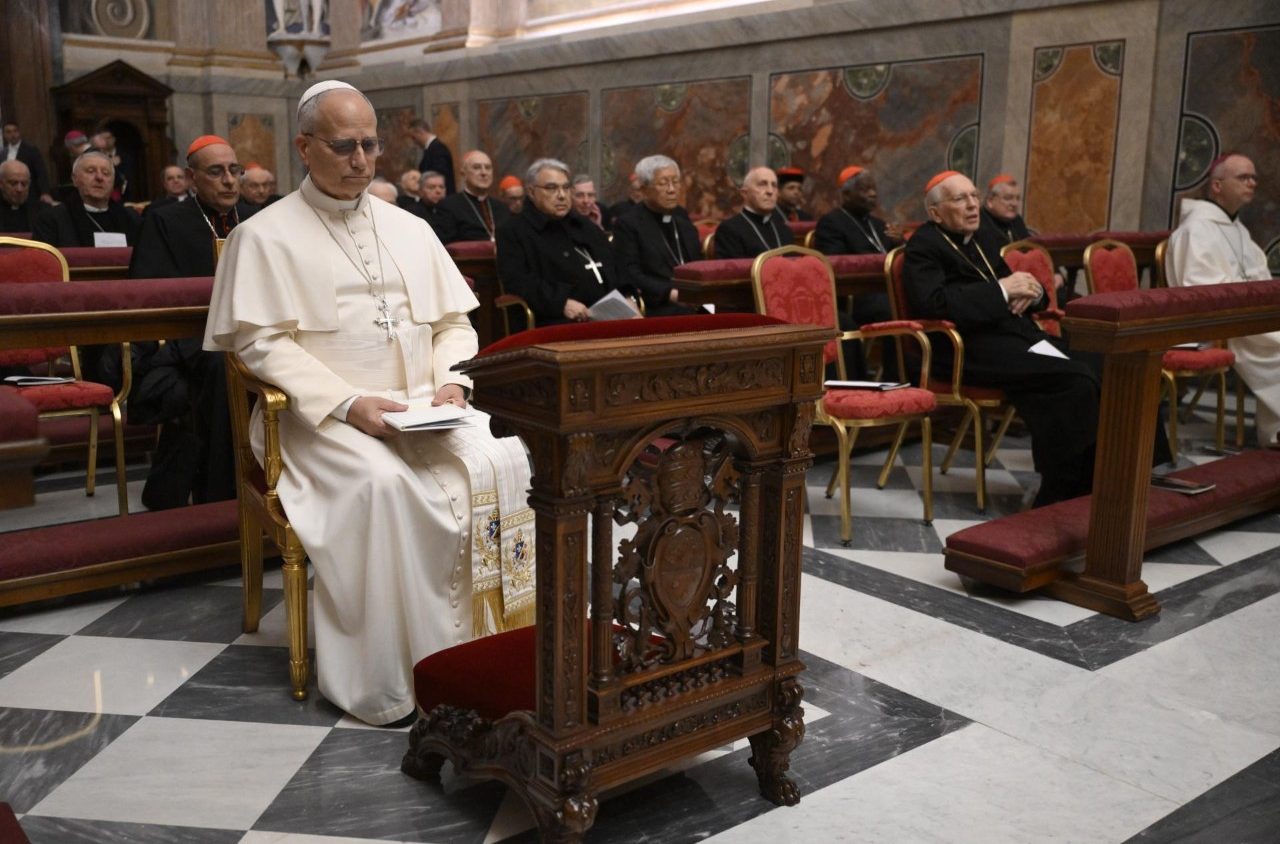

Bishop Erik Varden delivers his seventh reflection at the Spiritual Exercises in the Vatican for Pope Leo XIV, Cardinals residing in Rome, and heads of Dicasteries, focusing on the theme of ‘Glory’. The following is a summary of his reflection.
By Bishop Erik Varden, OCSO*
When Jesus spelled out what it means to remain with him, to enter the Kingdom towards which he was pointing, ‘many of his disciples drew back and no longer went about with him’. They would not put up with his discourses about sacramental realism, the indissolubility of marriage, the necessity of the Cross. When Christ was crucified on Calvary, the synodos that had walked with him six days before was no more. Two followers only remained: his Mother and John, the Beloved Disciple. John gives a stark account of Jesus’s kenosis. It plays out at two levels: that of divine, compassionate love crushed in the wine-press of the Cross; and that of the betrayal of human loyalties. Yet John insists that this scene of dereliction manifests Christ’s glory.
‘Glorification’, says Bernard, ‘happens in the presence of God’s face’ when, our earthly voyage done, we shall at last behold what in this life we have firmly hoped for, putting our trust in Jesus’s name. ‘Spes in nomine, res in facie est’. There is no way of rendering this terse formula except by way of turgid circumscription: ‘Our hope is in the name of the Lord; the reality hoped for will be revealed face to face.’
Yet a ‘hidden glory’ is perceptible even now. Augustine liked to say that we carry the image of glory in an ‘obscure form’. Once we have passed through this life, the form will reveal itself explicit and ‘luminous’. It will be apt to stand before God. Any deformities inflicted by ill-used liberty will be reformed then, so that the form will appear in its intended beauty: as ‘forma formosa’.
Augustine, at once so profoundly humane and trenchantly lucid, stresses that the glory of the image can never be lost; it is imprinted on our being. It can, though, be buried under accumulating layers of darkness, which must be removed.
The Church reminds women and men of the glory secretly alive in them. She shows us that present mediocrity and despair, not least my despair at my own persistent failures, need not be final; that God’s plan for us is infinitely lovely; and that God, through Christ’s Mystical Body, will give us grace and strength, if only we ask.
The Church manifests the radiance of ‘hidden glory’ in her saints. They stand as proofs that even illness and degradation may be means providence uses to realise a glorious purpose, bestowing strength on the feeble and making them radiant. The Church channels ‘hidden glory’ in her sacraments. Any Catholic knows what light can break forth in the confessional, in an anointing, at an ordination or a wedding. Most splendid, and in some ways most veiled, is the glory of the Holy Eucharist. What priest, after offering Mass, has not felt what a great musician once said about an instrument in a bright communication of beauty, healing, and truth: ‘death would really be no tragedy: [for] the best of that which is at the centre of human life has been seen and lived through’, his heart on fire with glorious wonder?
* Bishop Erik Varden, Bishop of Trondheim, Norway, was asked to preach the 2026 Spiritual Exercises for Pope Leo XIV, Cardinals residing in Rome, and the heads of Dicasteries of the Roman Curia, which runs from Sunday, February 22, to Friday, February 27. Here is the link to his website.
