
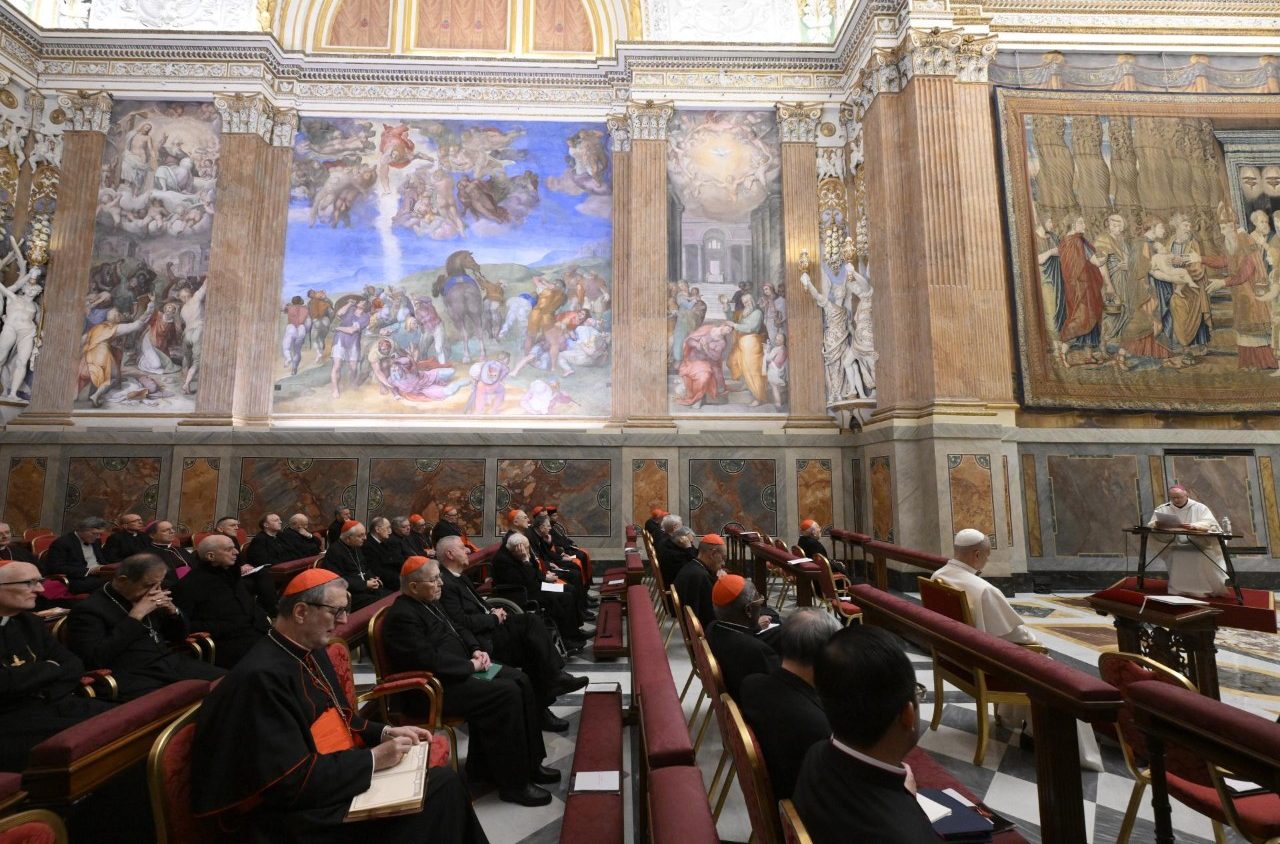

Bishop Erik Varden delivers his ninth reflection at the Spiritual Exercises in the Vatican for Pope Leo XIV, Cardinals residing in Rome, and heads of Dicasteries, focusing on the theme of ‘Bernard the Realist’. The following is a summary of his reflection.
By Bishop Erik Varden, OCSO*
The identity of the Cistercian movement is forged in the interface between the ideal and the concrete, the poetic and the pragmatic. Its protagonists are tested and purified by tensions that result.
I have spoken of Bernard’s high ideals, of his liking for working out a course of action in his mind, then following it a little ruthlessly. Riding a high horse came naturally to him. This fierce, intransigent aspect never left him. But it was sweetened over time. Of this process we must now speak. It turned the idealist into a realist.
The psychoanalyst Jacques Lacan said that ‘the real’ is what we butt against. The range of Bernard’s endeavours in Realpolitik made for a great deal of butting. But he became a realist not merely in the sense of accepting things as they are. He learnt above all that the deepest reality of all human affairs is a cry for mercy.
The more he recognised this cry in human hearts, in bitter tears, in worldly conflicts, in madcap campaigns against decency and truth, and in the whisper of the trees of the forest, the more he was conscious of God’s gracious response. He heard it in the holy name of Jesus, which became unspeakably dear to him. In Jesus God reveals his saving purpose, pouring it forth upon mankind as fragrant, healing, cleansing oil.
‘Every food of the mind’, Bernard told his monks, ‘is dry if it is not dipped in that oil; it is tasteless if not seasoned by that salt. Write what you will, I shall not relish it unless it tells of Jesus. Talk or argue about what you will, I shall not relish it if you exclude the name of Jesus. Jesus to me is honey in the mouth, music in the ear, a song in the heart.’
Bernard knew what wonders God’s mercy in Jesus can work. This gave his devotion affective depth. The term affectus is central to him. It has a broad remit, showing that grace moves us as sensate beings. But Bernard considered Jesus, the incarnation of truth, no less a hermeneutic principle. He read situations, persons, and relationships resolutely in Jesus’s light. This outlook has earned him firm admirers from well beyond the Catholic fold, from Martin Luther to John Wesley.
Only when supernaturally illumined will our nature reveal its perfect form, its forma formosa. Only then will the delightfulness of which earthly life is capable be apparent. Only then will the glory hidden within us and about us shine in substantial flashes, teaching us what we, and others, can become, providing a paradigm for a world renewed.
Such is the realism towards which Bernard matured. It enabled him to become not just a high-minded reformer, a matchless rhetorician, a chieftain of the Church. Knowledge of the utter reality of Christ’s love, and of its power to change everything, made Bernard a doctor and saint. And that is why we love and honour him.
‘He was’, the Vita Prima tells us, ‘at freedom with himself’. That is what life had taught him. A man or woman truly free is glorious to behold.
* Bishop Erik Varden, Bishop of Trondheim, Norway, was asked to preach the 2026 Spiritual Exercises for Pope Leo XIV, Cardinals residing in Rome, and the heads of Dicasteries of the Roman Curia, which runs from Sunday, February 22, to Friday, February 27. Here is the link to his website.
