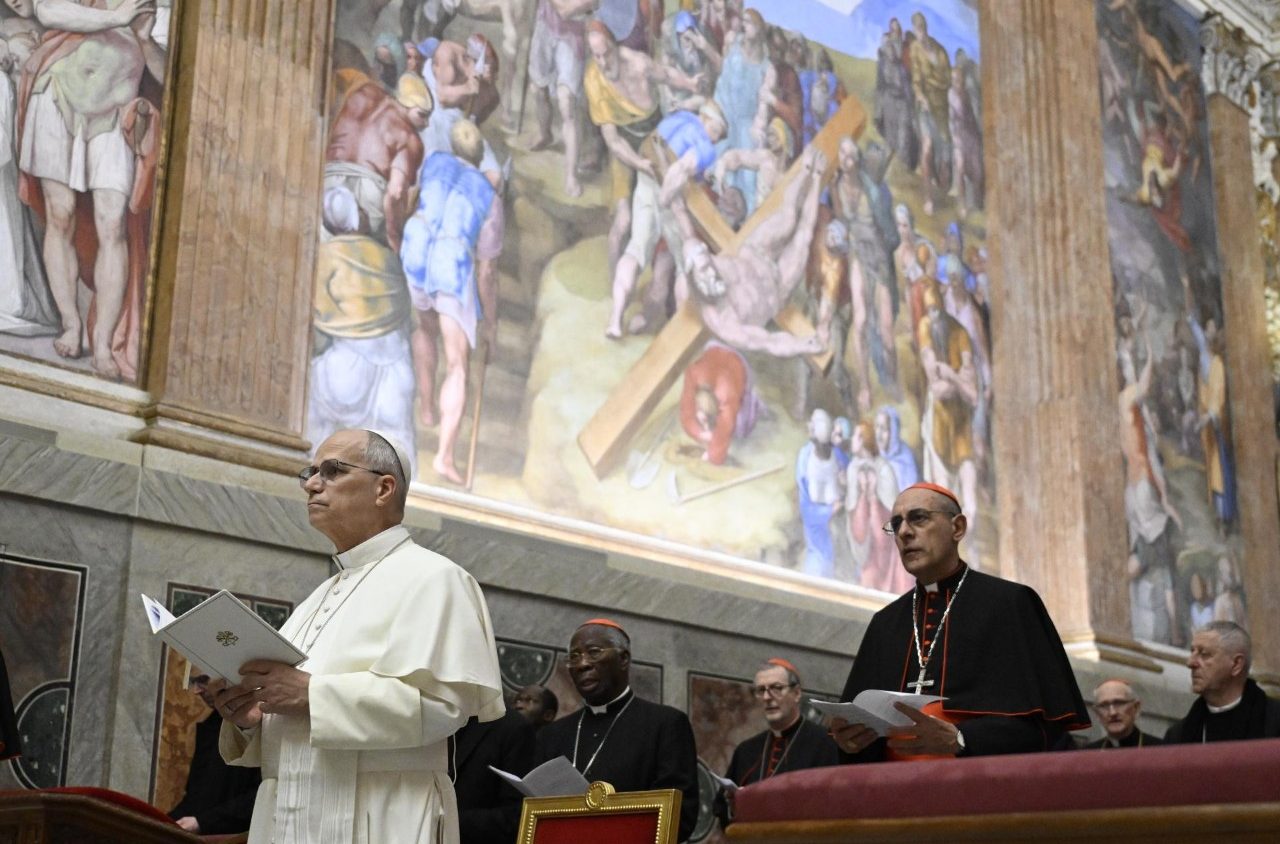

Bishop Erik Varden delivers his fourth reflection at the Spiritual Exercises in the Vatican for Pope Leo XIV, Cardinals residing in Rome, and heads of Dicasteries, focusing on the theme: “Becoming Free.” The following is a summary of his reflection.
By Bishop Erik Varden, OCSO*
The notion of ‘freedom’ has become contentious in public discourse. Freedom is a good to which we all aspire; we rise up against anything which threatens to curtail or confine our freedom. As a result, the vocabulary of freedom is an effective rhetorical tool.
Suggestions that the freedom of a particular group is at risk will call forth instant responses of outrage on the internet. It may even rally people into the piazza.
A variety of political causes in Europe now harness the jargon of freedom. Tensions result. What one segment of society perceives as ‘liberating’ is found oppressive by others. Opposing fronts are raised, with the banner of ‘freedom’ held high on all sides. Bitter conflicts arise from incompatible agendas of purported liberation.
This state of affairs poses a challenge for Christians. It is essential to qualify what we mean when, in the context of faith, we speak of becoming free. That is what Bernard does when he comments on the verse: ‘For He has freed me from the snare of the hunters and from the bitter word.’
For Bernard it is evident that true freedom is not ‘natural’ to fallen man. What seems natural to us is to have things our way, to satisfy our desires and realise our plans without interference, to flaunt and be vaunted for our own brilliant lights. Bernard, addressing man in this state of delusion, is deliciously sarcastic: ‘What do you fancy yourself as, you smatterer?! You have become a beast for which captors’ snares are laid.’
The fact that we are so easily tripped up, that we keep falling into the same old snares, though we know so well where they lie, is to him proof good enough that we are unfree, unable on our own to make steady progress towards our life’s true goal, delivered instead to all sorts of obstructions and distractions.
Rooting his understanding of freedom in the Son’s Yes! to the Father’s will, Bernard works a revolution in our grasp of what it means to be free. Christian freedom is not about seizing the world with force; it is about loving the world with a crucified love magnanimous enough to make us freely wish, one with Christ, to give our lives for it, that it may be set free.
Caution is called for when freedom, held hostage by force, is manipulated as a means to legitimate the doings of impersonal subjects like ‘the Party’, ‘the Economy’, or even ‘History’. In a Christian way of thinking, no oppressive policy can be redeemed by invocations of ideological ‘freedom’. The only meaningful freedom is personal; and one person’s freedom cannot cancel another’s.
To subscribe to a Christian idea of freedom is to consent to pain. When Christ tells us: ‘Resist not evil’, He does not ask us to countenance injustice. He lets us see that justice’s cause is sometimes best served by suffering for it, refusing to meet force with force.
Our emblem of freedom remains the Son of God who ‘emptied Himself’.
* Bishop Erik Varden, Bishop of Trondheim, Norway, was asked to preach the 2026 Spiritual Exercises for Pope Leo XIV, Cardinals residing in Rome, and the heads of Dicasteries of the Roman Curia, which runs from Sunday, February 22, to Friday, February 27. Here is the link to his website.
