
Church representatives and indigenous rights activists launch a global platform for divestment from mining activities that affect local communities in Latin America.
Vatican News
The “Iglesias y Minería” is an ecumenical network of organisations, church groups and activists for the rights of Indigenous Peoples in Latin America that works to support communities affected by mining. Together with church representatives, it launched a global platform for divestment from extractive activities affecting local communities on Friday at the Holy See Press Office.
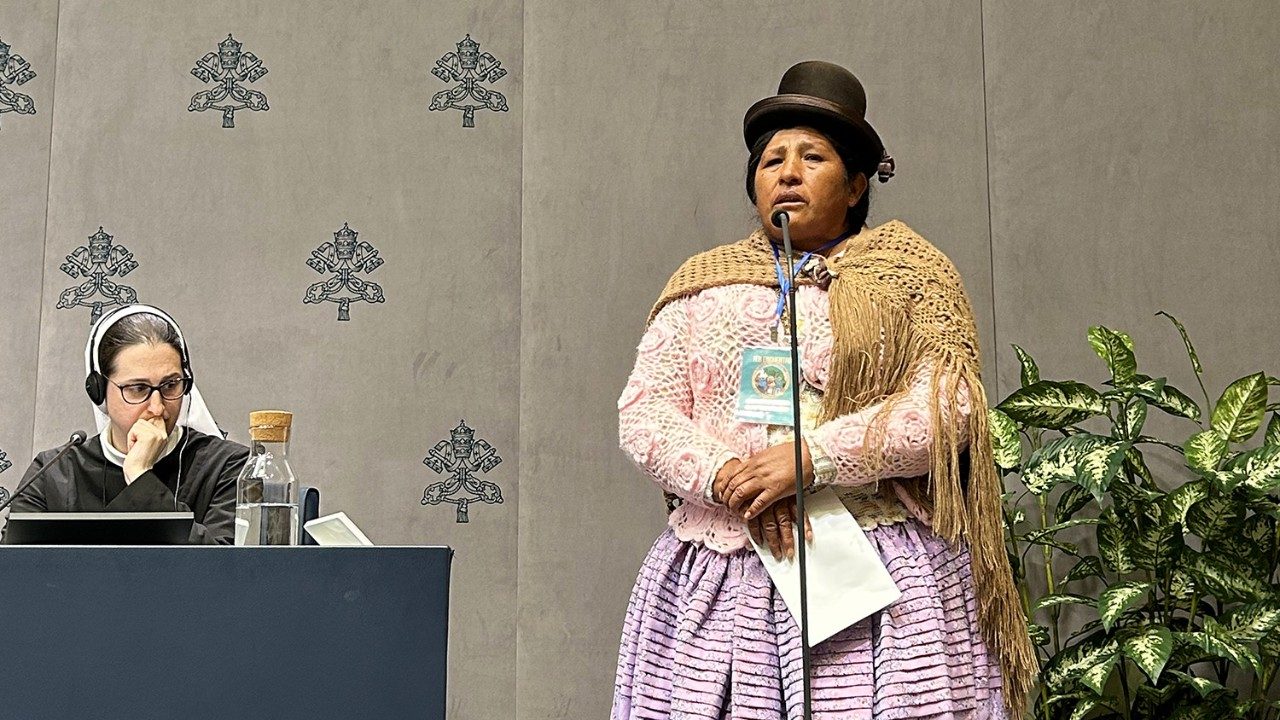
Yolanda Flores, an Aymara leader from Peru, described environmental and health concerns linked to mining in Indigenous territories. Communities, she said, are seeking investigation of contamination and the effects of heavy metals.
Bringing her witness during a press conference at the Holy See Press Office in the Vatican, Flores asked for support in assessing impacts and identifying those responsible for financing extraction activities. She also called for access to education, pastoral accompaniment, and greater visibility of Indigenous claims.
Cardinal Baggio: silence is not an option
Cardinal Fabio Baggio, Undersecretary of the Dicastery for Promoting Integral Human Development, said mineral extraction has often occurred without consultation with local communities and without regard for ecosystem limits.
The divestment platform in the mining industry, he explained, seeks to be a concrete sign of that necessary conversion, which is not merely a technical or financial decision. “It is an act of coherence with our faith, with the defence of human dignity, and with the commitment to care for our Common Home.”
“It is essential to listen to the voices of communities who experience first-hand the challenges and conflicts caused by both legal and illegal mining. We cannot remain silent in the face of evident injustices.”
Local communities: poor, deceived, exploited
Cardinal Álvaro Ramazzini, Bishop of Huehuetenango in Guatemala, known for his defence of human rights, Indigenous peoples, migrants, and social justice, recalled the concept of “integral ecology” developed by Pope Francis in Laudato si’, and the fundamental principle of existential interdependence that calls for a preferential option for the poor.
He spoke of cases in Guatemala involving mining concessions on Indigenous land and raised concerns about the distribution of benefits and impacts on local populations.
After acquiring the land at a very low price, the company proceeded with formal legal activity, the Cardinal said, but one not guided by the criteria of distributive justice for local populations.
“Do not be intimidated by the lure of money”
Bishop Vicente Ferreira of Brazil said mining expansion in Latin America is linked to geopolitical and economic demand for minerals.
He spoke of what he described as the false solutions of so-called “green capitalism” and of rapidly evolving scenarios of conflict that raise further concerns for Latin American and Caribbean peoples.
Their territories, he said, are increasingly targeted by a new form of military neocolonialism driven by the demand for “rare earths” to sustain global power structures. He also warned against financial pressure on affected communities.
“Act now”
Sr. Anneliese Herzig, Missionary Sister of the Most Holy Redeemer and head of the Department for Mission and Social Affairs of the Austrian Bishops’ Conference, highlighted the protection of children in areas affected by the consequences of extractive industries and called for changes in policy and practice.
Sr. Maamalifar M. Poreku, Missionary Sister of Our Lady of Africa, likewise stressed that integral ecology requires not only compassion but systemic transformation.
The path forward, she said, is to “align faith and economic choices,” referring to “martyred territories” sacrificed for profit. “The ecological crisis,” she added, “requires more than gradual adjustments; it requires prophetic leadership.”
Fr. Bossi: divestment as an ethical and effective strategy
Finally, Fr. Dario Bossi, Comboni missionary and coordinator of the Network, explained that the platform launched at the Vatican is intended as a space for information exchange, study of mining and financial processes, and calls for cooperation.
He cited examples of environmental damage linked to big mining operations in Brazil, noting that there are companies that have received tens of billions of dollars in international financing from banks and investment funds worldwide.
“In light of this reality,” he said, “many social and ecclesial organisations have begun to consider divestment as an ethical and effective strategy to address rights violations.”
