
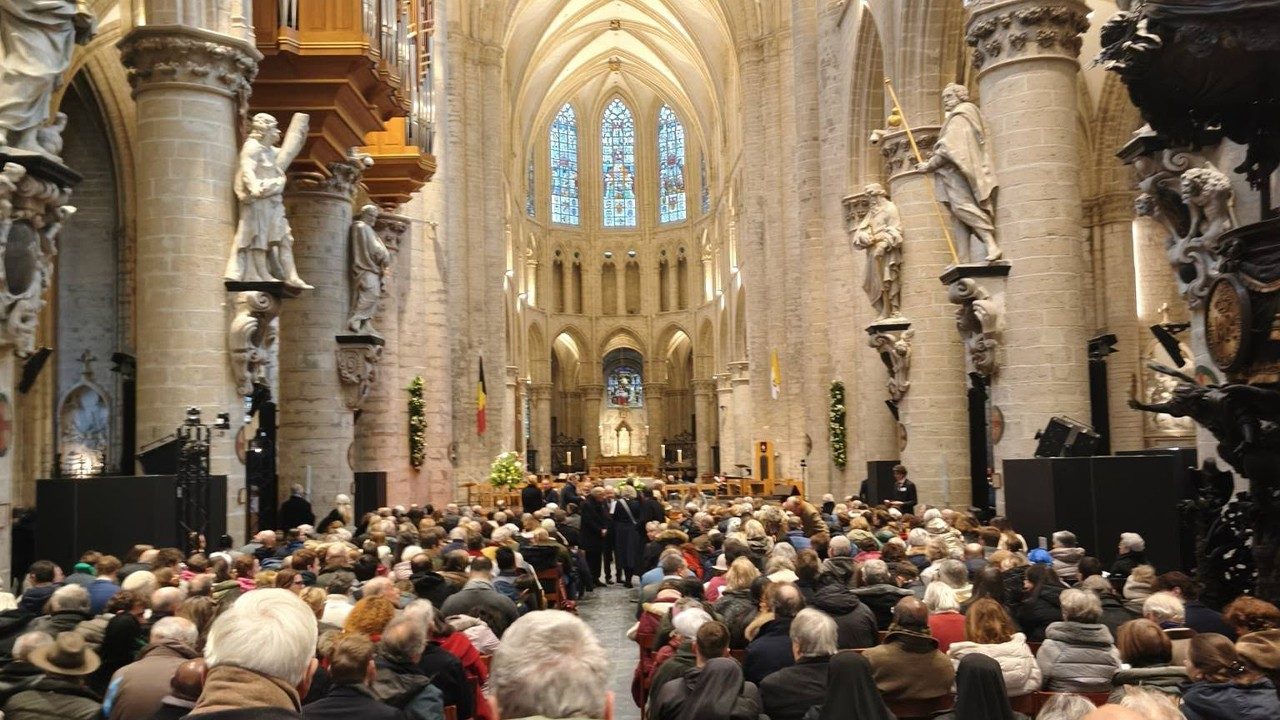
On the 800th anniversary of Brussels’ Cathedral of St. Michael and St. Gudula, the Holy See Secretary of State reflects on the spiritual future of a Europe marked by fragility and a loss of direction.
By Augustine Asta
Inside a cathedral steeped in eight centuries of history, filled with hundreds of the faithful and members of the Belgian royal family, Cardinal Parolin stressed that the “Christian faith does not exist outside of time or on the margins of history, but grows within it, in concrete places and through real communities.”
Long before this 13th-century Gothic structure was built, he said, a chapel dedicated to Saint Michael and a Romanesque church, had already borne witness to Christianity’s deep roots in Brussels.
This slow, patient growth, the Cardinal Secretary of State said, illustrates the very nature of the Church, which “is not born from a single isolated act or a project completed only in one moment, but from a fidelity that spans generations, in which each person receives, safeguards and hands on what has been entrusted to them.”
Over eight centuries, he noted, the cathedral has accompanied the Christian life of the city and the nation, embodying a faith which engages the questions of its time.

Cardinal Parolin delivers his homily
Saints Michael and Gudula: Two images of the Church
The first foundations of the Cathedral of Saints Michael and Gudula date back to 1226, when Henry II, Duke of Brabant, decided to build a church on a strategic site at the crossroads of routes linking France and Germany.
For Cardinal Parolin, the Cathedral’s two patron saints embody a mission that remains strikingly relevant today.
Saint Michael evokes “vigilance and discernment,” while Saint Gudula represents “daily fidelity.”
Together, he said, they sketch the face of a Church called to hold together truth and service, firmness and gentleness.
Brussels and European fragility
Home to many of the European Union’s institutions, Brussels is, Cardinal Parolin said, a city born from encounter and the ability to reconcile differences. Europe itself, however, he observed, is currently passing through “a period of profound fragility, marked by fears and fractures that are not only political and social, but also interior and cultural.”
An insignificant Church?
Recalling figures such as Robert Schuman, Konrad Adenauer, and Alcide De Gasperi—the architects of postwar European reconciliation—the cardinal stressed the need to rebuild not only Europe’s institutions, but also its people’s sense of trust in one another.
Self-doubt, he said, also is also a challenge for the Church today – its greatest danger is not numerical decline, but irrelevance. “It is not numerical weakness that undermines Christian witness,” Cardinal Parolin warned, “but the loss of evangelical boldness.”
“The Church does not stand above history, nor does she simply merge with it,” he said. “She journeys through it as a presence that accompanies, discerns and serves.”
A Prayer for Brussels, Belgium, and Europe
In closing, Cardinal Parolin entrusted the Church, the city of Brussels, Belgium, Europe, and the community of nations to the intercession of Mary.
The Holy See’s Secretary of State expressed his hope that the Cathedral of Saints Michael and Gudula would remain “an open home and a space of communion,” one that continues to for consciences for justice, responsibility, and hope.
