
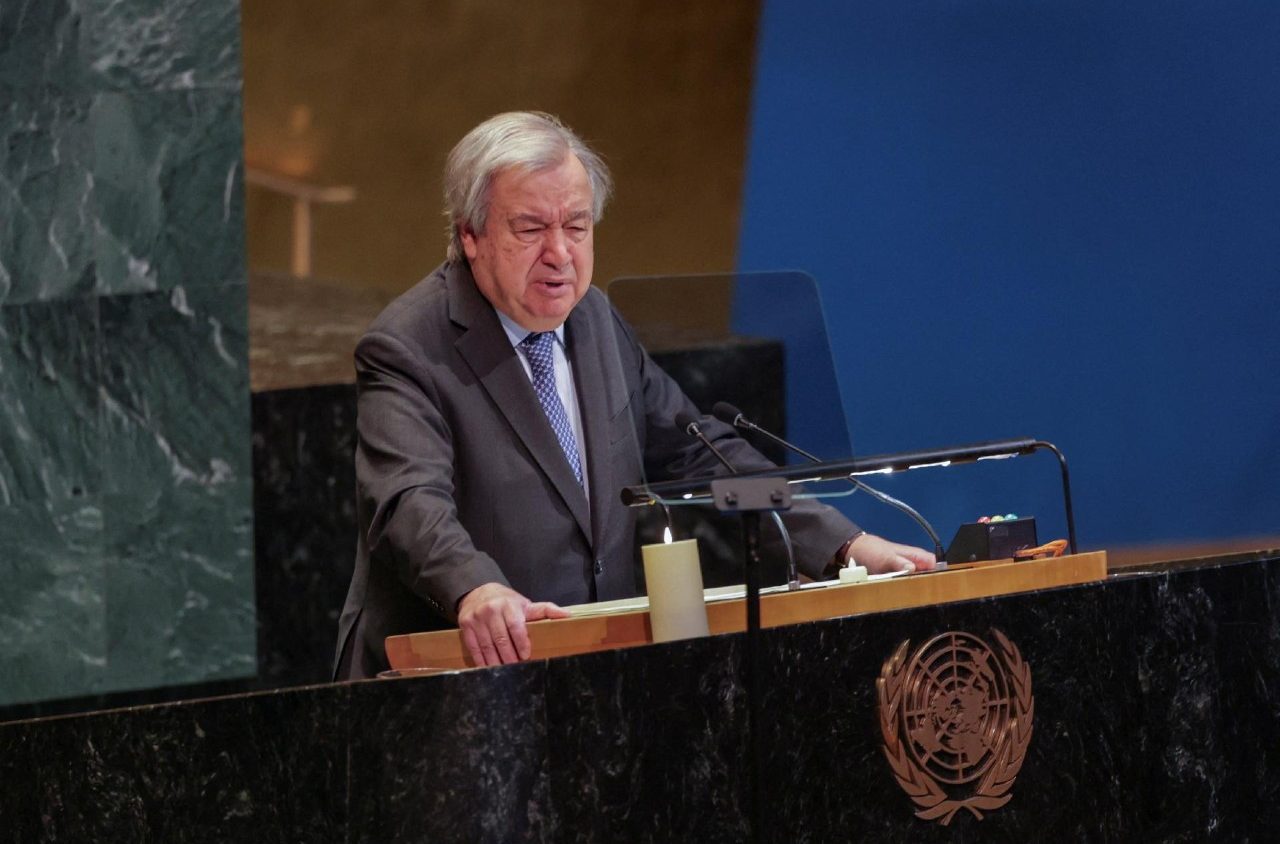

We publish extensive excerpts from an interview with Antonio Guterres, Secretary-General of the United Nations, first published in the Italian daily newspaper, La Repubblica.
By Paolo Mastrolilli
“When the law of power replaces the power of law, the consequences are deeply destabilizing.”
The UN Secretary-General, Antonio Guterres, issued this warning in the following exclusive interview with La Repubblica, on the occasion of his visit to Italy for the opening of the Olympic Games, which cuts to the heart of the threat shaking the entire global community.
Q: The Games have historically been an opportunity for dialogue, inclusion and peace. However, in your recent address to the United Nations General Assembly on the priorities for 2026, you said: “We are in a world brimming with conflict, impunity, inequality, and unpredictability. A world marked by self-defeating geopolitical divides… brazen violations of international law… and wholesale cuts in development and humanitarian aid. These forces and more are shaking the foundations of global cooperation and testing the resilience of multilateralism itself. That is the paradox of our era: at a time when we need international cooperation the most, we seem to be the least inclined to use it and invest in it.” What are in your opinion the root causes of this trend and what could be the solutions?
[Mr. Guterres:] First of all, the Olympics are an excellent moment to symbolize peace and respect for international law and international cooperation. I want to express my deep appreciation to Italy for its leadership in revitalizing the ancient Olympic Truce as a powerful symbol of peace.
Thanks to Italy’s initiative, the United Nations General Assembly adopted a resolution calling on nations to observe the Olympic Truce during the lead-up to and throughout the Milan-Cortina 2026 Olympic and Paralympic Winter Games.
This is a powerful reminder that even in times of division, humanity can unite around shared values. Sport has a unique ability to bridge divides and inspire cooperation, and I commend Italy for embracing this spirit through the 2026 Games.
The challenges I highlighted are deeply rooted in multiple, interconnected factors. In geopolitics today, reckless actions provoke dangerous reactions. Impunity fuels escalation, inequality roils societies, and climate change triggers storms, wildfires, and rising seas. Technology without guardrails multiplies instability.
At the same time, brazen violations of international law and norms weaken the credibility of global institutions, sending a dangerous signal that powerful actors can act without consequence. Reduced investment in development and humanitarian aid further compounds these crises, leaving populations exposed to hunger, displacement, and conflict. The cumulative effect is a weakening of multilateralism at precisely the moment when global cooperation is most needed – to prevent conflicts, respond to crises, tackle climate change, and uphold the principles of peace, justice, and human rights that underpin the United Nations.
The Olympic Games also offer a unique platform to raise awareness of the climate crisis. Climate change directly threatens the future of winter sports: without urgent action, the number of locations able to reliably host winter events could drop from over 90 today to as few as 30 by the 2080s.
Safeguarding the future of sport—and our planet—requires decisive, collective action by all governments to limit warming, in line with the Paris Agreement, the 2030 Agenda, and the Sustainable Development Goals. The Games can mobilize governments, athletes, and citizens alike – showing that global cooperation can deliver real results, for both peace and the climate. I believe the Olympics are excellent moments to symbolize peace, respect for international law, and international cooperation (…)
Q: You recently said: “There are those that believe the power of law should be replaced by the law of power. Indeed, when one sees the present policy of the United States, there is a clear conviction that multilateral solutions are not relevant and that what matters is the exercise of the power and the influence of the United States.” What are the consequences and dangers of this behavior for global peace and stability?
If we want a stable world—one in which peace can be sustained, development can be shared, and our common values can prevail—we must support multipolarity rooted in cooperation, not confrontation.
When the law of power replaces the power of law, the consequences are deeply destabilizing. Impunity drives conflicts, fuels escalation, and widens mistrust, allowing spoilers to exploit tensions and act without accountability. Multilateral cooperation is weakened, and international institutions struggle to respond effectively to crises.
When powerful states prioritize influence over adherence to international law, it undermines the credibility of the rules-based international system, sending a dangerous message that rules and norms can be disregarded and discarded. This erodes trust between countries, encourages unilateral actions, and increases the risk of confrontation, instability, and human suffering.
Ultimately, global peace and stability cannot be achieved without respect for international law, predictable behavior, and collective cooperation. Strong, inclusive multilateral institutions, grounded in shared responsibility and values, are essential to managing conflicts, addressing inequalities, responding to humanitarian crises, tackling climate change, and upholding the principles of the UN Charter.
Q: In your speech about the 2026 priorities, you said that you welcome the start of the Phase Two of the Gaza ceasefire, however many analysts consider the Board of Peace as a direct challenge to the United Nations. President Trump himself said that it could replace the UN, do you see this as a risk?
The Security Council has adopted resolution 2803, which relates specifically to Gaza. That resolution sets out a number of roles and responsibilities, including for the Board of Peace and other actors, and it is essential that it is fully implemented. I encourage all parties to abide by it. All efforts must be guided by relevant United Nations resolutions and international law.
We need the ceasefire in Gaza to hold and to move decisively into Phase Two. That means a full withdrawal of Israeli forces, the dismantling of armed groups, and creating the conditions for a credible political horizon, including a two-State solution.
At the same time, it is important to be clear about mandates. The responsibility for international peace and security rests with the United Nations, and within it, with the Security Council. The Council alone has the Charter-mandated authority to act on behalf of all Member States, to adopt decisions that are binding, and to authorize the use of force under international law. No other body or initiative can replace that role. This is precisely why strengthening and reforming the Security Council remains so important.
On the ground in Gaza, since the ceasefire we have seen a significant increase in humanitarian assistance. But it is still far from sufficient. Beyond food, there are enormous needs in health care, shelter, water and sanitation. The United Nations remains fully engaged and committed to overcoming obstacles so that life-saving assistance can reach those who need it most.
Q: You recently sent a letter to the UN Ambassadors alerting them that the UN is facing the risk of an “imminent financial collapse.” Is the UN risking bankruptcy, why is this happening and what should the member states do in order to avoid it?
I have stressed that this is not a routine cash-flow challenge. I have made it clear to the Member States that, although the UN has managed difficult periods of unpaid assessed contributions before, today’s situation is categorically different. Decisions not to honour assessed contributions that finance a significant share of the approved regular budget have now been formally announced.
This creates a structural crisis. Under existing financial rules, if funds are not received, the Organization is legally required to return “unspent” amounts, even when mandates cannot be fully implemented. The result is an untenable cycle of uncertainty, delayed operations, hiring freezes and reduced delivery on mandates approved by Member States themselves.
The current trajectory is untenable. It leaves the UN exposed to structural financial risk and forces a stark choice: Member States must either agree to overhaul the UN’s financial rules – or accept the very real prospect of its financial collapse.
Q: Recently, Abu Dhabi hosted the first tri-lateral negotiation among Ukraine, Russia and the US, however the condition attached to the security guarantees is for Ukraine to accept ceding territories. Do you consider this an acceptable solution for a just and lasting peace?
I welcome all efforts towards achieving a just and inclusive peace, and the United Nations stands ready to support such efforts. However, when discussing Ukraine, it is crucial not to forget fundamental principles. First, it was Russia that invaded Ukraine, not the other way around. Second, any possible solutions to this or any conflict must be grounded in international law and the principles of the UN Charter. Violations of these rules are extremely dangerous, as they send a message that international law no longer matters and that States can act without consequence.
Any peace in Ukraine must uphold the country’s sovereignty, independence and territorial integrity, within its internationally recognized borders, in accordance with the UN Charter and international law. The UN is ready to support a peace process if the parties agree and ask us to do so, but such decisions do not depend on the UN – they depend on the parties.
In less than a month, we will mark four years since the start of the Russian Federation’s full-scale invasion of Ukraine—a war that has brought death and destruction, claimed an unimaginable number of lives from both countries, and poses a grave threat not only to peace and security in Europe but also to the very foundations and core principles of the United Nations.
In recent months, as temperatures have plunged far below freezing, we have seen intensified, systematic attacks on Ukraine’s energy infrastructure, with devastating humanitarian consequences. These strikes have killed and injured scores of civilians and left millions of Ukrainians without electricity, heating and water. No matter where they occur, attacks against civilians and civilian infrastructure are unacceptable, unjustifiable, and must stop immediately. This war, which should never have begun, must end.
