
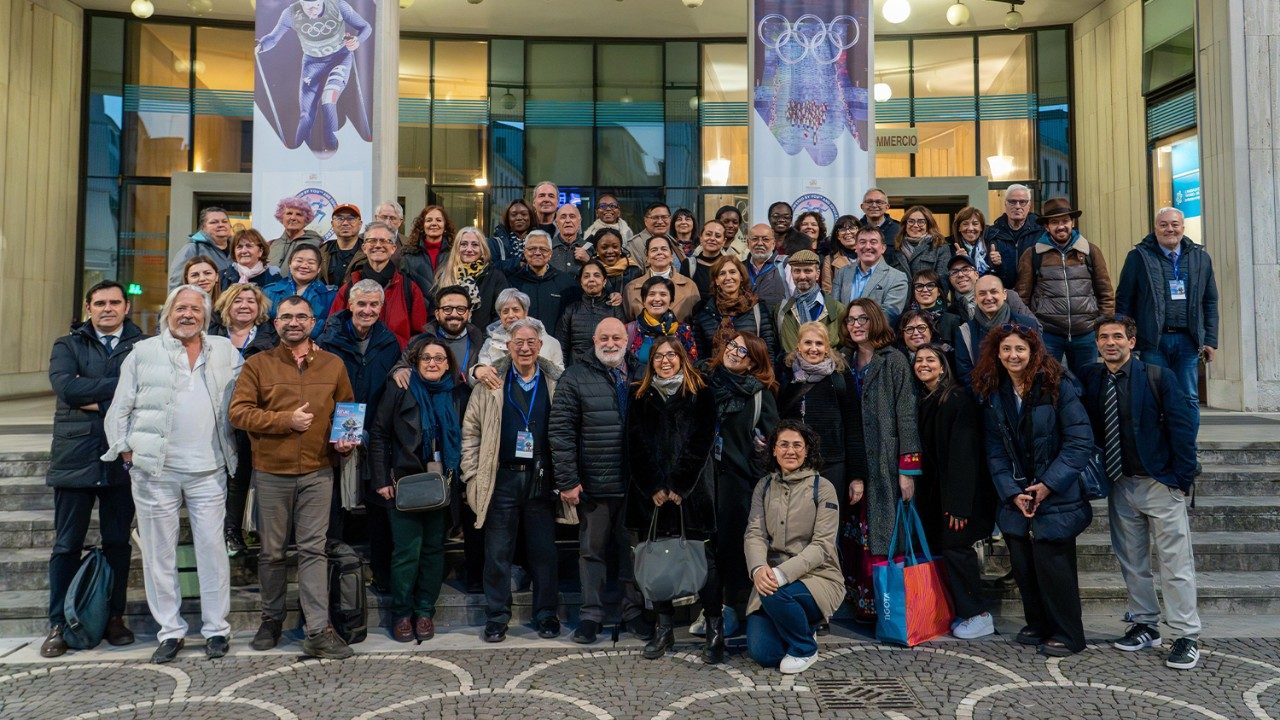
At the GreenAccord Forum in Treviso, journalists reflect on how to report the climate crisis without paralysing audiences, as this year’s media award goes to Covering Climate Now.
By Francesca Merlo – Treviso, Italy
The 17th GreenAccord International Forum has drawn to a close in Treviso, Northen Italy. The numerous conversations that have taken centre stage over the last few days have left behind a vital question: the issue is not only how we respond to the climate crisis, it is also about how we tell it.
Central to this reflection here at GreenAccord but also worldwide is Santiago Sáez, Director of Training at Covering Climate Now and recipient of this year’s GreenAccord International Media Award. His recognition comes at a moment that he describes as being “very difficult, globally” for journalists. In the climate story he describes it as a moment that is both urgent and increasingly contested.

A program of the four-day even in northeastern Italy
“We’re very grateful,” he tells Vatican News on the sidelines of the event. “But we accept it on behalf of journalists everywhere…this is probably the most important story of our generation.”
One of the trickiest aspects of his work, and a mistake he himself admits to having made, is working out how to report on the climate emergency without overwhelming audiences or leaving them paralysed. “It is a tricky topic,” he admits. But the solution, he continues, is not to soften the truth, bur rather to change the way it is told, focusing on solutions.
Sáez goes on to describe what he calls a three-pillared approach, which consists in a style of reporting that is local, human, and oriented towards solutions. Climate change, when it is framed only in global or abstract terms, risks becoming distant and something that happens elsewhere, or risks happening in a future that seems too far away to grasp. But when it grounded in lived experience, it becomes immediate.
An example he uses to illustrate this point is the recent Covid-19 pandemic, which if you are old enough to read this article, you are likely old enough to remember. Journalism, notes Sáez, did not shy away from suffering. “There was a lot of it,” he says. But it also did not ignore solutions: masks, social distancing, vaccinations…they were all reported, investigated and questioned, and, he adds, “fake solutions were quickly identified as such”.
For Sáez, climate journalism must follow this example and it must be neither pure advocacy nor pure reassurance, but rather a rigorous balance. “Science tells us we are facing a huge challenge,” he says, “but it also tells us we already have the tools to avoid the worst consequences.”
However, it is impossible to ignore the fact that we are living in an age of disinformation and this balance is difficult to keep. Throughout the Forum in Treviso, the responsibility of media has been a central theme, particularly on this final day of works. For Sáez, it is a responsibility that continues to evolve. Artificial intelligence has increased both the spread and the detection of misinformation, whilst political and economic pressure in some parts of the world is making reliable data harder to access – including in the United States where the charity for which Sáez works operates as its government removes itself from all climate groups and talks, reducing funding and support for Climate Action movements worldwide.
“There is a broader retreat,” he notes, particularly in climate discourse. For journalists, this means navigating not only this complexity, but also all resistence.
In response, however, Sáez describes some of the new tools that are being created in an attempt to fight the spread of misinformation. Among these is the so-called “truth sandwich” which begins with verified facts and places false claims in context before then returning, once more, to the truth. Another approach he mentions is known as “inoculation” and it prepares audiences to recognise misinformation before they encounter it.
These, Sáez continues, are not definitive solition, but they are a part of an ongoing effort to preserve trust, which is so precious. And, in fact, trust, like hope, has been present and running throughout the forum.
From discussions revolving around eco-anxiety among young people to reflections on biodiversity, food system and sustainable architecture, the days in Treviso have repeatedly pointed to the same conclusion. That is that the ecological crisis is not only environamental but human – reaching how people think, how they feel and their sense of future.
Sáez recognises this, and he, along with numerous other attendees, have learned that awareness is no longer the main obstacle. The challenge now is what follows. The task of a journalist is no longer only to inform, but to help build the bridge which connects data and daily life; global crises and personal responsibility; and fear and action.
And so as the forum draws to a close, attention has turned to the necessary cooperation that must evolve between countries, sectors and disciplines as well as the responsibility of those who tell the stories. Because, as these days in Treviso have emphasised, the future is not shaped merely by what we do but by how we understand and how we choose to speak about and act on what lies ahead.
