
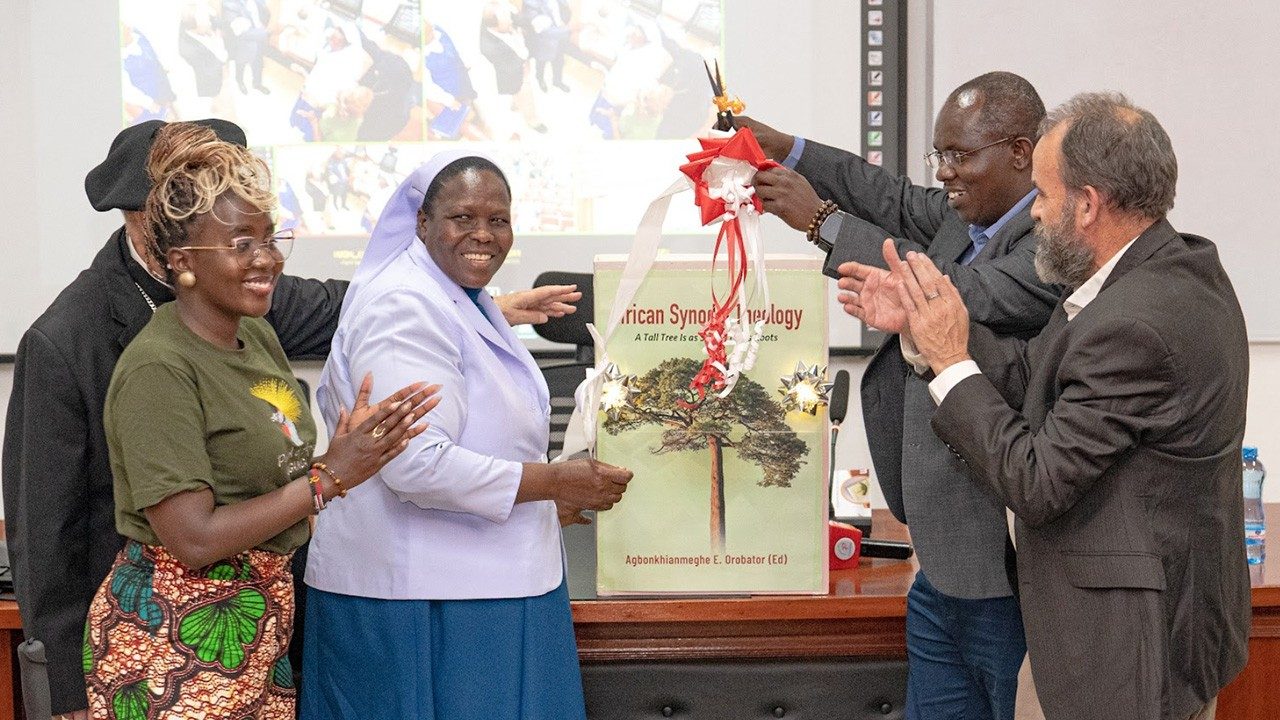
Various presenters at the launch of the book on African Synodal Theology held at Hekima University College in Nairobi, Kenya, have stressed the need to shift the discussion on synodality from theory to implementation.
Sr. Christine Masivo, CPS, and Angella Rwezaula – Vatican
The official launch of the book, “African Synodal Theology: A Tall Tree Is as Strong as Its Roots”, was held at Hekima University College (HUC) recently. The book is a product of the African Synodality Initiative. It is edited by Jesuit priest Fr. Agbonkhianmeghe E. Orobator, with contributions from various African theologians and writers.
The Synod on Synodality now calls for pragmatism and implementation. At the launch, speakers consistently emphasised that synodality must shift from discussion to action.
The book urges the Church in Africa and elsewhere to increase inclusivity, foster collaboration, and promote grassroots participation among the faithful.
African perspective on synodality
The African proverb, “A tall tree is as strong as its roots,” explores the evolving understanding of a synod Church. It emphasises the importance of culture from an African perspective. The book also highlights tradition, listening, and inclusivity in shaping a mission-driven future Church.
Without lived experience among the faithful, synodality risks remaining abstract and inaccessible. Participants noted a critical gap in awareness, as many within the Church still do not fully understand synodality or its implications for daily ecclesial life.
Dr Stephen Eyowa, SJ, Dean of the Faculty of Theology at Hekima College University, said, “Synodality resonates deeply in the African culture.” There is, he observed, the urgency of promoting African Theology in both academic and ecclesiastical fields, ensuring that the continent’s rich traditions and content generate appreciation not just in Africa but worldwide. The idea is to ensure that Africans add their own voice to the global Church, rather than rely on imported theologies.

African Synodal Theology book launch
Africa’s voice in the global Church
The publication positions Africa not as a passive recipient of a theological frameworks but as an active contributor, shaping the global Church. As emphasised during the launch, the text enables Africa to “speak with its own voice,” grounded in its cultural heritage and lived realities rather than on imported ideologies.
Furthermore, the book provides the Church in Africa with an essential resource for reference and reflection. This, in turn, can help revitalise pastoral opportunities. The Synod is a journey undertaken together. In the midst of current challenges, the African philosophy of “Ubuntu” is an apt reminder of the need not only to walk together in synodality but also to work together to create a better world for all.
Conversion and spiritual affirmation
“African Synodal Theology is not just a title but a vision,” said Dr Marcel Uwineza, SJ. He called the book a call for conversion in Africa. He added, “This book is from Africa to the world. It offers a spirituality for a wounded world that requires spiritual conversion.” Thus, the Synod in the Church is a mystery of God. It is not hierarchical, but begins with the Sacrament of Baptism.
The Catholic Bishop emeritus of the Apostolic Vicariate of Soddo in Ethiopia, Bishop Rodrigo Mejía, S.J. spoke of the advantages that synodality brings to the Church. Synodality, he said, is in the making. It is becoming a celebration.
Bishop Mejía also called for synodality’s integration into priestly formation and ecclesial structures. For all this to be concretised, there is need for a change in mentality and attitude towards a new way of being Church.
The role of women religious
Dr Sr. Veronica Rop, ASE’s contribution underscored the sometimes-overlooked role of consecrated women, noting that, “Sisters have no voice in the Church to contribute in accordance with the synodal spirit.” She challenged cultural and structural barriers, urging that women be given space to participate fully. She said religious women need to be valued so that they can walk confidently in Church spaces. “Without religious women, where would we be in Africa?’ she asked.
The significance of communication, the role of digital media in fostering participation, youth engagement and continued discernment were also underlined by other speakers.
As the global church continues its synodal journey, the new book offers not only insight but leadership rooted in the Gospel, African culture and community living -all enriched and oriented towards a future where all voices are heard.
