
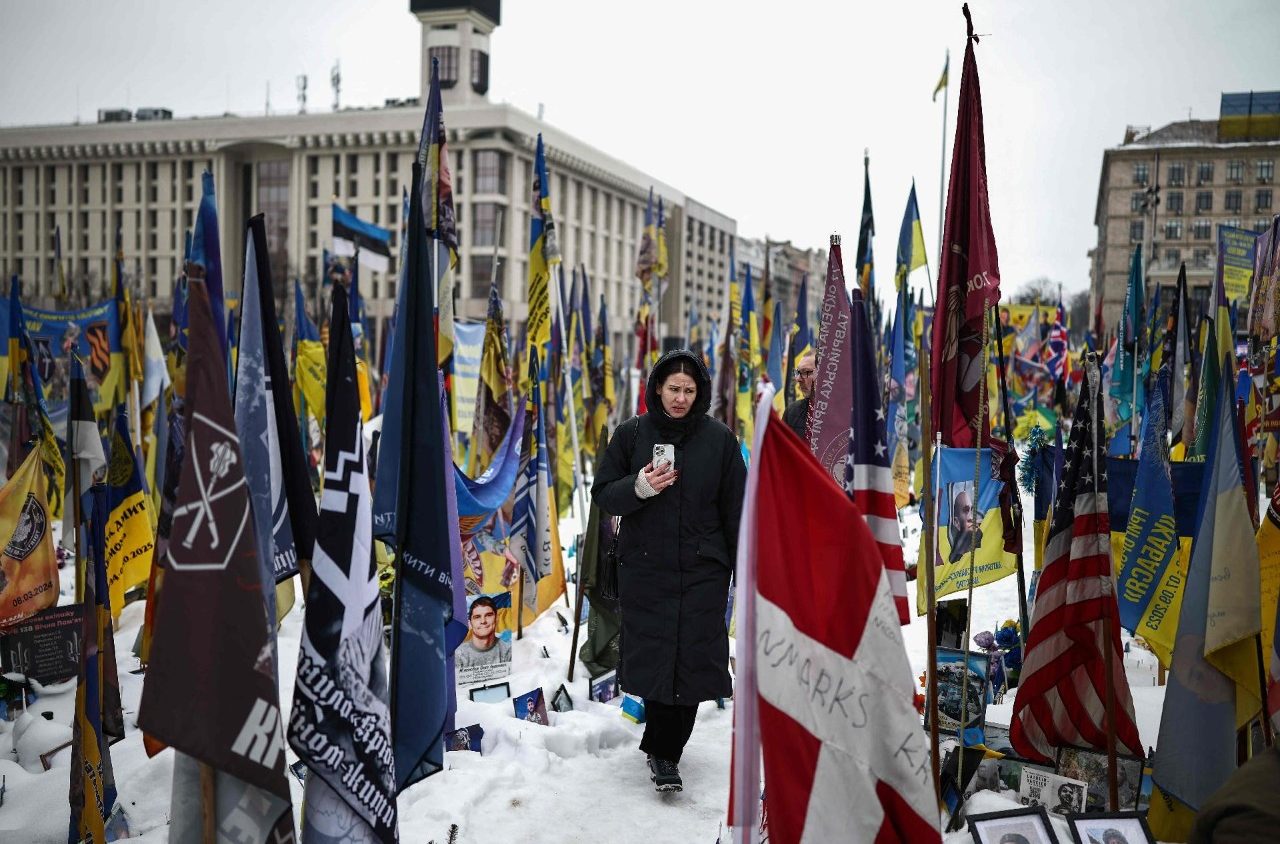
Four years after Russia’s invasion, Ukrainians live amidst destruction, fear, and resilience. Mediation efforts have yet to deliver results, while Europe’s weakness is on full display. This fourth anniversary is a call for the international community to get back to building peace.
By Massimiliano Menichetti
Emptied-out cities, shattered families, thousands dead and displaced, hunger, cold, fear, resistance and pride. This has been everyday life in Ukraine, ever since the Russian invasion on 24 February 2022. You cannot get used to war, any war, and yet time keeps passing, seeming to confirm the invincibility of those who sow nothing but destruction and steal dreams, hope, and the prospect of growth.
Images of cities with crumbling buildings, underground shelters, and trenches have become normal, part of the constant flow of global news. A conventional war in the heart of Europe once seemed unthinkable, and yet here we are: counteroffensives, mobilizations, alliances, energy crises, killings.
For now, suffering and grief remain hostage to strategies of conquest and revenge; mediation attempts and peace conferences have achieved little. Weapons still prevail.
Last Sunday Pope Leo once again forcefully called for an immediate end to hostilities, speaking plainly about reality: “How many victims, how many lives and families shattered! How much destruction! How many unspeakable sufferings.”
This war, which has also raised the spectre of nuclear weapons, and therefore the destruction of the entire world, confronts us with the fragility of a Europe that is economic in nature, far removed from the political, social, humanistic horizons of unity envisioned by its founding fathers: Robert Schuman, Alcide De Gasperi, Konrad Adenauer.
War cannot and must not be accepted: it has to be stopped; the guns must fall silent. Rearmament, so strongly desired by some, is not the only possible path – indeed, it is a very dangerous one. Peace is not achieved through force: it is built and safeguarded. Peace is protected through dialogue, relationship, respect, diplomacy, and multilateralism.
Politics, in its fullest and truest form, builds coexistence; it puts the person at the centre; it serves the common good. It is therefore at the service of the community and never promotes power for its own sake. And yet politics, too, seems to have become fragile, on the Old Continent as elsewhere.
It is necessary to silence the world’s weapons immediately and work to build “a peace that is unarmed and disarming,” as Pope Leo XIV has often said: first rooting out the weapons within ourselves, dissolving hatred and distrust of the other.
This fourth anniversary asks us not to look away, not to ignore the fact that an entire generation of Ukrainian children is growing up knowing only the sound of sirens, bombs, violence, and deprivation. Wounds that will not heal quickly, and will not disappear. After the conflict, decades will be needed for all the horror and hatred to be transformed and to loosen their grip on people’s hearts.
We will need a way of seeing that does not humiliate the enemy, that can turn the enemy into a counterpart at the table – an approach capable of changing hearts. And even then, no one must be left alone. Europe will have to restore the image of fraternity, hospitality, subsidiarity, and also those Christian roots that it struggles so much to recognise.
In this time of pain, hope is still alive. It sustains the work of thousands of people who help, rescue, and labor in every field so that unity and mutual aid can prevail. Peace is not a sudden event, but a process, sometimes built on imperfect negotiations animated by political courage.
We must hope that this fourth anniversary will mark the year in which the international community stops “managing” the war and returns to building peace, nurturing trust, coexistence, and shared memory.
