
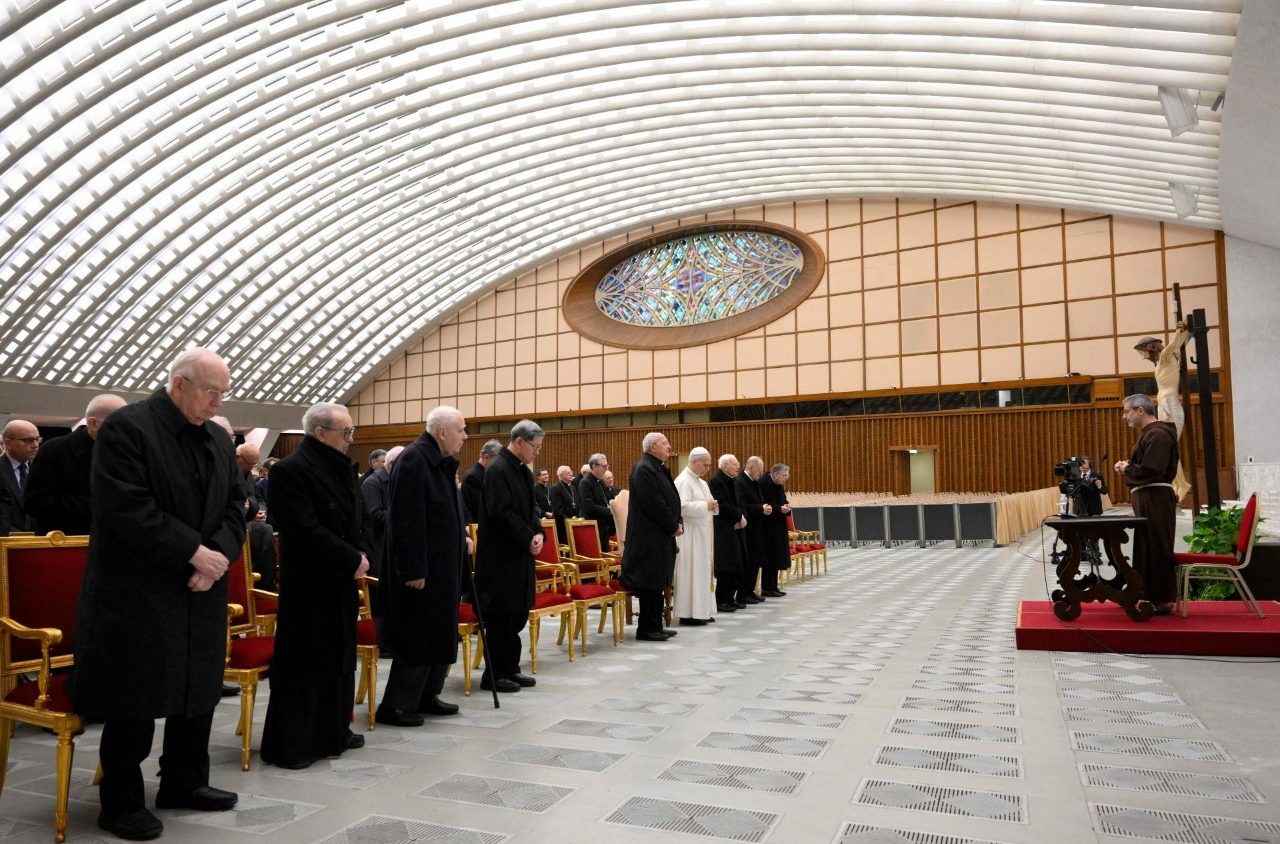
Fr. Roberto Pasolini, the Preacher of the Papal Household, gives his first Lenten meditation, with Pope Leo XIV in attendance, reflecting on the importance of humility as part of our ongoing conversion.
By Benedetta Capelli
On March 6, Fr. Roberto Pasolini, the Preacher of the Papal Household, gave the first of his Lenten Sermons, which will take place every Friday until March 27 in the Paul VI Audience Hall, with Pope Leo XIV present.
The series is centered around the theme: “If anyone is in Christ, they are a new creation (2 Cor 5:17). Conversion to the Gospel according to Saint Francis.”
This first meditation’s topic was “Conversion: Following the Lord Jesus on the Path of Humility.” The Capuchin friar recounted how “in days marked once again by pain and violence, talking about smallness might seem like an abstract, almost spiritual luxury. In reality, it is a concrete responsibility, tied to the fate of the world.”
Peace, he explained, is not only born from political agreements or diplomatic or military strategies, but from men and women who find the courage to be small. This happens when people step back, renounce violence in all its forms, refuse to give in to the temptation of revenge and dominance, and choose dialogue even when circumstances seem to deny its possibility.
Awakening of the image of God
Fr. Pasolini called it “a demanding and daily task,” one that concerns everyone who sees themselves as children of God and knows that “this conversion of the heart” is their responsibility.

Pope Leo listens to the meditation by the Capuchin friar (@Vatican Media)
Introducing his reflection—related to the life of St. Francis—Fr. Pasolini described him as “a man consumed by the fire of the Gospel, able to reignite in each person the longing for a new life in the Spirit.”
But what exactly does “conversion” mean? The question is only a “starting point” because there is a risk of “building on fragile foundations,” he said.
“Evangelical conversion,” the preacher said, “is primarily an initiative of God, to which man is called to participate with all his freedom.” It happens “at the deepest point of our nature, where the image of God imprinted in us waits to be awakened.”
The response to grace
St. Francis speaks of “doing penance” when he enters the path of conversion. He refers to a “change of sensitivity,” a way of seeing others with mercy and through the light of the Gospel, sweeping away “the bitterness of a life full of many things but still empty of its essential value.”
Doing penance marks the beginning of a fight to defend the “new taste of things,” while faithfully nourishing the seed that God has placed in each person’s heart.
Conversion is no longer the attempt to straighten life out with one’s own strength, but a response to a grace that has redefined the parameters of our way of perceiving, judging, and desiring.
Recognizing sin
Conversion is connected to “the depth of the furrow that sin has carved in us,” the Capuchin friar explained, but sin is a word that today seems to have disappeared.
“In common consciousness—and sometimes even in the life of the Church—everything is explained as fragility, wound, limit, conditioning. When sin is discussed, it is often reduced to a small mistake or weakness.” If we limit ourselves to this, he said, we lose “the greatness of human freedom and responsibility.”

Fr. Roberto Pasolini is the preacher of the Papal Household and a Capuchin friar (@Vatican Media)
If there is no longer the possibility of true evil, we cannot believe in the possibility of true good. If sin disappears, holiness too becomes an abstract and incomprehensible destiny.
In sin, man recognizes that “his freedom is real and that with it he can build and destroy: himself, others, the world.” A “deep healing” is therefore necessary to recover a relationship with God—repeatedly choosing to live in love and freedom, even enduring hardships that are not “sterile” but are expressions of “fidelity by those who have already glimpsed the meaning and value of what they live.”
Returning to humility
St. Francis is seen as the saint of poverty. But it is also impossible to separate him from humility. Both spring from the mystery of the Incarnation. They are the very traits of God that man is invited to live in order to resemble Him.
“Humility,” Fr. Pasolini highlighted, “is a path that every baptized person is called to walk if they want to fully embrace the grace of life in Christ.” It is “a way of inhabiting the world and relationships” to reduce the “inflated image we have of ourselves” and to return to truth. He called it “a gift of the Spirit before it is an ascetic exercise.”
However, humility does not impoverish man. Rather, it returns him to himself. It does not lessen him, but restores him to his true greatness. For this reason, it is so closely linked to conversion. Original sin arises precisely from a rejection of humility: from not wanting to accept ourselves as human beings, finite and dependent on God. Conversion, then, must also be understood as a return to humility.
The face of the new man
The greatness of man, the preacher explained, comes through his smallness. The saint of Assisi—by embracing the smallest—understood that this is “the privileged place” chosen by the Lord. “In them manifests that ‘power’ spoken of in the Gospel, the power to become children of God.”
A child who is not ashamed to ask the Father for things experiences “a special strength: the ability to inspire good in others.” “The small, with their fragility, awaken mercy,” Fr. Pasolini continued, “which is perhaps the most precious energy in the world.” It is a radical openness that requires the hospitality of the other; “to become small is an essential dimension of being Christian.”
When we choose to become—not remain—small because we have recognized God’s smallness and have felt welcomed and loved by Him, then this choice is not a form of regression or renunciation. It is the face of the new man that Baptism restores to us.
Constant conversion
The final step is to recognize that conversion never ends. We remain sinners, always asking to be sanctified by the Spirit. “To convert means to continually begin this movement of the heart, through which our poverty opens up to God’s grace,” even in our reluctance to diminish our self-image, by doing ongoing inner work that places us “at service, freely and concretely.”
Fr. Pasolini recalled St. Paul, who understood that “weakness is not a phase to overcome but the very form of his life in Christ,” “the form of baptismal life.”
However, we often think that evangelical smallness is only possible when everything is going well. In reality, the opposite is true. It is precisely in conflicts and difficulties that this littleness is even more necessary. When the instinct is to defend oneself or impose oneself, that is where we see if we have truly learned the Gospel of the cross. Light, in fact, shows its strength not when everything is clear, but when darkness reigns.
The meditation ended with a prayer from St. Francis and an invocation to “follow in the footsteps of Your beloved Son, our Lord Jesus Christ.”
