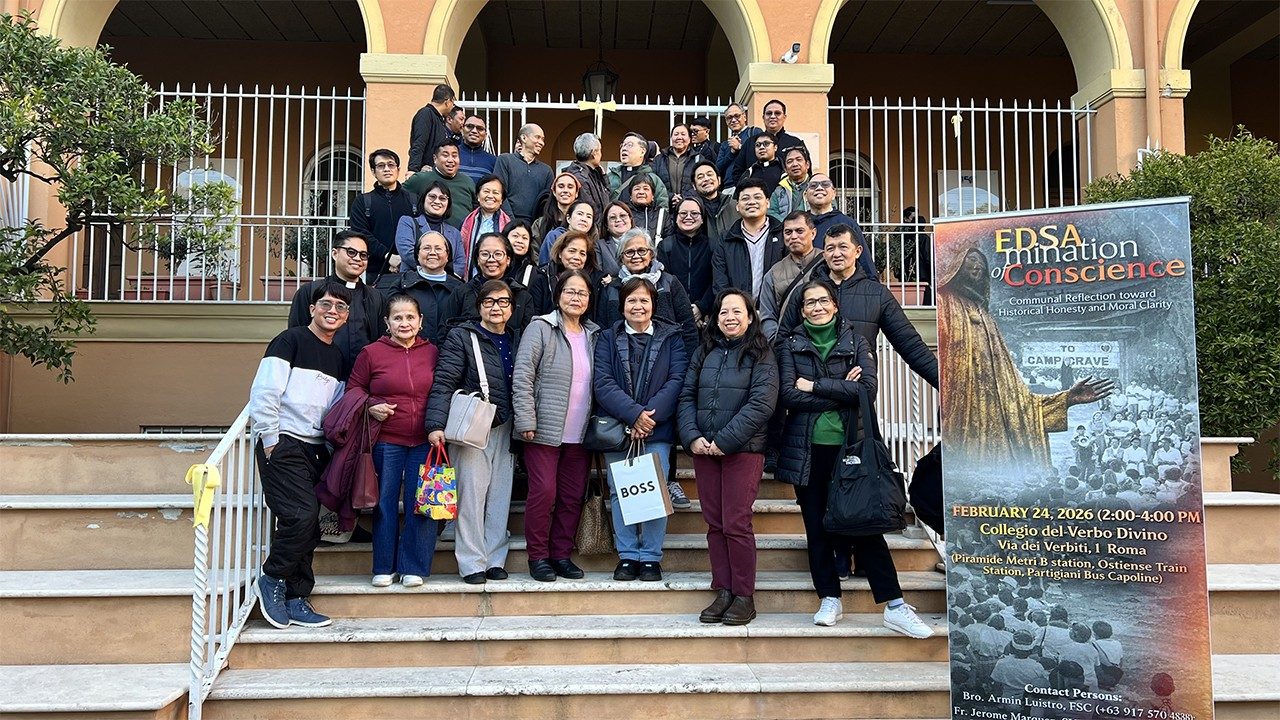

Filipino clergy, religious, and lay faithful residing in Rome gather to remember EDSA People Power as a moment of courage, unity, and moral clarity.
By Fr. Mark Robin Destura, RCJ
On February 25, Filipinos around the world commemorated the 40th anniversary of the EDSA People Power Revolution, recalling the peaceful uprising that ended two decades of dictatorship in the Philippines in 1986.
The unarmed resistance, inspired by the call of the late Cardinal Jaime Sin, brought thousands of Filipinos to Epifanio de los Santos Avenue (EDSA) in Manila. Priests, religious, and lay faithful stood alongside ordinary citizens in front of tanks and soldiers, bearing witness to the power of faith, conscience, and nonviolence.
The event remains a defining moment in Philippine history and a powerful example of the Church’s moral leadership in times of crisis.
Remembering EDSA People Power in Rome
This year, Filipino priests, religious, students, and overseas workers in Rome marked the anniversary through a communal gathering for reflection and dialogue.
On February 24, they gathered at the Collegio del Verbo Divino for a program entitled: “EDSAmination of Conscience: Communal Reflection about Historical Honesty and Moral Clarity.”
The event was spearheaded by Br. Armin Luistro, FSC, Fr. Jerome Marquez, SVD, and Fr. Albert Alejo, SJ.
Participants reflected on the meaning of EDSA in today’s social and political context and shared personal memories and insights.
Call to unity and conscience
In his opening remarks, Fr. Jerome Marquez reminded participants of the enduring relevance of People Power.
“We are here in Rome, far from our country in the Philippines, but our hearts are very close to our country,” he said.
“EDSA is not only a part of our history, it is a part of our consensus as Filipinos,” he said. “This is not a romantic look back on history. This afternoon, we will travel together, listen, examine, and judge ourselves and our souls as a Filipino community.”
Reflecting on present divisions, he noted: “After 40 years, we are still separated by our differences… The country is still divided in understanding justice, human rights, and who will answer.”
He invited participants to see the gathering as a space “of courage, of justice, of truth, and of our love for our country.”
Personal testimonies of courage
Several participants shared firsthand experiences of the 1986 revolution.
One religious nun recalled how her family responded to the call of Cardinal Sin: “What gave us courage to go was what my father told us… ‘You go, the Cardinal is calling for the people to go there.'” She described witnessing helicopters hovering above EDSA and the fear of possible attacks, yet choosing to remain.
Another priest, then a student, shared: “We were praying the rosary behind the tank… We were trying to protect June Keithley, who was really announcing what’s going on day and night.”
He added: “We united together as one Filipino so that we could put down the dictatorship.”
From Mindanao, another priest recalled organizing peaceful marches and confronting armed soldiers: “No one will throw a single bottle…we sang ‘My Country’, in front of the military.”
Reflecting on the Church’s role, he said: “During the time, the Church was really, really in the front… There was moral clarity, where to position ourselves.”
Voices from reflection groups
During the group-sharing sessions, participants expressed both gratitude and concern about the legacy of EDSA People Power.
One reflection group shared: “What is clear for us is first, the joy and kindness that is clearly present in the experience of EDSA… even if you’re a stranger, you help one another.”
They also raised questions about the Church’s role today: “With all this revisionism, distortion, how would we practice our prophetic role as a Church?”
Another participant reflected: “It is clear that EDSA changed our life. And our lives are continuously being changed, as Filipinos and as Catholics, by EDSA.”
Yet, they acknowledged continuing challenges: “There is still a lack of education… about what the true meaning of EDSA is.”
Others emphasized nonviolence and unity: “With nonviolence, change can be possible. There can be a change even if we don’t use force.”
“At the end of the day, it’s Christ who will unite us, not our political ideas.”
Renewing the spirit of People Power
As the gathering concluded, participants affirmed that remembering EDSA is not only about honoring the past, but about shaping the future.
One group summarized: “EDSA people power has evoked a lot of good memories… It has been a source of hope… and brought out the best Filipino version of ourselves.”
At the same time, they recognized ongoing responsibilities: “How can we preserve the truth, unity, how can we protect and restore justice… How can we become a Church?”
Through prayer, dialogue, and shared memory, the Filipino community in Rome renewed its commitment to truth, justice, and solidarity.
Four decades after EDSA, their gathering affirmed that People Power remains a living call to choose conscience over fear, unity over division, and faith over indifference.
