
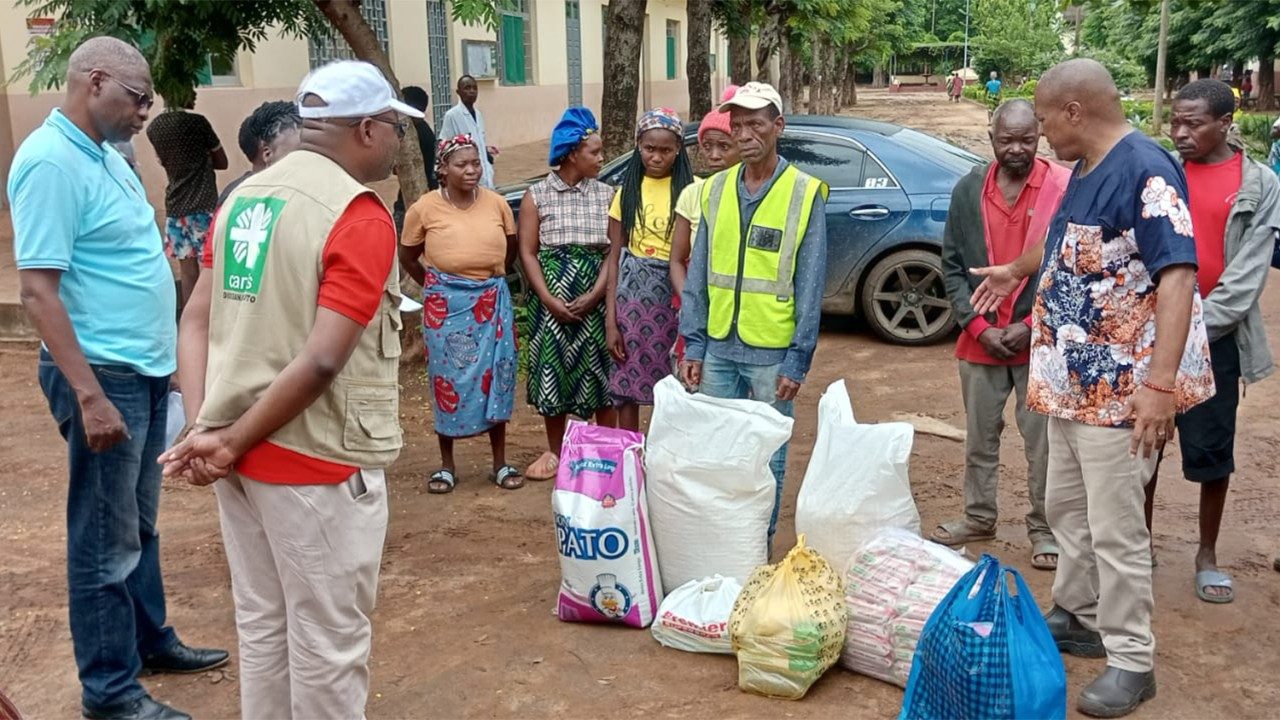
A just-released Caritas Europa report calls for a structural shift to place local actors at the heart of humanitarian action. At a time when humanitarian funding is shrinking, the report argues that locally-led action, which is rooted in social cohesion, must be protected and strengthened for the common good.
By Linda Bordoni
A new report by Caritas Europa urges a fundamental rebalancing of power within the humanitarian system, calling for local actors to move from the margins of decision-making to positions of genuine leadership.
The report, launched on Monday 2 March, is entitled “Advancing local leadership in humanitarian action: “Tracking progress, challenges and opportunities” builds on a 2023 report which exposed the gap between global promises and the reality on the ground of local humanitarian organisations.
Speaking to Vatican News, Abriel Schieffelers, Caritas Europa Humanitarian Advocacy Officer, pointed out that despite years of commitments to localisation, progress remains uneven.
“We’re still seeing a reliance on short-term, project-based grants, where local organisations are primarily seen as implementers rather than leaders,” she said. “There is still a tendency not to co-create programmes and not to put local organisations in decision-making positions.”

Caritas Polska in Ukraine
A “lived reality” of local leadership
At the official launch of the report earlier in the day, Caritas Europa President, Monsignor Michael Landau, stressed that local leadership is intrinsic to the Church’s social mission.
“For us, local leadership is not an aspiration; it is a lived reality where the human person and their intrinsic dignity should be front and centre,” he said.
Yet, he acknowledged, across the broader humanitarian system this principle is “still too often not fully recognised, not adequately resourced, and not sufficiently trusted.”
The report comes at what Landau described as a “particularly difficult moment” for humanitarian actors. Widespread funding cuts – including reductions initiated by USAID and followed by several European donors – have had far-reaching consequences.
“The analysis shows that local and national actors are often bearing the heaviest burden,” he said.
“When funding shrinks, partnerships risk becoming more transactional, risks are pushed downward, and local organisations are expected to deliver more with fewer resources and less influence. This is not only unjust; it is unsustainable.”
Bearing the brunt of funding cuts
In the interview, Schieffelers noted that local organisations are “bearing the brunt of the humanitarian funding contraction” that began about a year ago.
“This is leaving local organisations really vulnerable as resources are shrinking,” she explained, pointing to increased competition and heightened risks for national actors compared to international organisations, particularly regarding organisational sustainability.
Risk-sharing and the equitable distribution of overhead costs remain key gaps.
“When it comes to sharing of overhead costs, sharing of risks, those are some key aspects that are not there yet in terms of local leadership,” she said.

The Caritas Baby Hospital in Bethlehem
Beyond cost efficiency: justice and self-determination
While localisation is often framed in terms of cost efficiency, Caritas argues that the issue is more fundamental.
“Sometimes local leadership is framed very much in this cost efficiency and effectiveness argument,” Schieffelers observed, “But what we really want to promote as Caritas is that it’s much more foundational. It’s rooted in justice and self-determination and really local ownership.”
Ensuring that those affected by crises participate in decisions that shape their lives, she said, is not simply a technical reform but a matter of principle. Financial flows should follow leadership shifts, and while this may prove cost-effective, that is not the primary motivation.
Two-way accountability and structural reform
Among the concrete changes proposed in the report is the development of two-way accountability mechanisms.
“We wanted to illustrate the importance of partners being in the lead of capacity assessments and discussions around redefining the role of international organisations,” she said. In this model, international actors would take on a supportive rather than dominant leadership role.
Local organisations consistently reported that decision-making power remains unequal, often describing partnerships as hierarchical or transactional. “Shifting that power element is so fundamental and goes far beyond even the funding shifts,” she added.
Looking ahead, Caritas calls for protecting recent gains while addressing systemic barriers that hinder progress. Pilot initiatives and innovative models already exist, but scaling them, she explains, will be essential.
This includes embedding risk-sharing practices, fostering long-term partnerships instead of short-term project cycles, and aligning donor policies with accountability frameworks that promote structural reform, and “the sector can really work towards that transformative approach.”
The Pope’s appeals and the political dimension of crises
Commenting on the impact of the Pope’s repeated appeals not to forget neglected crises and wars, Abriel Schieffelers said they carry significant weight.
“We know so often it is a political decision when crises are not only forgotten but neglected,” she said. Humanitarian assistance alone is insufficient in protracted crises; diplomatic engagement and peacebuilding efforts are also required.
In this context, she highlighted the precious role of local organisations, particularly faith-based actors, in strengthening social cohesion at the community level.
Monsignor Landau, she recalled, echoed this perspective at the launch, underscoring that the Caritas approach is rooted in solidarity and subsidiarity, principles that call for decisions to be taken as closely as possible to those affected.

A Caritas development project in Cape Verde
