
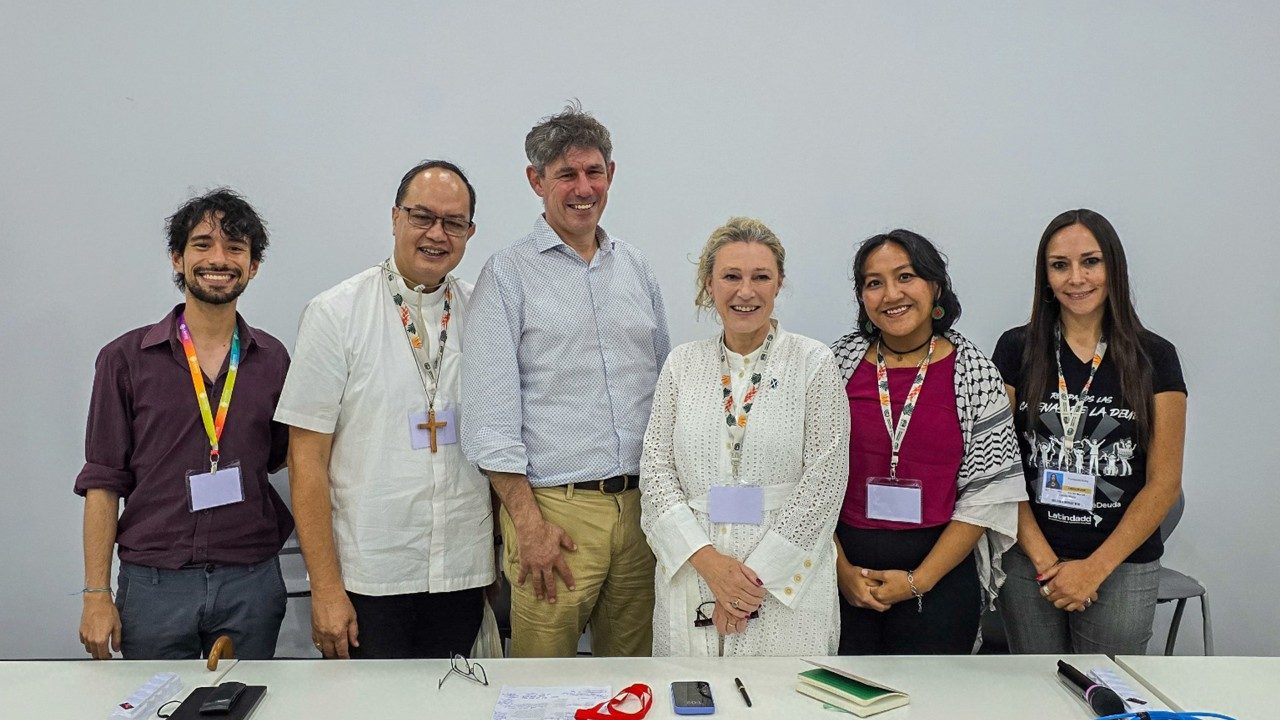

Caritas representatives from over forty countries are in Brazil for COP30, urging world leaders to place human lives above political interests as the climate crisis deepens from the Philippines to the Sahel.
By Francesca Merlo
Caritas Internationalis is on the forefront of the most horrific human rights catastrophes all across the globe. It truly is everywhere. COP30 in Brazil is no exception, where Caritas representatives from over forty countries are bringing the voice of the people they serve to the global stage.
Caritas’ worldwide presence was made evident during their panel at COP, in which representatives and guests spoke about the horrific typhoons striking the Philippines, and in which they placed survivors and frontline responders at the centre of the conversation.
This was also reflected, when, at the conclusion of a meeting with the three cardinals of the Global South – who presented a document urging negotiators to place human lives, rather than political interests, at the heart of the COP30 process – Alistair Dutton, Secretary-General of Caritas Internationalis invited everyone to sign a petition he had just handed over to the UNFCCC secretariat that heads COP (the UNFCCC being the climate change body of the UN) with 200,000 signatures on it from 200 organisations globally who’ve signed it. That petition, he told Vatican News “has some very specific recommendations that we have to we have to act on quickly if we’re to allow people to escape the debt crisis they’re facing”.
This COP, like others before it, is dominated by the question of finance. Pope Leo, and Pope Francis before him, have repeatedly called for the countries of the Global North to consider releasing those of the Global South from crippling debt – a plea that Dutton echoes at a time in which the timeline to meet the Paris Agreement targets has dwindled to nearly nothing; meanwhile, aid budgets are being slashed, even as the effects of climate change worsen.
“More than 50 countries spend more on debt repayments each year than on health, education, and public services combined,” he says. “They are pouring money out of their own countries instead of being able to spend it on their own people.”
From debt to displacement, the consequences of climate change appear in different forms across the globe, but they share one heartbreaking thread: they strike first – and hardest – those who have done the least to cause them. Dutton speaks of three simultaneous super cyclones in the Philippines; of videos arriving daily from Jamaica, where Caritas teams deliver aid in darkness because electricity has failed; of devastating food crises across the Sahel, Malawi, and Zambia; of Pacific islands like Kiribati, where only the stumps of former homes remain as the sea advances.
“I don’t think there is a country in the world anymore that isn’t facing dramatic weather conditions,” he says.
And as we look at the victims of climate change, we cannot help but think of the victims of conflict. “Climate change and conflict are intrinsically linked,” Dutton explains. As resources become scarcer, competition grows: between herders and farmers, between communities sharing river basins, even between nations. The example of Ethiopia and Egypt struggling over water rights is only one among many.
“It often begins with a changing circumstance: when land becomes inhospitable, when people are forced to move,” he says. “And with movement comes friction, and with friction, conflict.”
Yet even as he describes these overwhelming crises, Dutton turns again to the theme chosen for this Jubilee Year: hope. It is not naïve optimism, he stresses, but a determined, stubborn hope, rooted in the countless small actions carried out daily by Caritas teams worldwide.
“With all of the news we hear, it is very easy to become overwhelmed,” he admits. “But we have to hold on to those glimmers of hope – the actions moving in the right direction, the opportunities, the concrete work happening every day to help people adapt despite the odds.”
Caritas, along with other Catholic organisations, tries “to bring that moral teaching, that moral voice, into the room,” he explains. “To appeal to the hearts of people, so that they do what we already know in our heads we need to do.”
But alongside the moral dimension lies the undeniable weight of numbers: 1.4 billion Catholics, and – more broadly – 85% of the world belonging to a faith tradition. For Dutton, this is not about religious influence but about reminding leaders that their decisions must reflect the values and realities of the vast majority of humanity. “Whichever faith you come from,” he notes, “we all arrive at largely the same conclusions. It’s important that the voice of faith – Catholic, yes, but alongside many others – is present, saying: this matters to all of us.”
That is why, Dutton stresses, today’s negotiations must be pulled away from narrow national interests and centred again on people – especially those most vulnerable. “We need an economy that serves people,” he insists, “not people serving the economy.”
Hope, he says, is a choice. And it is one the Church must continue to make, loudly and relentlessly.
“We cannot grow in despair,” he concludes. “We must keep pushing for a better world. Because it is possible.”
