
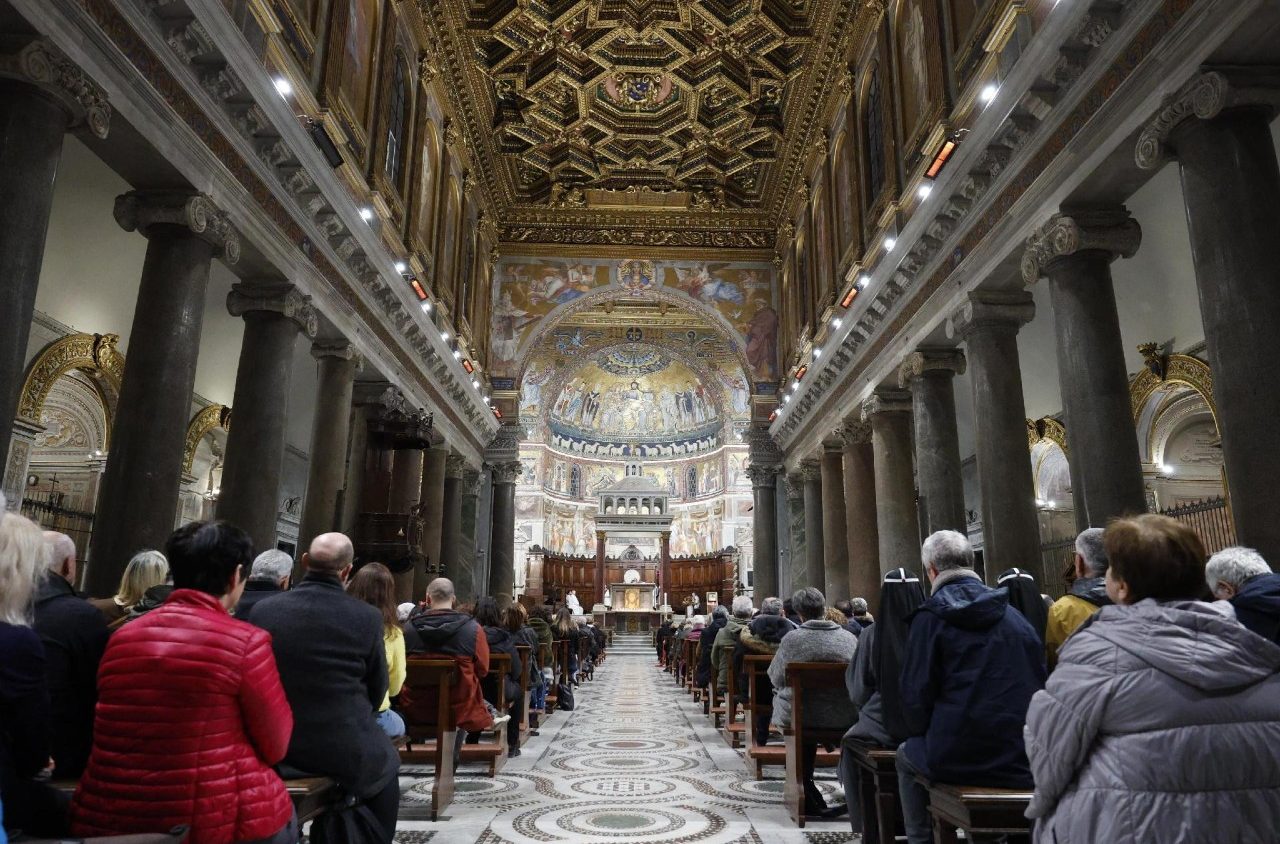

Cardinal Matteo Maria Zuppi, president of the Italian Bishops’ Conference, presides at a prayer vigil in Rome organized by the Community of St. Egidio to mark the fourth anniversary of the beginning of the war in Ukraine.
By Guglielmo Gallone
“How can we pray always without growing weary?” Cardinal Matteo Maria Zuppi asked, during a prayer vigil for peace in Ukraine, organized by the Community of Sant’Egidio. The liturgy was held on February 24, 2026, the fourth anniversary of the full Russian invasion of the country, at the Basilica of Santa Maria in Trastevere in Rome.
In an age in which we are not accustomed to waiting, prayer continues to demand perseverance, the president of the Italian Bishops’ Conference observed. He explained that prayer asks us not to give up and not to be overcome by habit and resignation, because ultimately it too is a form of rebellion: against evil, against war, against the “globalization of indifference” that makes acceptable what should never be so.
“The Church asks only that the weapons fall silent”
“The Church, as Pope Leo XIV has said, asks only that the weapons fall silent, that a ceasefire be reached, and that a path toward peace be opened,” Cardinal Zuppi said.
These “four years of commemoration are painful and shameful for all humanity,” as Pope Francis had said about the third anniversary, and the President of the Italian Bishops’ Conference added, “the shame has increased today.”
Conflicts, he reiterated, “are not resolved with weapons but through dialogue. And they can be resolved: this conviction requires everyone’s effort, and above all of Europe.”
For this to happen, however, it is important to recover a social and communal sense of acting together for a shared goal because, Cardinal Zuppi emphasized, “the only victory we must all seek is the Easter of peace.”
This victory comes through perseverance in prayer, he continued, capable of “making us hear that cry” and “freeing us from weariness.”
The commitment of the Community of Sant’Egidio
In this regard, the growing solidarity of the Community of Sant’Egidio toward Ukraine is fundamental. The Community has been present in the country since 1991, which allowed it to set up an extensive humanitarian aid network as soon as the Russian invasion began.
Today Sant’Egidio has five centers for internally displaced persons—3 in Kyiv, 1 in Lviv, and 1 in Ivano-Frankivsk—along with distributions in regions near the front line, particularly in Kramatorsk, Nikopol, Kharkiv, and Sumy.
Since the beginning of the conflict to today, 213 shipments have been sent, totaling 4,450 tons of humanitarian aid: 750,000 people have received food, clothing, and hygiene products, while 2 million have benefited from medical assistance. These figures tell the story of an ongoing commitment that has grown over time as the war continues.
Ukraine, martyred by war
Recalling the Community’s commitment in Ukraine, Cardinal Zuppi spoke of “security, a light of hope, warmth.” He mentioned Nadia, displaced from the Donbas and now a refugee in Kyiv, who understood—thanks to the role of the Community of Sant’Egidio—that “the priority in each of our lives is the life of others.”
“The world is dying from a lack of love,” Cardinal Zuppi concluded.
“It is dying from human hatred. Let us not stop imploring the Almighty to send down from heaven abundant and warm rains of His holy grace. Each of us can be a drop of that warm rain of His holy grace. And each of us can fight the lack of love with our own love.”
