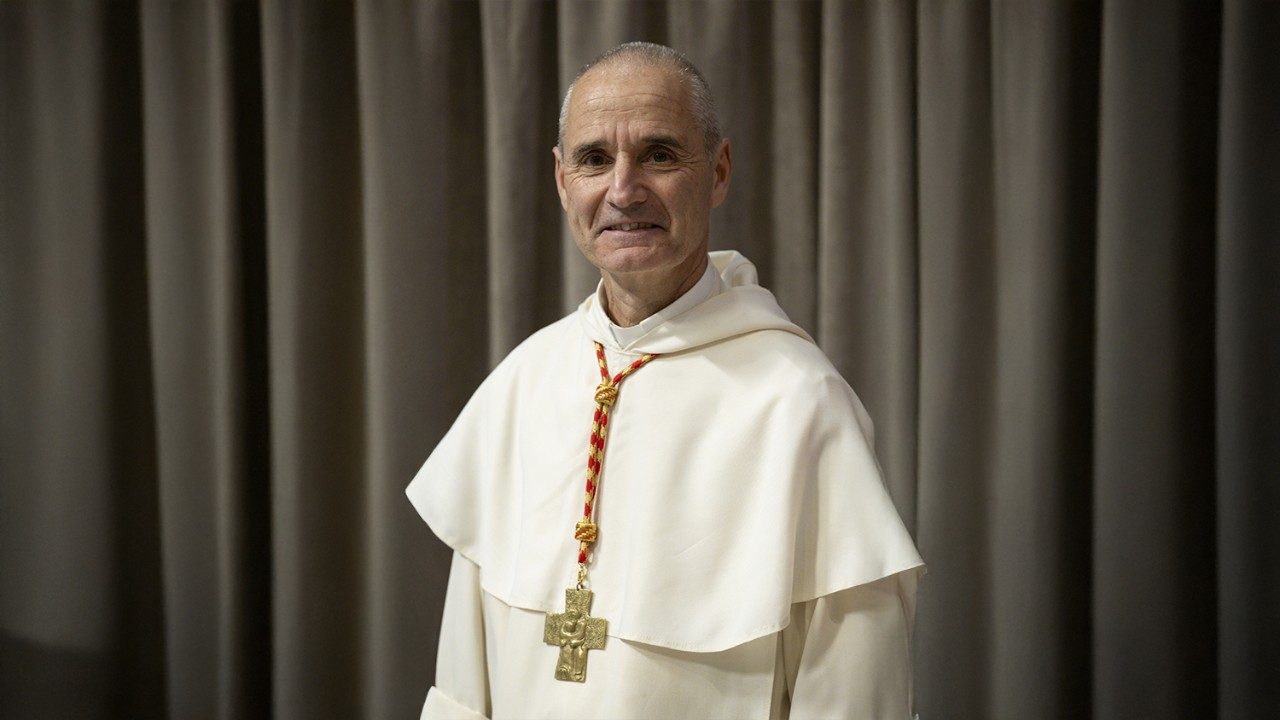
Cardinal Jean-Paul Vesco, Archbishop of Algiers, speaks to Vatican News following the official announcement of Pope Leo XIV’s journey to Algeria in April.
By Jean-Charles Putzolu
Appointed Archbishop of Algiers in 2021 by Pope Francis, after spending nine years leading the Diocese of Oran, Cardinal Jean-Paul Vesco will welcome Pope Leo XIV to Algeria on April 13, during the first stop of his journey to four African countries.
In an interview with Vatican News, the Dominican cardinal reflected on the joy that this visit brings to a long-suffering country. It’s a visit with strong symbolic significance, as the Pope will be walking in the footsteps of Saint Augustine, and also of the Algerian martyrs, Pierre Claverie and the monks of Tibhirine.
Vatican News: How did you react to the news of the Pope’s upcoming visit?
Cardinal Jean-Paul Vesco: This is news we had been hoping for. We had long wished for him to come. We had invited Pope Francis several times, and Pope Leo accepted immediately. What is beautiful is that this is one of his very first trips; he included it in his agenda from the very beginning.
I think this is a very beautiful sign of openness on the part of the Pope, the authorities, and everyone. And we need that. After [his visit to] Türkiye, a Muslim country, Lebanon, a country with a strong Muslim majority, here is the third country: Algeria.
This says something about the Pope Leo XIV’s pontificate. It shows that in this regard he truly follows the dynamic of his predecessor, Pope Francis, and indeed of all his predecessors. It says something beautiful about the Church. It was also the case with Pope Benedict and with Pope John Paul II.
Q: There is a strong symbolism attached to this trip, because the Pope will be visiting sites associated with St Augustine …
A: There is a great deal of symbolism in this journey. That will be the whole question. One the one hand, it’s a simple trip—the Christian community is small—but he will be walking in the footsteps of St. Augustine. He has already come twice as Superior General of the Augustinian Order, but now he comes as Pope.
Who could have imagined in 430 when St. Augustine was ill – about to die, with the Vandals at the gates and the city of Hippo about to be taken and sacked – that 16 centuries later a Pope inspired by him would come to this city of Hippo, today Annaba? It is still a phenomenal source of hope in the long term.
Then there are also the 19 Blessed of Algeria. Pope Leo XIV was elected on the day of their liturgical feast—I pointed that out to him when I told him we were waiting for him in Algeria. Of course, for him it has meaning, because the monks of Tibhirine, Christian de Chergé, all of that has meaning.
In his January 1 message for the World Day of Peace, he quoted a phrase by Christian de Chergé, the prior of the monks of Tibhirine: “Lord, disarm him, disarm me, disarm us.” That was the phrase he repeated.
It also has meaning because Algeria stands at a crossroads, along fault lines, as Bishop Pierre Claverie used to say. Algeria is also a meeting point between North and South. We are truly there, between North and South, with all the questions regarding migration. We are between the Western world and the Arab-Muslim world. It is the point of contact. We are at the gateway to Africa. And it is beautiful that this stop opens the first journey to Africa.
North Africa is a gateway to the entire continent. All of this has meaning. There will be a meeting with the Christian community and its friends at the Church of Notre-Dame d’Afrique. It was from there that the White Fathers and White Sisters set out. This is also the starting point from which the Gospel spread to Africa; it was one of the gateways for its dissemination. There will be many simple symbols, and then simply the human encounter, fraternity.
It is a sign of recognition toward our Church, which seeks to remain connected with the Algerian people, Christians and Muslims alike. I think this journey will be marked by fraternity.
Q: You spoke about continuity with previous pontificates. We see a line very close to that of Pope Francis. In Algeria, we are in the Mediterreanean, and we know how important this region was for Pope Francis. Is Pope Leo XIV on the same path?
A: Yes, absolutely. It is indeed the Mediterranean. By continuing to deepen this path, something will happen. Mediterranean civilization is a richness. The Mediterranean Sea, Mare Nostrum, is not meant to be a border.
Yet today it is a border; it has also become a cemetery. It is not meant for that. All around the Mediterranean we see the same fauna, the same flora, the same cultures. In the same way, whether Muslim or Christian, there is a similar form of popular spirituality, of popular religiosity. As soon as one moves a little north, south, east, or west, everything changes very quickly within just a few dozen kilometers. But the Mediterranean itself forms a whole. It is a culture that blends with others and is gentle. And the Pope’s next trip, to Monaco, will again be on the Mediterranean rim.
After Africa, the Pope will go to Barcelona and Madrid, where there will be a meeting of the bishops of the Mediterranean. Indeed, in this respect too, Pope Leo follows in the footsteps of Pope Francis.
Q: The Church in Algeria is also a Church of martyrs; it paid with its blood for its determination to continue proclaiming the Gospel. In this context, can interreligious dialogue still fully take its place in this country?
A: It is a dialogue of life. We need interreligious dialogue. Fundamentally, what we thirst for and what the world needs is a dialogue of life. It’s about people meeting each other, and religious differences can only be a plus. If it becomes a barrier, it only has the importance we give it. Today, our Church paid the price of blood for its desire to remain with the population, with the people to whom it was sent when they were in difficulty.
And the people of Algeria were martyred—indeed during this dark decade, during the War of Liberation. It is a martyred people, that is true. And it is also a resilient people.
Our Church is the same; it has gone through trials and is resilient. Indeed, the lives of 19 people were taken. But the beatification of these 19 was the testimony of a Church that remained faithful and took risks for that reason. That is why this witness is still alive today. Let us remain with one another in times of trial; let us remain united. It is a beautiful witness for today, of which I am extremely proud.
