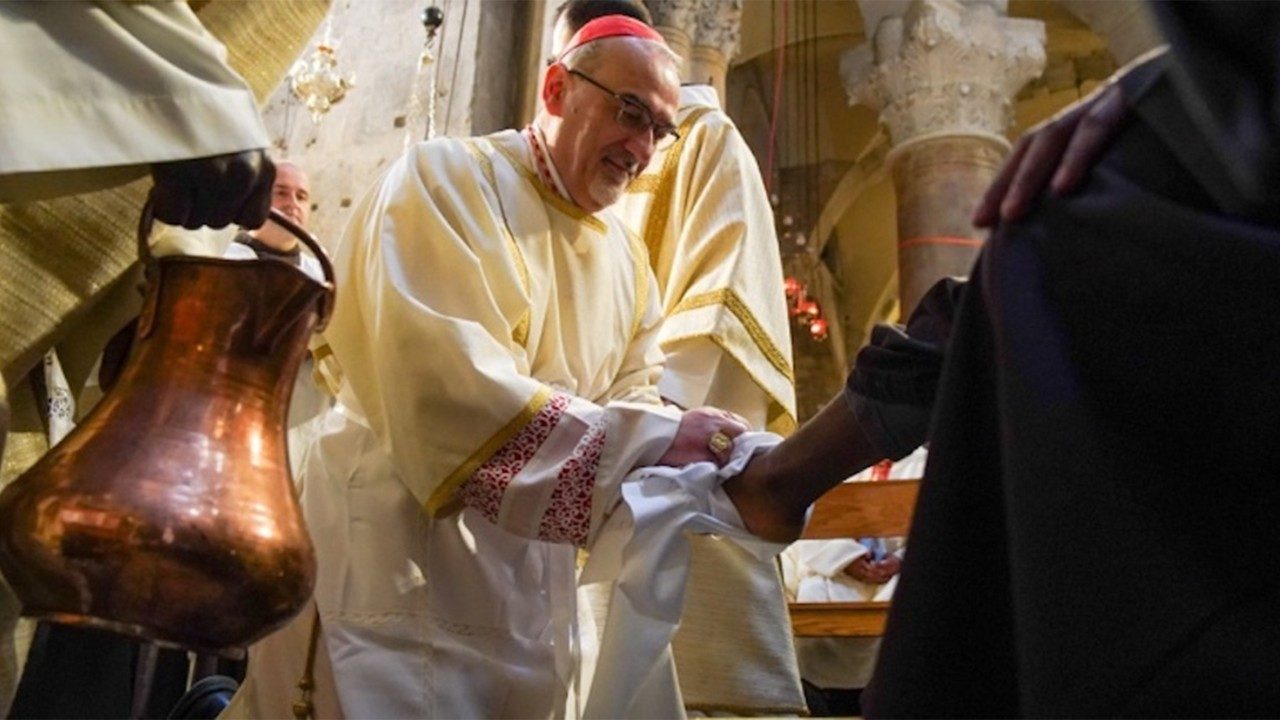
The Latin Patriarch of Jerusalem, Cardinal Pierbattista Pizzaballa, presides over the In Coena Domini Mass behind closed doors in the Church of the Holy Sepulchre in Jerusalem. He says that at a time marked by tensions that cannot be ignored, “we are here as within a womb of peace, while around us the world is torn apart, and we wish we could change all of this.”
Vatican News
In a context marked by war and restrictions, on Holy Thursday morning, the Latin Patriarch of Jerusalem, Cardinal Pierbattista Pizzaballa, presided behind closed doors at the Mass in Coena Domini in the Church of the Holy Sepulchre in Jerusalem.
In his homily, the Cardinal said, “We are in the place where a stone once sealed death. And yet today we are here to celebrate life.”
He reflected on the atmosphere surrounding this particular historical moment in the Middle East, saying, “There is a tension we cannot ignore: outside, the doors of the Holy Sepulchre are closed. War has turned this place into a refuge, an ‘inside’ cut off from an ‘outside’ weighed down by fear and strain. We are here as within a womb of peace, while the world around us is being torn apart, and we wish we could change all of this.”
A Church put to the test standing beside Christ
And never straying from this context, the Cardinal pointed to the gesture of the washing of the feet as the heart of the Christian Passover.
“Jesus,” he said, “transforms the gesture of one who sets out into the gesture of one who serves. In God’s logic, the Exodus is not a flight away from the world, but a descent into the world, all the way to its depths. The girded loins of Jesus are no longer the sign of one fleeing from slavery, but of one who freely makes himself a slave out of love. ”
For this reason, he continued, “the washing of the feet is not a moral lesson, nor simply an edifying example, nor a tender scene. It is the concrete form of Jesus’ Passover. It is the way God passes through history. It is the way love chooses to enter the world.”
Recalling the dialogue between Jesus and Peter proclaimed in the readings – “Unless I wash you, you will have no part with me” – the Cardinal highlighted the radical nature of Gospel love. These words, he explained, do not indicate mere belonging, but deep communion: “You may admire me, you may follow me… but if you do not accept this way of loving, you will not enter into my passage.”
From this follows the invitation to allow oneself to be loved by Christ without resistance. In the present context of the Holy Land, marked by violence and fear, it may not be possible to “change the great movements of history,” but it is possible to “decide whether to stand with Christ in His way of being within history: not above it, not against it, but alongside it.”
For the local Catholic Church, “often a weary Church, a Church put to the test, at times tempted to defend itself rather than to give itself,” this means embracing the logic of service: “the Lord does not ask us to be powerful, but to share in his life. He does not ask us to resolve everything, but not to reject his way of loving. For the Church shares in Christ not when it is secure, but when it accepts to share in his self-lowering.”
“To have a part with him, for us who live and bear witness to the Gospel in this land, means learning the language of humility, the language of bending down.”
Holy Land wounded by war
The Cardinal concluded with a question addressed to the whole community: “Do we want to have a part with Him? (…) Do we want to enter into a love that humbles itself? Do we want a salvation that comes through service?”
Such a choice becomes a new exodus: “a passage from self-defence to self-giving, from fear to trust, from pride to communion.”
In a Holy Land wounded by war, Easter, he said, begins by allowing ourselves to be loved and by learning to bend down before others.
“Today,” the Patriarch concluded, “as we celebrate the Eucharist, let us ask for an essential grace: to allow ourselves to be washed, to allow ourselves to be served, to allow ourselves to be loved without conditions. For only in this way can we truly have a part in his life. And only in this way will our lives, little by little, take on the form of his Passover.”
