
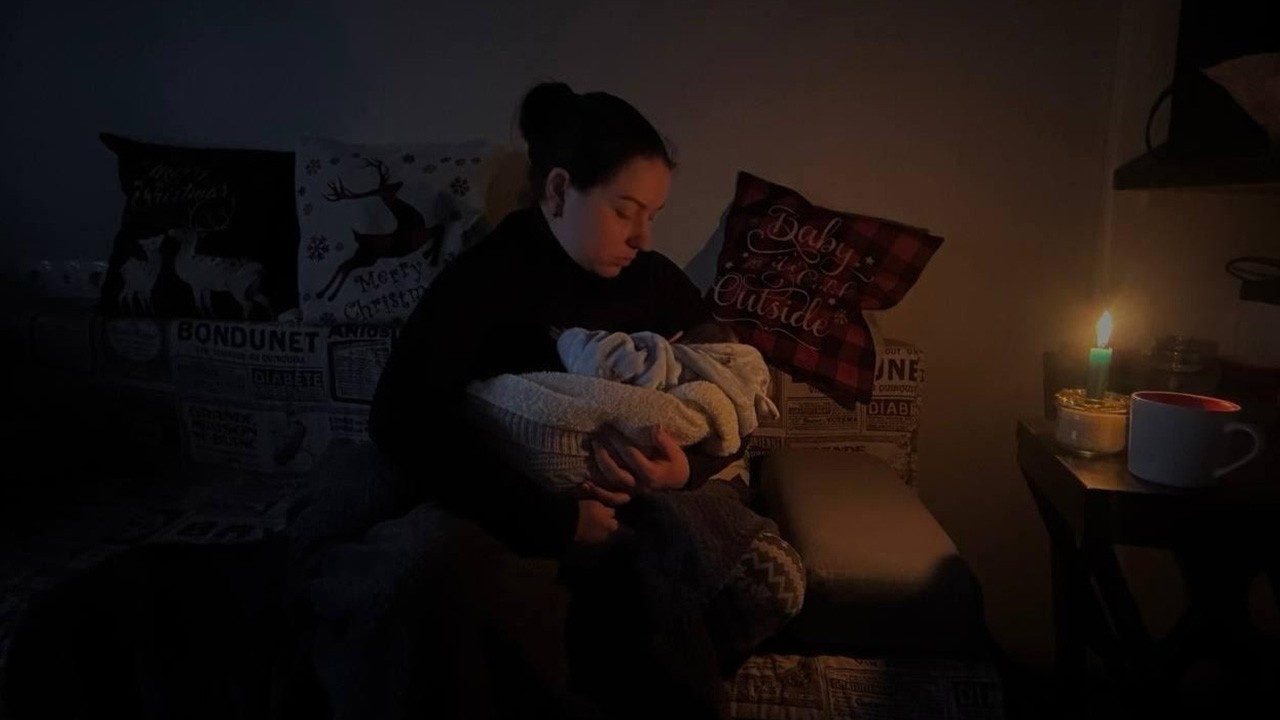
As the humanitarian crisis in Ukraine worsens, Cardinal Konrad Krajewski, Prefect of the Dicastery for the Service of Charity, launches a forceful appeal to support fundraising efforts by the Basilica of Saint Sophia in Rome, gathering blankets, thermal clothing, and supplies.
By Svitlana Dukhovych & Benedetta Capelli
The light of a candle softly outlines the face of a mother holding her baby, wrapped in many blankets that conceal his features. It might seem like an image full of tenderness, yet it reveals the tragedy of the Ukrainian people, who for four years have known no peace.
The Ukrainian people now live in darkness, with temperatures well below zero, without heating, without electricity, because of intense Russian raids on the capital, Kyiv—the latest carried out overnight.
Cardinal Konrad Krajewski, the Prefect of the Dicastery for the Service of Charity, the Pope’s Almoner, launched a heartfelt appeal for the country “martyred” by war, which he has visited at least ten times on behalf of the Holy See.
The Polish-born Cardinal has made numerous journeys to deliver food, power generators, and even ambulances, expressing the Church’s closeness through concrete action as well as prayerful support.

Winter in Ukraine amid cold and power outages
A call to charity
“One cannot remain indifferent to pain, to suffering—we must act,” the Cardinal said, “because the risk, as Pope Leo says, is that of the ‘globalization of impotence,’ even more serious than the globalization of indifference.”
We must act “as Christians,” Cardinal Krajewski added, which means responding to the needs coming from the Ukrainian church in Rome, the Basilica of Saint Sophia—the starting point for trucks loaded with aid from the Apostolic Almonry, made possible by the generosity of so many people.
The very practical invitation, then, is to bring to Via Boccea 478: chemical hand, foot, and body warmers; thermal underwear and fleece; thermal and wool socks; thermal blankets and emergency isothemic blankets; thermoses and thermal mugs; camping gas burners and canisters; solid fuel alcohol; and dry showers.
Energy bars, nuts, and chocolate can also be donated. “Every contribution,” the Basilica of Saint Sophia notes, “means warmth, food, and a chance of survival for those most in need.”
Caritas-Spes Ukraine: Enormous difficulties
Fr. Vyacheslav Hrynevych, executive director of Caritas-Spes Ukraine, echoed Cardinal Krajewski’s appeal, the charitable organization of the Latin Rite Catholic Church.
“It is important not to turn our gaze away from what is happening in Ukraine,” the priest said to Vatican News, “not to think of it as a distant war or a simple conflict between other countries on Europe’s borders. We must stand by those in need, those who long to live at least a bit of normal life and to look to the future.”
Fr. Vyacheslav speaks of enormous difficulties and the need to respond swiftly to every need, in a situation that has grown more complex in recent days due to Russian attacks on infrastructure.

“Resilience Point” (credits: Caritas-Spes Ukraine)
Resilience and solidarity
Compounding the situation are extremely low temperatures: at night it drops to minus 15 degrees Celsius, while during the day it ranges between minus 10 and minus 12. After the strikes on the night of January 19–20 on the capital, 5,635 buildings were left without heating; almost 80 percent of these were buildings where service had just been restored.
“Many people,” he explained, “are forced to seek shelter or temporarily leave their homes, not only to escape the bombings but also because of the cold.”
Daily life has grown more difficult: going to work, for example, is not easy because roads must be cleared of snow and ice, and the metro and trams do not run regularly due to a lack of electricity needed to ensure service.
It is “a struggle for survival,” said the Caritas director, who nonetheless highlights strengths of the Ukrainian people: resilience and solidarity.
“When we see how people react even during bombardments or long blackouts—when they come together, when they seek moments of sharing—we understand that we truly are a resilient people. People know how to share and are able to support one another.”

Ukrainians in line for humanitarian assistance (credits: Caritas Spes Ucraina)
A “resilience point”
Humanity thus resists the horrors of war, and this is an incentive for Caritas’s own work in responding generously to people’s needs.
For example, Fr. Vyacheslav Hrynevych recounted that it was possible to install a large power generator to ensure the distribution of hot meals in Kyiv several times a week.
“Each time,” the priest emphasized, “about 200 people come to receive a meal.” As time has passed, needs have grown: initially, those most vulnerable relied on soup kitchens, but today the number of people turning to them is increasing.
Caritas-Spes Ukraine needs support to help those “who do not have the possibility of leaving their homes, to offer them a warm place even if only for a few hours, and to enable them to withstand the cold.”
“In Kyiv,” the director explained, “we have also set up a ‘Resilience Point,’ with a power generator where people can recharge electronic devices, warm up, and have something hot to drink.”
Creative charity
The initiative has also been extended to Kharkiv, where Caritas-Spes—alongside projects for job reintegration and housing reconstruction—has organized the distribution of hot meals and set up a center where people can receive material assistance and warm themselves. “Every day,” Fr. Vyacheslav noted, “between 100 and 150 people are welcomed.”
“The situation remains extremely difficult: Kyiv has three to four million inhabitants, and about 50 percent of the capital’s buildings are without heating. Raids also hit facilities, and the cold makes things worse—there is a risk of total paralysis.”
Parishes are trying to organize themselves, and, at the initiative of Bishop Vitalii Kryvytskyi, Latin Bishop of Kyiv-Zhytomyr, each is attempting to open a shelter in its own area.
“We are also evaluating,” the Caritas director continued, “the possibility of installing heated tents. One parish has even started a social laundry, where people can wash their clothes.”
A brutally cold winter
The warmth born of solidarity and closeness is also described by Fr. Taras Zheplinsky, deputy director of the Department for Communication of the Ukrainian Greek Catholic Church.
In a video sent to Vatican News, he recounted the daily hardships faced by Kyiv’s residents, worn down by frequent Russian attacks “against thermal power plants and energy infrastructure,” while also speaking of the consolation felt by those who do not feel abandoned.
His face, too, is lit by the faint glow of a candle and by a Christmas decoration behind him—a detail that seems to carry a message: a refusal to surrender to the darkness of war, “which,” the priest explained, “last year saw the number of victims increase by more than 30 percent compared to 2024, according to UN data.”
“This is the harshest winter of recent years,” he stressed in the video, “with temperatures below minus 16 degrees; we have been without electricity. Almost 6,000 buildings are without heating, some neighborhoods of the capital are even without water.”
The Cathedral of the Resurrection of Christ, he said, is lit only by car headlights; shops are closed, as is the shopping mall, because the electric generator no longer works.
Protecting children
The chronicle of a day in Kyiv could end here, but Fr. Taras also looks to the joy that comes from small and great things, from the joy of being a man of God.
“In these dark and dangerous days, in the family of one of our priests a third child has been born, a baby boy. A true happiness that also becomes a task. We feel obliged to protect with all our strength the life of this child, like the lives of millions of other Ukrainian children. And in this task, as the Church in Ukraine, we are not alone: we feel the closeness of the Universal Catholic Church, the solidarity of Pope Leo, and the warmth of those who remember us.”
His final words are imbued with hope and determination.
“We Ukrainians,” he said, “are certain that we will get through this winter and these attacks, that we will overcome all the darkness brought by the war, because we know we are not abandoned. We welcomed the Savior born at Christmas, and as the Prophet Isaiah says, ‘The people who walked in darkness have seen a great light; on those who dwelt in a land of deep darkness a light has shone.’
“We are in darkness and in the shadow of death,” he concluded, “but upon us shines the light of Christ and the light of your solidarity throughout the world.” His final “thank you” is for the warmth of a supportive and generous part of the world that warms “our frozen hands, our faces, our homes”—a warmth that is fraternal love.

The cold strikes even the littlest Ukrainians
