
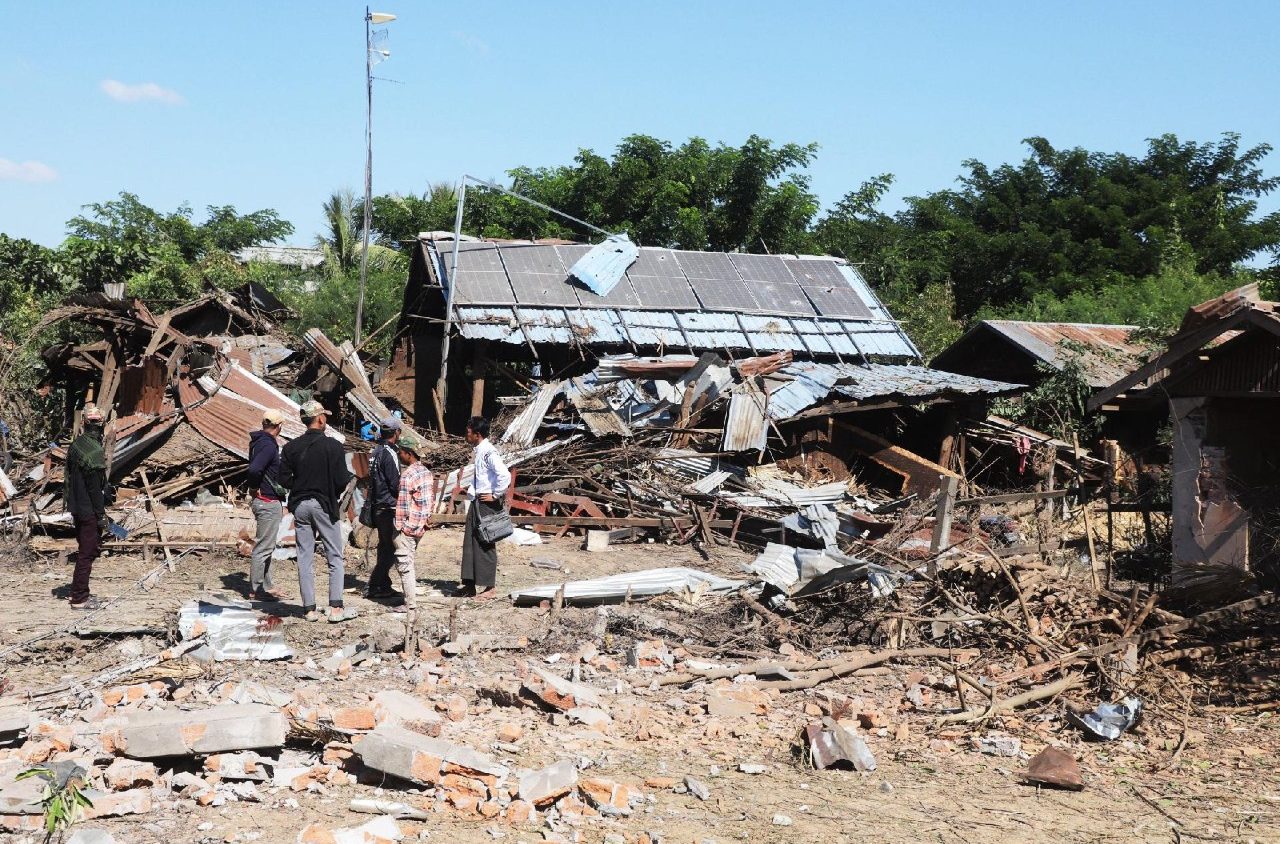

Cardinal Charles Maung Bo of Myanmar sheds light on the situation in the Asian country, afflicted by a civil war that shows no sign of ending, and marked by an economic, social, healthcare and education crisis, with more than 3.5 million people displaced and many young people fleeing abroad.
By Deborah Castellano Lubov
Cardinal Charles Maung Bo, Archbishop of Yangon, has repeatedly warned that “Myanmar is going through a ‘polycrisis’: an economic crisis, with rising prices; a crisis due to the loss of job opportunities; a social crisis, with more than 3.5 million displaced persons and young people fleeing abroad; a crisis of basic health care; and a crisis of education, with a generation that has lost five years of schooling.”
Sharing with Vatican Media the dire situation facing the country, the Cardinal described Myanmar, five years after the military coup, as a nation marked by fear, exhaustion, and deep uncertainty, especially among young people. Yet, he observed, while hope is “not dead,” it is “crucified.”
Toll on young people
Cardinal Bo acknowledged that the general mood among the population is complex and varies according to personal experience, geographic location, and proximity to violence.
Among young people in particular, the Cardinal noted, daily life is increasingly defined by insecurity, psychological strain, and a loss of trust in the future.
“Young people are living with near-constant fear for their personal safety,” Cardinal Bo explained, pointing to ongoing conflict, widespread violence, economic instability, and the threat of forced recruitment. This prolonged insecurity, he said, has led to rising anxiety, stress, and psychological pressure among youth across many regions of the country.
Loss of education, work, and normal life
Cardinal Bo also decried a deep sense of loss, observing how years of disruption have eroded education, employment prospects, and normal social life.
Many young people, he said, express frustration, sadness, and helplessness, with surveys showing sharp increases in anger and emotional distress compared to the years before the coup. “Very few still experience any sense of normalcy,” he noted, adding that a growing number of young people are considering leaving Myanmar, or have already done so.
At the same time, Cardinal Bo cautioned against reducing Myanmar’s youth to victims alone. Even amid hardship, he observed signs of resilience and determination. Some young people continue to believe in the possibility of a better future, investing in education and new skills, including digital technologies, in an effort to create opportunities against extremely difficult odds.
Digital pressures and political challenges
Digital life, the Cardinal suggested, has its pros and cons. Online platforms offer connection, learning, and solidarity, but they also expose young people to hate speech, abuse, and misinformation, further undermining mental well-being and social cohesion.
Participation in recent elections, the Cardinal also observed, was low among younger voters, with many being politically disillusioned.
“Crucified hope”
Against this backdrop, Cardinal Bo insisted that hope remains possible.
“This is not naïve optimism,” he said. “It is a Christian hope born of the Cross and Resurrection.”
This hope, the Cardinal explained, does not rest on circumstances or political calculations.
“The people of Myanmar have lost many securities—peace, livelihood, stability, even international attention—but,” he noted, “they have not lost God’s presence.”
That presence, he said, is visible in displaced villages, in camps for the internally displaced, and in the quiet endurance of families, mothers, catechists, and religious who continue to serve amid suffering.
Families share the little they have
“Families continue to share what little they have. They continue to pray together,” Cardinal Bo said.
Young people, he noted, still volunteer and serve their communities, refusing to abandon their dreams of a different future. These acts, he added, may seem small, but they are “Gospel signs,” like the mustard seed.
The Cardinal stressed that by refusing hatred, rejecting violence, and continuing to speak the language of reconciliation and human dignity, the Church seeks to act as “a sacrament of hope.”
Even when the world appears indifferent, he said, “we continue to believe that violence will not have the last word.”
Feeling forgotten, but not abandoned
At the same time, Cardinal Bo acknowledged that many people in Myanmar do feel forgotten.
“Years of suffering have passed with little visible change,” he said, and international attention often fades except during moments of extreme violence.
The Cardinal suggested that the silence or caution of powerful global actors, combined with isolation caused by sanctions and reduced engagement, has left many ordinary citizens feeling abandoned.
However, the Cardinal clarified that feeling forgotten by the world is not the same as being abandoned by God.
“Myanmar may feel overlooked,” he said, “but it is not forgotten in God’s plan.”
Working toward reconciliation
Cardinal Bo described the pastoral and practical role of the Church in Myanmar.
Catholic leaders, he recalled, consistently call for an end to violence and for reconciliation rooted in justice, forgiveness, and compassion, insisting that peace is more than the absence of fighting. Interfaith initiatives, he added, bring together Christians, Buddhists, Muslims, and Hindus in shared prayers for peace, offering concrete models of coexistence amid division.
The Cardinal noted that pastoral messages emphasize empathy and listening rather than the pursuit of victory; ecumenical bodies such as the Myanmar Council of Churches, supported by international partners, promote unity, human dignity, and dialogue; and grassroots initiatives focus on protecting the displaced and the most vulnerable.
“God is faithful”
The Cardinal of Myanmar also underlined that Myanmar is not forgotten by the Holy See. The Pope, he said, is “deeply concerned,” a concern expressed through repeated appeals for peace, dialogue, protection of civilians, and humanitarian access. While political solutions remain slow and complex, the Cardinal insisted that there is genuine prayer and attention from Rome.
Finally, Cardinal Bo called for perseverance in hope and faith. “To lose hope would be to surrender the future to violence and despair,” he said, adding that Myanmar hopes “not because the situation is easy, but because God is faithful.”
