
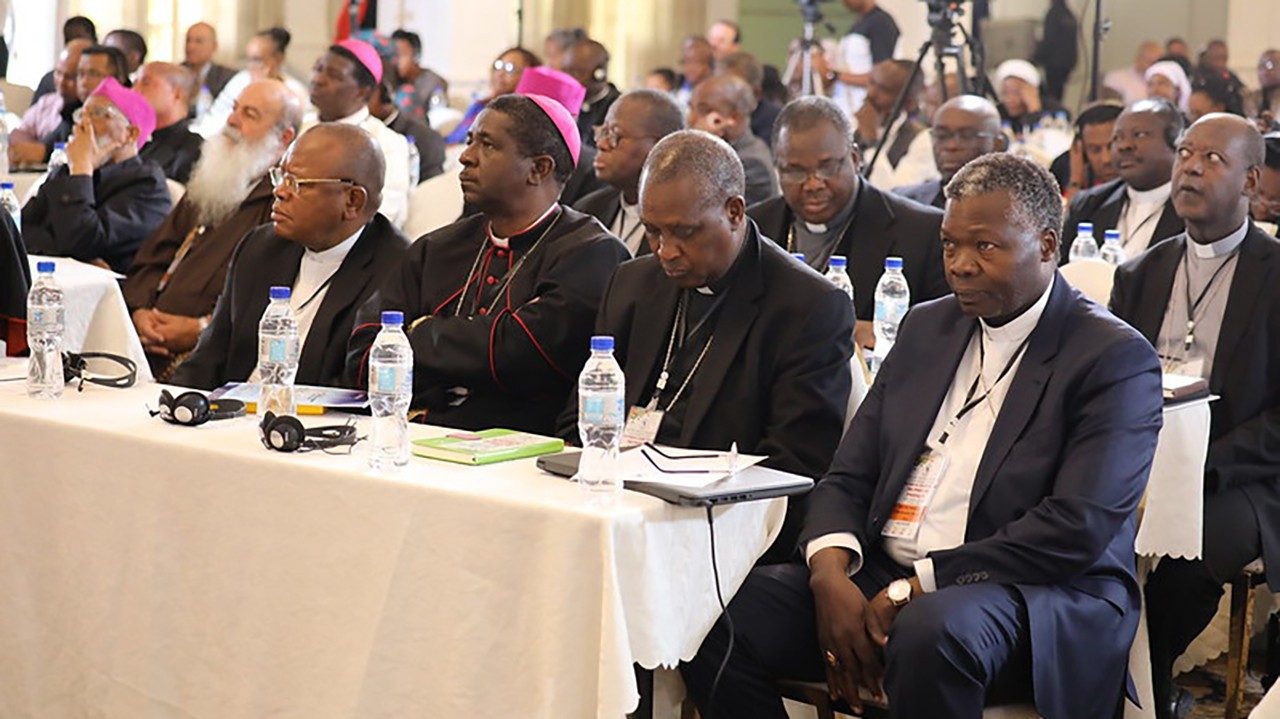
During the launch of the AMECEA synodality formation manual and synodality songs in the Association of Member Episcopal Conferences in Eastern Africa (AMECEA), the keynote speaker stressed that the future of synodality in the Catholic Church across Eastern Africa rests with the Bishops.
Sr. Jecinter Antoinette Okoth, FSSA – Nairobi
According to Bishop Bernardin Francis Mfumbusa of Kondoa Diocese, Tanzania, in his address read by Bishop Edwin Mwansa Mulandu of the Mpika Diocese, Zambia, the success of implementation of Synodality depends largely on Bishops.
He warned that a formation manual left gathering dust on a shelf will do nothing to build a synodal Church.
Bishops and Synodality
“Your Excellencies, you hold the keys to implementation in your dioceses. A manual on a shelf does not form a synodal Church,” Bishop Mulandu rea. He urged Church leaders in the region to take concrete steps to ensure that every deanery and parish has access to the newly launched resource, and to integrate it into ongoing formation programmes for the clergy, religious houses of formation, catechist training centres, and diocesan synodal assemblies.
The launch event marked the culmination of a process that began in May 2025, when the AMECEA Secretariat initiated a structured consultative process involving all eight-member Episcopal Conferences across the AMECEA region. National Pastoral Coordinators, AMECEA’s trained trainers, diocesan and parish priests, religious women, particularly through the Association of Consecrated Women in Eastern and Central Africa (ACWECA), and lay leaders were all drawn into the drafting process.
The urgency of formation
“This was not a document written about the People of God; the People of God wrote it,” the Zambian Prelate stressed.
Bishop Mfumbusa, who is also president of the Pan-African Episcopal Committee for Social Communications (CEPACS), explained in his discourse that in developing the manual, the Church in the AMECEA region has begun to “practise what we preach about synodality.”
The keynote address underscored the urgency of formation, citing the Final Document on Synodality, which calls the implementation phase a matter that must be treated with urgency. The Synod on Synodality, which concluded in October 2024, was described not as an endpoint but as a commission, one that requires systematic formation at every level of the Church.
“A commission without formation is a letter without a carrier,” the address stated, echoing the late Pope Francis, who repeatedly described synodality as a living process of conversion requiring patient, persistent, and prayerful formation work in local Churches.

Bishop Bernadin Mfumbusa of Kondoa Diocese, Tanzania
The journey must continue
According to the keynote speaker, Priests, catechists, lay women and men, young people, and children must be empowered to recognise and exercise their baptismal calling.
He said, “Synodal transformation will happen gradually, through patient formation and persistent practices in the local Churches.”
The launch of the manual drew resonance from the words of Pope Leo XIV, who, on 29 June 2025, blessed the implementation pathway of the Synod on Synodality, affirming that the journey must continue across the universal Church.
In his Apostolic Letter of 8 December 2025, marking the sixtieth anniversary of the conciliar decrees Optatam Totius and Presbyterorum Ordinis, Pope Leo XIV called for formation at every level, particularly in the initial and ongoing formation of priests. The keynote address described these words as “a direct mandate addressed to every bishop and priest.”
Priests are the first point of encounter
Priests were singled out as “the first point of encounter between the faithful and the synodal vision,” and urged not to allow fear to become a barrier to implementation. “Let this manual be an instrument in your hands for your own formation first, and then for the communities entrusted to your care,” the message read.
The manual is a collaborative fruit that involved theological consultants, pastoral experts, and formation specialists who contributed their expertise, which the Bishop says is “a collaborative wisdom of the entire AMECEA family.”
AMECEA has done its part in providing this tool. Now the conferences and dioceses must do their part in deploying it,” the address noted.
