
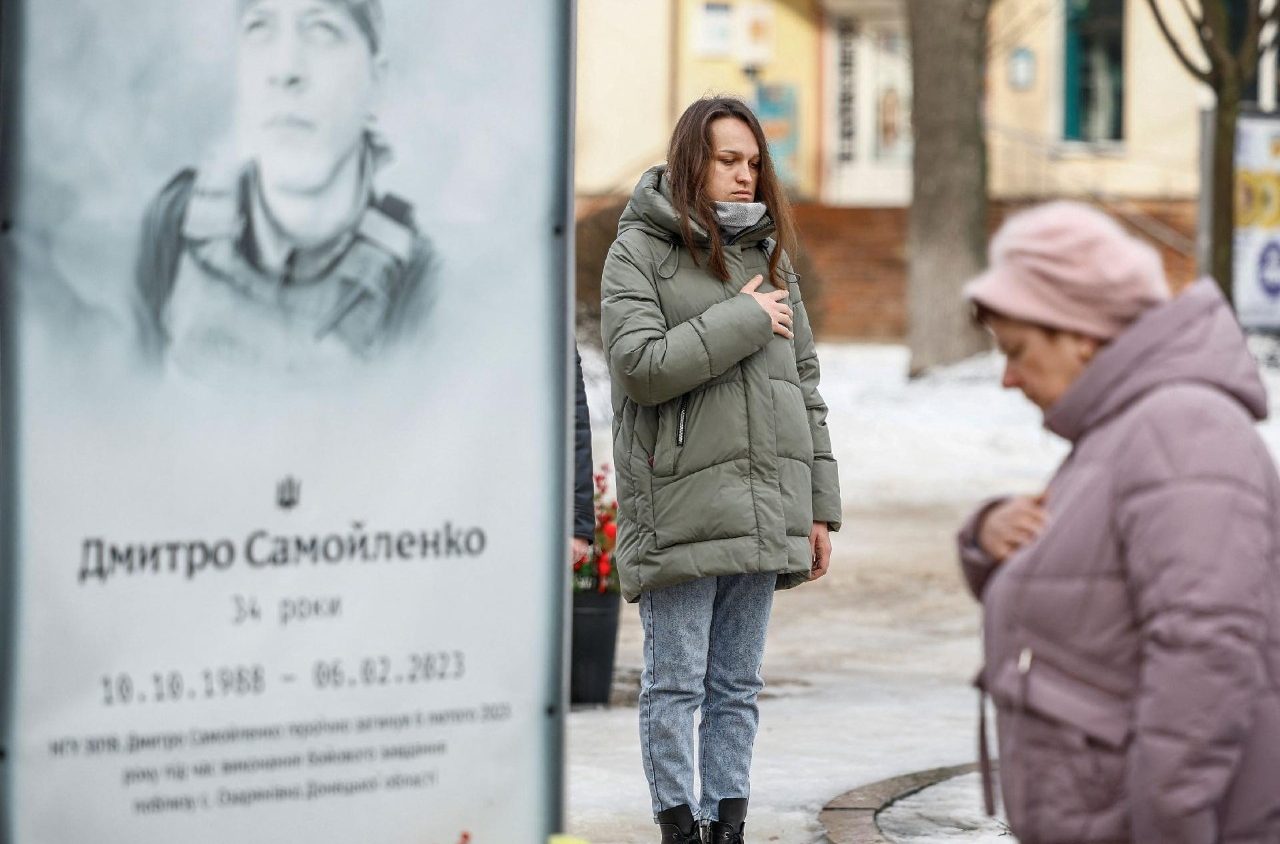
In an interview with Vatican News marking the fourth anniversary of Russia’s full-scale invasion of Ukraine, Archbishop Visvaldas Kulbokas speaks about how amidst the growing intensity of the conflict, Ukrainians remain resilient and continue to help one another without losing hope.
By Svitlana Dukhovych
Previously, in Ukraine, it was possible to set up medical aid points near the front line in basements, but now this is no longer feasible, as every building comes under fire. The closer one gets to the front, the deeper underground support points must be dug to protect against constant drone attacks.
This description alone is enough to understand the situation in a country that, after four years of full-scale war and under constant shelling, strives every day to resist—in order to secure at least some degree of safety and life amid instability.

The Apostolic Nuncio prays with families of the victims of an attack on Ternopil
Speaking to Vatican News, the Apostolic Nuncio to Ukraine, Archbishop Visvaldas Kulbokas, also reflected on people who “try not to focus only on suffering.” Rather, they notice “the sprouts of hope,” and, even more, embody a heart attuned to the words of Pope Leo XIV that we must not “remain among the ashes, but rise and rebuild.”
Q: Your Excellency, four years have passed since the beginning of Russia’s full-scale invasion of Ukraine…
Four years of such a large-scale war is a very long time, and the intensity of this war continues to grow. I reviewed the statistics. Compared to four years ago, the number of Russian armed forces on Ukrainian territory has increased approximately fourfold. The number of missile and drone attacks has also risen three- to fourfold over these years. Reports from the United Nations and other organizations indicate that the number of civilian casualties is also increasing.
At the beginning of the war, most civilians who were killed or injured were in occupied territories or near the front line. Now the number of civilians killed or injured far from the front is rising. The UN indicates that 35% of civilian casualties are spread across the entire territory of Ukraine.
Q: Shelling also takes place far from the front line…
Yes. The largest number of civilian casualties in a single bombing last year was recorded in Ternopil, a city located very far from the front. Last year, there were many civilian casualties in the capital, Kyiv. More than twenty embassies suffered varying degrees of damage.
The Apostolic Nunciature sustained minor damage in July last year. But, for example, almost nothing remains of the Azerbaijani embassy, because it was struck three times, despite President Aliyev having precisely informed the Russian authorities of its location.
Q: What are medical workers able to do under such intense shelling?
A few days ago, I spoke with a doctor who has dedicated his life to assisting the wounded near the front line. He told me that at the beginning of the war, in 2022–2023, he was able to set up aid stations in basements and on the lower floors of houses and buildings. Now, he says, this is no longer possible, as every building comes under fire.

Daily life in the frontline zone near Kramatorsk of Donetsk region (ANSA)
As they approach the front line, they must establish positions five or six meters underground to protect themselves from constant drone attacks. Moreover, evacuating the wounded is extremely difficult. He told me that sometimes they must wait up to seven days to evacuate an injured person. It is very cold. Temperatures have dropped to minus twenty degrees Celsius, with extremely serious consequences.
Q: Is it possible to deliver humanitarian aid under such conditions?
I asked a representative of the International Red Cross whether it is still possible to deliver humanitarian aid near the front line. He replied that, unfortunately, they have been forced to significantly reduce it, since everyone without exception becomes a target: civilians, military personnel, humanitarian workers, doctors, priests. Therefore, delivering water, food, medicine, and other basic necessities is extremely difficult. This is the reality.
Q: What can be done in such circumstances?
I repeat that we need much prayer. But let us not forget that Russia is a permanent member of the UN Security Council and bears responsibility for promoting peace and justice. Let us also recall the Budapest Memorandum signed in 1994: Russia, the United States, and the United Kingdom promised Ukraine guarantees of its sovereignty and territorial integrity. Then there was the 2003 Treaty between Russia and Ukraine on mutual recognition of borders, not to mention the Minsk agreements.
Thus, there is this difficulty—including for me—in understanding how it is possible to emerge from this violence, which seems only to grow and intensify. That is why I place great trust in prayer.
Q: Amid this tragic situation, there are many examples of resilience…
Yes. For example, a few weeks ago a group of women from an interfaith association that promotes prayer and humanitarian assistance attended a General Audience with the Holy Father. I met these women after their return from Rome, and their reflections struck me.
They said: “We focus on what we can do. When there is a wounded girl, we look for a prosthesis if she has lost an arm. Likewise, we seek prostheses for wounded soldiers or for children. We try to take them abroad so they can rest for a while. Then, at least they will be able to sleep at night.”
The women added: “There is no point in accusing all Russians now, because we do not know what we ourselves would do if we lived in the same political reality, with such propaganda.” They do not focus on condemnation, but on what positive good they are able to do.
Q: Do you notice the same reaction in other people?
I see it among civilians as well. An ambassador told me that after yet another night of bombing in Kyiv, he canceled all his morning meetings. Usually missile and drone attacks take place at night because they are harder to intercept, and the attackers hope to strike and cause greater devastation.
Yet when the ambassador looked out the window in the morning, he saw people already on the streets going to work—some by car, others on foot. He said this was a great lesson for him. People try not to focus on suffering. Moreover, they thank God for what they still have.
Q: What appeal would you like to make?
I would like to encourage everyone to support Ukraine, above all in a spiritual sense. This means prayer, humanitarian assistance, solidarity, and heartfelt closeness.
A few days ago, I read the Holy Father’s letter to the priests of the Archdiocese of Madrid. Pope Leo encouraged everyone, in the face of complex situations, to learn to understand deeply the moment we are living, discerning in the light of faith the challenges and opportunities that the Lord opens before us. We must exercise discernment, he wrote, “so that we can perceive more clearly what God is already doing, often silently and discreetly.”
God acts even when people do not build peace. On Ash Wednesday, Pope Leo also said that we may “perceive in the ashes imposed on us the weight of a world that is ablaze, of entire cities destroyed by war”; we may feel “the ashes of international law and justice among peoples,” as if the foundations of common life no longer remained.
But ashes are human. From God, however, hope always comes, because when people do not act, He—God—takes the initiative. Thus, the Pope said, we can “not remain among the ashes, but will rise up and rebuild.”
Q: What are today’s prospects, four years after Russia’s full-scale invasion of Ukraine?
Our task is to see even now glimmers of hope in the negotiations taking place between Ukraine and Russia with the help of the United States and other countries, even if these talks are very limited due to enormous difficulties.
When we entrust ourselves more fully to the Lord, we become capable of seeing these signs of hope with spiritual eyes, even amid all these ashes and human malice, disrespect, and distrust.
In this sense, I believe that the greatest help the Church can offer the Ukrainian people is above all spiritual help: to assist everyone—including myself—to broaden our gaze, so as not to focus solely on the evil we see and experience every day, but to maintain a gaze filled with hope.

Pope Leo meets with the Apostolic Nuncio in June 2025 (@VaticanMedia)
The more hope is transmitted through prayer, closeness, counsel, and presence—which is very important—the more it becomes a gift. It is about carrying the hope that we cultivate in our own hearts.
As military chaplains say: “Our task is to bring hope to the soldiers, because on the battlefield very little of it often remains. Our task is to give that divine hope which overcomes human limitations.”
Therefore, I repeat: above all, we can offer two things—prayer and spiritual hope.
