
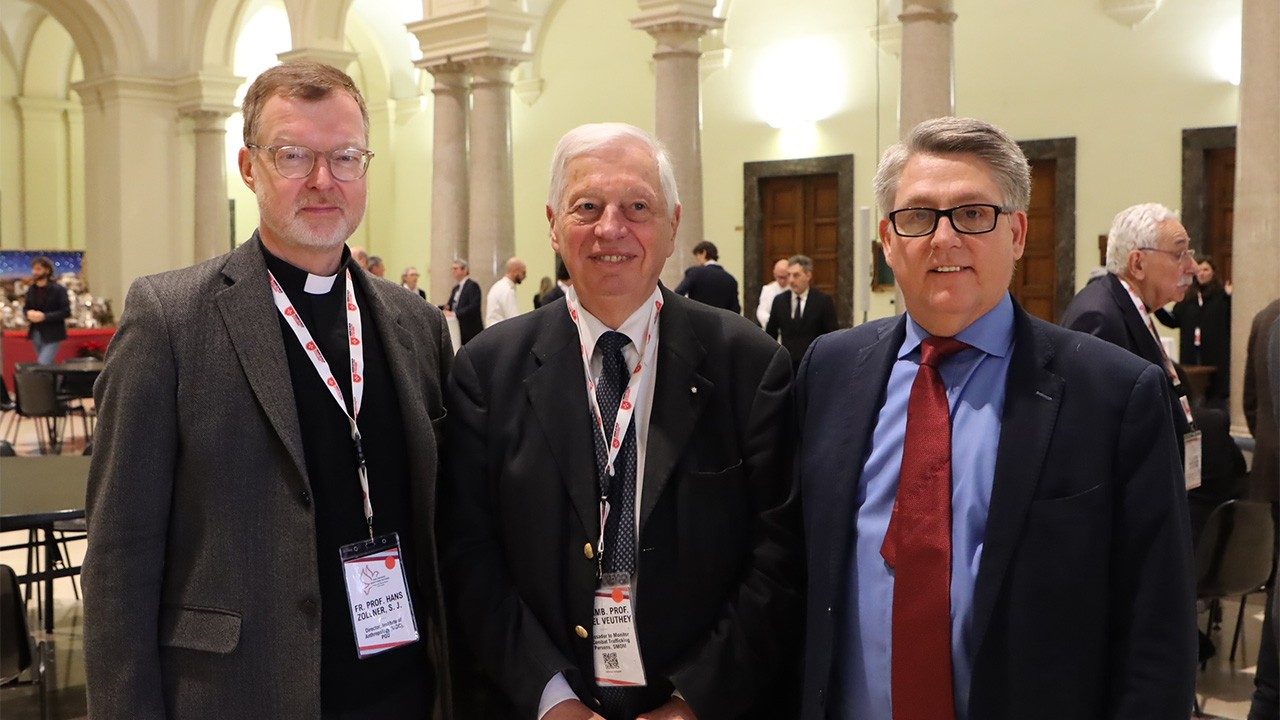

At a conference organised by the Institute of Anthropology of the Pontifical Gregorian University, Church actors highlight the urgent need for action against human trafficking on the 25th anniversary of the Palermo Protocol.
By Christine Seuss and Linda Bordoni
Twenty-five years after the adoption of the Palermo Protocol—established to prevent, suppress and punish the trafficking of persons, especially women and children—human trafficking remains widespread and is even expanding.
According to the 2023 Global Slavery Index, an estimated 50 million people are trafficked globally, generating more than USD 236 billion in criminal profit each year.
Marking this anniversary on 10 December, the Sovereign Order of Malta, Praeveni Global, the Santa Marta Group, and the Institute of Anthropology of the Pontifical Gregorian University convened a high-level conference in Rome. Participants, who included Cardinal Fabio Baggio and Fr Hans Zollner, examined how to strengthen the implementation of existing legal standards and how to mobilise greater resources for concrete, on-the-ground action to eradicate this global crime.
Church’s “very important role” in communities
Among the speakers was Mama Fatima Singateh, UN Special Rapporteur on the Sale and Sexual Exploitation of Children. Speaking to Vatican Radio on the sidelines of the event, she underlined the importance of Church engagement at the grassroots level.
“The Church has a very important role in supporting communities… raising awareness on the vulnerability of children and the dangers that exist,” she said.
Through its presence in local settings, she added, the Church can contribute significantly “not only [to] empowerment, but also building capacity… providing financial but also moral support in order to tackle this problem.”
Reflecting on the conference, Singateh noted the value of bringing together experts from diverse countries and institutions. “
It’s an opportunity to share our own experiences… but also we learn from others,” she said. “We learn about what is happening in other countries… so that we can get best practices and examples… to help us do our work better.”
The Special Rapporteur also acknowledged the emotional toll of confronting such grave violations daily. “It’s not easy because we also suffer from vicarious trauma,” she explained.
“I speak to survivors every day, and it breaks my heart. But I know that my voice is a very powerful voice to speak for them… and to influence policy that would ensure their protection.”
Despite the challenges, she said she remains motivated: “Every day I wake up, I feel that a little can count towards impacting positively on the lives of children [and] vulnerable communities around the world.”
Despite progress networks still operate with near impunity
Kevin Hyland, member of the Santa Marta Group and long-time anti-trafficking advocate, offered a sober assessment of global progress since the Palermo Protocol entered into force.
“We’re here to look at 25 years on from this protocol… which was groundbreaking in many ways,” he said. Nearly 180 countries now have domestic legislation in place, and multiple international agencies and civil-society actors—including Catholic institutions—are active. “The Church has really taken a leadership role… through the religious sisters… Bishop conferences and different organisations.”
However, Hyland stressed that real-world outcomes still fall far short of what is needed. “Last year, there were 2,000 fewer victims recovered than the year before, and that only represents less than 0.5% of the 50 million victims,” he stated. “There were 7,000 convictions last year… So 99.8% of the time, people are getting away with the crimes.”
He contrasted the scale of the problem with the resources allocated to address it. “Globally, there is only about 1.5 billion invested by G20 countries… a very small amount of money for a crime that is so global,” he said, particularly when criminal profits are estimated at USD 236 billion annually.
Work of religious sisters
Hyland highlighted the “incredible work” carried out by religious sisters worldwide, recalling his recent participation in awards recognising Catholic women religious combating trafficking in some of the world’s most challenging environments. Their contribution, he said, “really opens up your heart.”
Quoting reflections from Church leaders, Hyland recalled that at the first meeting of the Santa Marta Group, Pope Francis urged participants to “learn to cry” in the face of this “open wound on the body of Christ.” He also noted that Pope Leo XIV has continued to emphasise this priority.
“Our deeds are what we’re measured on”
Turning to the future, Hyland stressed that the next phase must focus on concrete implementation. Modern challenges—from globalised supply chains to artificial intelligence—were not envisioned in 2000, he noted. “The Palermo Protocol… doesn’t talk about AI. It’s very passive towards the way the world has moved on.”
He called for renewed commitment: “We need governments to invest financially and politically… to support the work of charities, civil society and religious sisters.” Accountability, he added—of businesses, states, and criminal networks—is essential.
Reflecting on the venue, the Pontifical Gregorian University, Hyland cited Saint Ignatius of Loyola: “Your deeds are what you’re measured on, not your words.” That principle, he said, must guide anti-trafficking efforts today. “This is about our deeds, our actions, not just the words and the policies.”
He concluded that the conference’s purpose is precisely this: to discern “how do we make those actions that prevent human trafficking, that respond to it when it happens, and that [address] human suffering with the passion, compassion and love that we need.”
