
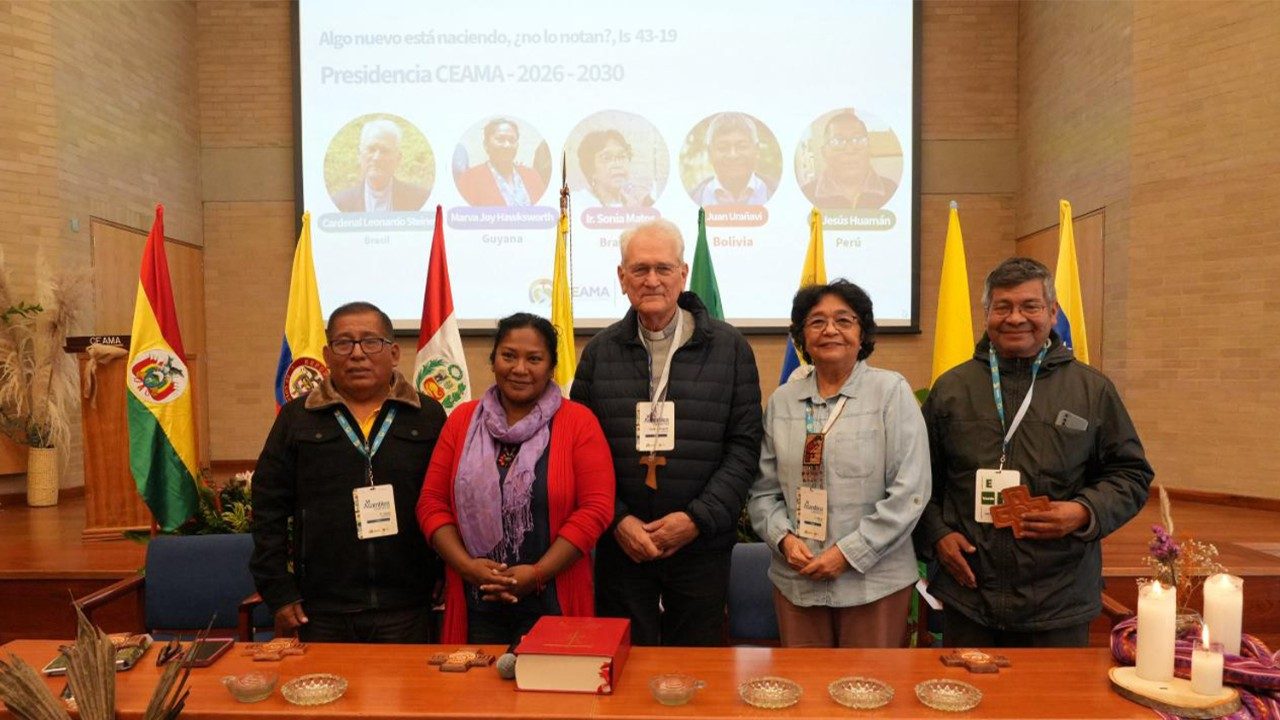
The Ecclesial Conference of the Amazonia renews its presidency for the 2026–2030 period, consolidating a synodal ecclesial path in which diverse vocations, ministries, and cultures converge at the service of life in the Amazon Region.
By Johan Pacheco
Inspired by the biblical text, “I am about to do something new; even now it is springing forth. Do you not perceive it?” (Is 43:19), the Ecclesial Conference of the Amazon (CEAMA) is holding its 6th General Assembly from March 16 to 19, electing a new presidency for the 2026–2030 period and renewing its missionary and synodal commitments in the Amazonian territories.
The new presidency of CEAMA is composed of Cardinal Leonardo Steiner, OFM, of the Archdiocese of Manaus (Brazil), as president; and the vice presidents: Fr. Jesús Huamán, of the Apostolic Vicariate of Puerto Maldonado (Peru); Juan Urañavi, of the Apostolic Vicariate of Ñuflo de Chávez (Bolivia); Marva Joy Hawksworth, of the Diocese of Georgetown (Guyana); and Sr. Sônia Maria Pinho de Matos, of the Archdiocese of Manaus (Brazil).
“We are gathered in Bogotá, Colombia, at the CEAMA Assembly, the Ecclesial Church of the Amazon,” Cardinal Leonardo Steiner told Vatican News. “We are reflecting on our mission, deepening the question of our mission, and we are also seeking some common horizons for the action of our particular Churches, our dioceses, our prelatures, our vicariates. It is a path we are undertaking, and we wish to give it continuity.”
He said the General Assembly also saw the election of a new presidency, “to give continuity to that dream of Pope Francis to go to the Churches of the Amazonia and to be an ecclesial Church. We want to carry forward that dream of Pope Francis, implementing especially the four dreams he addressed to us in Querida Amazonia. We take into consideration the social question, the cultural question, the ecological question, and also, naturally, our ecclesial situation.”
“This way of being Church is deeply synodal and missionary. May God bless us, and may Our Lady of the Amazon always accompany us,” he said.
The diversity of members of the new presidency offers a concrete sign of the synodality that drives CEAMA, a Church that walks together, values the diversity of gifts, and allows itself to be challenged by the reality of the territory. It is also a living expression of the dream of a Church with an Amazonian face, where interculturality, participation, and shared responsibility are fundamental pillars.
Marva Joy Hawksworth, Vice President of CEAMA
Representing the laity of the Amazon, Marva Joy Hawksworth, of the Diocese of Georgetown (Guyana), was elected vice president of CEAMA. Belonging to the Macushi people, she was born in the community of Tipuru, in southern Rupununi, where she has developed much of her educational and community vocation.
“These last few days have been very informative and very interactive,” she said in an interview with Vatican News. “I have learned a great deal, and I have become involved and participated in everything that has happened. It has been a wonderful time here, and today, I was elected Vice President. And that was a surprise to me; it was an absolute surprise. I know it is a great office, that it is an enormous responsibility that I am taking on, but I also know that I am not alone.”
Her ministry has been centered in rural and indigenous contexts, where she has promoted an intercultural education that strengthens the identity, language, and traditions of indigenous peoples. Her pedagogical work has been characterized by integrating ancestral knowledge and contemporary methodologies, generating meaningful educational processes for the new generations.
Amazonia and communication
The Prefect of the Dicastery for Communication, Dr. Paolo Ruffini, spoke during the assembly, emphasizing the communicative role of the Church in the Amazon.
“The communicative challenge is very great in a global media system dominated by commercial or geopolitical logics that have no interest in narrating the ecological crisis and the stories of the Amazon,” he said.
“We must not confuse communication with the mere dissemination of news. News is necessary, but it has a very short cycle and operates within an editorial hierarchy that decides what counts and what does not. The Amazonia story appears when there is a catastrophe, when there is a summit, or when there is the murder of an indigenous leader. And then it disappears. To break the wall of silence and disinterest, creativity is needed,” Dr. Ruffini said.
He also invited participants “to act on the dominant platforms without being colonized by the logic of the same media system that marginalizes the Amazonia. Effective global communication on these issues instead requires a plural grammar of languages, each with a different function and a different audience.”
“This is where you can give free rein to your creativity,” he said. “Your communication must not only be about Amazonia, but also from Amazonia.”
The Pope: missionaries in the Amazon
In a video message at the opening of CEAMA’s 6th Assembly, Pope Leo XIV encouraged the Church in Amazonia “to continue together, pastors and faithful, in strengthening the identity of missionary disciples in the Amazon Region. Keep sowing in the furrow that has been watered even with the blood of so many men and women who have gone before you, and who, united to the passion of Christ, have become the root of a ‘giant tree’ growing in the Amazonia.”
“I am pleased that among the objectives of the Assembly is the formulation of the Synodal Pastoral Horizons, which could be a useful instrument for guiding the proclamation ‘of a God who infinitely loves every human being, who has fully manifested that love in Christ’ (Pope Francis, Post-Synodal Apostolic Exhortation Querida Amazonia, 64).”
As it renews its mandate and mission, CEAMA confirmed its commitment to the defense of life, the dignity of peoples, and care for our Common Home, walking alongside the Amazonian people with hope, faith, and deep missionary conviction.
