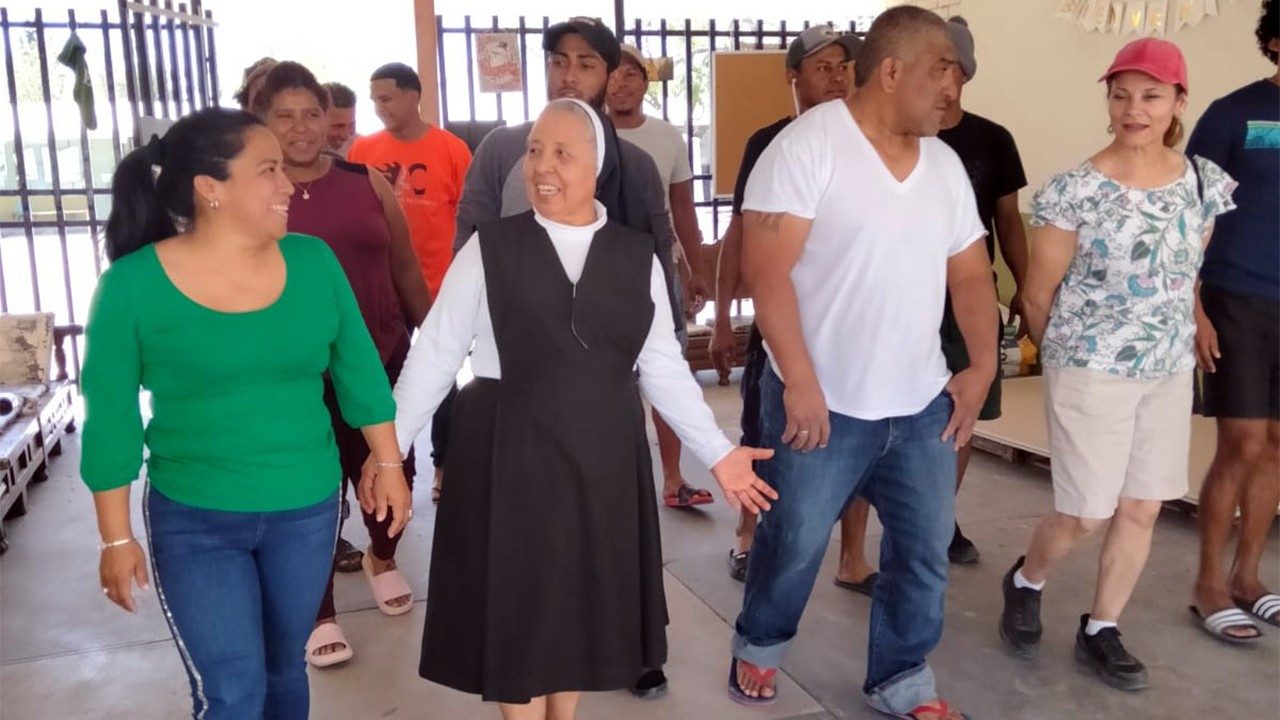

Inspired by a spirit of equality, the Franciscan Sisters of Mary Immaculate give all their attention to those who decide to set out in search of a better future and arrive at their home for migrants along the US-Mexico border.
By Yamile López
“May all those who emigrate love one another as brother and sisters, which we all are. We are all living beings, with or without defects, but we are all equal,” according to Camilo.
Asked what his life as a migrant means to him, the young man summed up his belief of how migration should be understood.
The Franciscans of Mary Immaculate carry out this mission along the US-Mexican border through their ministry known as ‘Movilidad Humana’.
Thirty years ago, the Diocese of Piedras Negras, located on the Mexico-US border, opened a shelter for citizens who had been deported.
Over time, circumstances changed and it became the Casa del Migrante ‘Frontera Digna’, an ‘oasis’ for people who walk with the hope of building a better future.
Mission is to work where the need is greatest
Sister Isabel first worked with migrants with the Conference of Religious of El Salvador (CONFRES), which focused primarily on prevention with regard to the risks of migration.
She later completed the migration route herself, passing through eight shelters, through Guatemala, and finally arriving in Ixtepec, Mexico.
In 2018, the religious sister travelled to Bogotá, and, along with other religious sisters, she offered a special service to the Venezuelan migrants who at that time were arriving in Colombia in large numbers.
“I would go to the terminal of Salitre, where I would go every morning to welcome all the Venezuelan migrants who arrived. I would give them some direction, offer them a sweet beverage and a pastry, read the Word with them, and organize some events also to guide the young women who had the Scalabrinians there,” the sister recalled, moved by the women’s plight. “The timid young women who arrived with their small suitcases—it was known that they were bought and sold to prostitution there in Bogotá, so we would walk around the entire terminal telling them what human trafficking is.”
A few months later she left for Mexico with two other religious sisters.
Solidarity rekindles hope
The Franciscan sisters have shared many stories of suffering with the migrants, among them those experienced during the Covid-19 pandemic.
“Piedras Negras is a place with good, solidary, dedicated people. During that period, the parishes also joined us to serve food to migrants and to continue to help them,” said Sister Isabel.
For her, Divine Providence is the only explanation for how she was able to help nearly 1,000 migrants daily. She was able to provide food, a pillow, a blanket, medical attention, and spiritual comfort to everyone.
That is why she is very grateful to the many volunteers, the parishes, Doctors without Borders, and the Franciscan Network for Migrants.
Franciscan prayer and spirituality help the sisters carry the migrants’ suffering.
They include situations like those of pregnant women determined to cross the river with the false hope that if their child is born in the United States, they will obtain citizenship.
Others fall victim to abuse, kidnapping, or slavery, but later manage to free themselves and reach the north.
The sisters remember all of them, and many of these women call the sisters to thank them because they will be able to follow their dreams.
Migration and Blessed María Caridad Brader
Camilo decided to leave his country in search of something better for him, his mother, and his sister.
“The message I would like to give to all the mothers [the religious sisters] is that they not get discouraged in this beautiful and great work they do with all migrants… I will never forget the day of my country’s independence, they celebrated with me with a special lunch, flags, and typical cuisine.”
Migration is a reality to which the sisters respond with fraternal and synodal service.
The foundress of the Congregation, Blessed María Caridad Brader, in her time, embraced the missionary ideal and left her native Switzerland to work for forgotten peoples in Ecuador and Colombia at the end of the 19th century.
“I think that Mother Caridad would have founded homes or places for the sisters’ presence on every border, because that’s what she did,” said Sr. Isabel. “In our history, we have had some situations in which during war, she would close her school and convert it into a hospital and have the sisters work as nurses to help the wounded. It is this missionary spirit of Mother Caridad that inspires those of us in Piedras Negras every day.”
About the Author