

By Tyler Arnold
Washington, D.C. Newsroom, Oct 6, 2025 /
18:13 pm
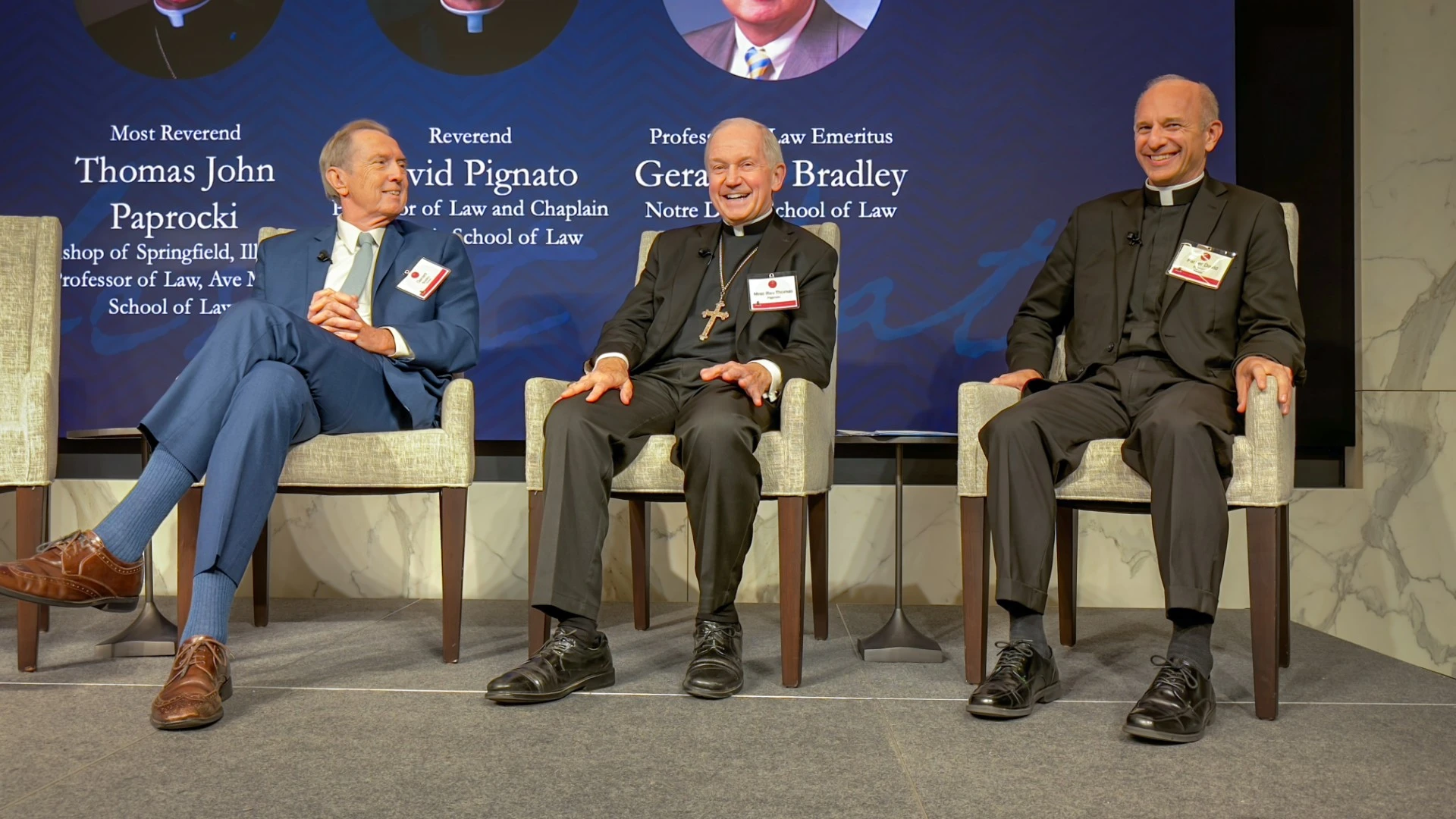
Bishop Thomas John Paprocki and other figures emphasized the importance of faith formation for Catholic lawyers and the role that Catholic law schools have in helping shape perspectives of soon-to-be lawyers.
“Law certainly follows values,” Paprocki said in a panel discussion at an Ave Maria School of Law conference on Oct. 3, hosted at the Heritage Foundation in Washington, D.C.
Paprocki — the bishop of Springfield, Illinois, and an adjunct professor at Ave Maria School of Law — said a person’s values, whether they come from theology or a secular notion of virtue, influence the way laws are crafted for all issues, including marriage or abortion.
For Catholic law schools, he said Scripture and doctrine “should be the basis for what we’re teaching” about values. He said values consistent with Church teaching should “influence the way we go about” addressing those issues.
Paprocki said he’s heard Catholics say they are “personally opposed to abortion” yet support legalized abortion. But he said he has never heard a person say he is “for open borders, but I don’t want to impose that belief on others.”
The bishop said faith formation for Catholic lawyers should ensure they have “a more robust understanding of the natural law,” as understood through Catholic social teaching. He said Christ instructs us to “go out and make disciples” and “not to be bashful about [our faith].”
Paprocki told CNA that in some contexts “you don’t necessarily have the opportunity to be very explicit” about matters of faith when employed as a lawyer, but “you should still be informed by your faith life.” Regarding lawmaking, he said “[you should] have religious principles that inform your [views] … and help shape what a policy should be.”
According to Paprocki, the nation’s founders saw the United States as a “religious country” to be informed by religious beliefs. He said that views informed by faith pose no threat to the First Amendment’s establishment clause, which prohibits “an establishment of religion.” The clause, he said, prohibits “an official church of the government.”
“That has been misinterpreted by some people to mean that you can’t mention God at all,” the bishop said.
Gerard Bradley, a retired Notre Dame law professor, said at the conference that the distinction between a secular law school and a Catholic law school ought to be that a Catholic school is “wed … not just to this truth or that truth, but the whole concept of truth.” He said a Catholic law school must reflect the view that Catholic doctrines “are truths that permeate everything we do.”
Lee Strang, executive director of Ohio State University’s Salmon P. Chase Center, spoke earlier in the day about the history of Catholic law schools in the United States, noting that they were initially created to advance the upward mobility of Catholic immigrants, bolster university reputations, and establish a culturally distinct law school.
Over time, he said some schools began to teach a more intellectually Catholic understanding of law rooted in Catholic law tradition, which is focused on “a Catholic theory of the human person within the context of law.”
Retired Loyola University Chicago law professor John Breen said modern Catholic law schools ought to ultimately be “directed toward worship of the Holy Trinity” with an understanding of human anthropology “that comes to us through the Church: the ‘imago Dei.’”
“You can’t understand the human person if you don’t also contemplate God,” Breen said.
He said alternative anthropologies lack an understanding of human exceptionalism and the soul, which distorts the understanding of law and emphasize an “atomized self” focused solely on “desire” or “choice.”
Ave Maria law professor Ligia Castaldi noted an understanding of natural law rooted in Catholic doctrine is important for discussions about the sanctity of life from the moment of conception until natural death.
(Story continues below)
Subscribe to our daily newsletter
Richard Myers, another law professor at the university, noted the importance of Catholic legal thought on the issue of same-sex civil marriage. He said in the wake of the Supreme Court’s ruling to legalize same-sex marriage nationwide, “[most] advocacy scholarship [was] on the wrong side of the issue.”
Catholic legal thought, he said, “served an important function, a corrective function … [that was] important to the debate on those issues at that time.”

Tyler Arnold is a staff reporter for Catholic News Agency, based in EWTN News’ Washington Bureau. He previously worked at The Center Square and has been published in a variety of outlets, including The Associated Press, National Review, The American Conservative, and The Federalist.
