
Denominations do not exist apart from their churches. They reflect the health of the congregations within them. When more churches are healthy than unhealthy, the denomination tends to have strategic capacity. When more churches are unhealthy than healthy, denominational leaders are pushed into triage mode rather than long-term leadership.
That dynamic is increasingly evident in the Southern Baptist Convention (SBC). The denomination’s challenges are not merely institutional. They are congregational. When churches thrive, denominational structures have something to amplify. When churches decline, the institutions that depend on them begin to wobble as well. I’ve always heard “the local church is the headquarters of the SBC.” If that’s true, then “the central station of health in the SBC is the local church.”
The Long Arc of Decline in the SBC
The warnings have been visible for a long time. What first appeared in the early 2000s as a stall in baptisms and a softening in evangelistic effectiveness has now become a prolonged institutional decline. I wrote in 2004 about the “striking plateau” of baptisms and the “inefficiencies” of our evangelism compared to previous eras. My father followed with another similar and more detailed report in 2005. These initial warnings were largely ignored, but the data and statistics were there. And the plateau we both saw gave way to a precipitous decline.
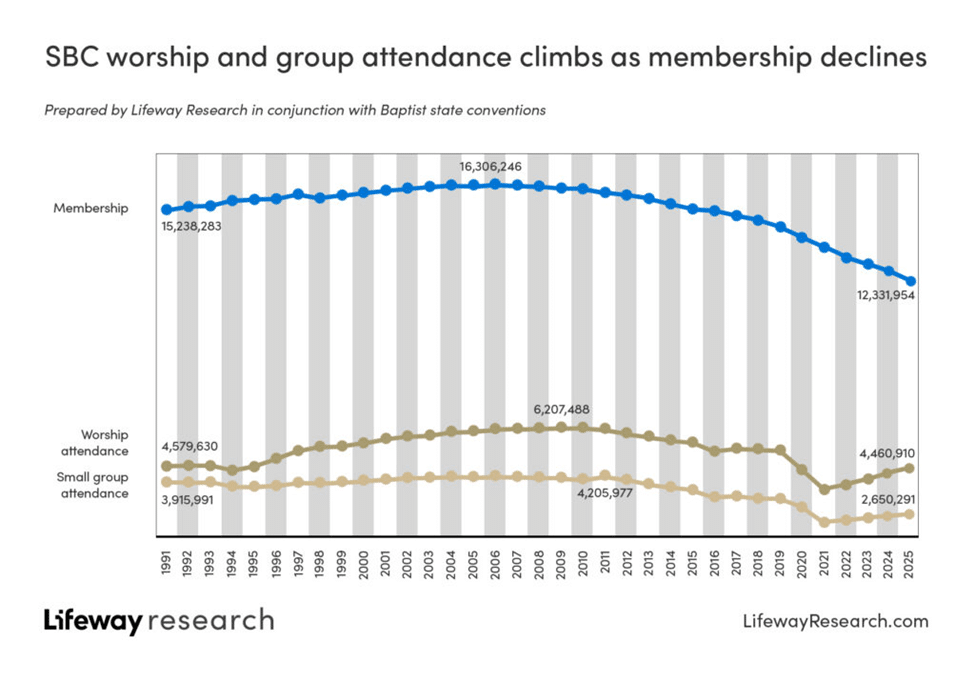
The latest Annual Church Profile shows that Southern Baptist membership fell again in 2025, declining more than 3 percent to 12,331,954. That marks the nineteenth consecutive year of membership decline, bringing the convention down to levels last seen in 1973. But the same report also shows that average weekly worship attendance rose to 4,460,910, small group participation climbed to 2,650,291, and baptisms increased to 263,075. Baptisms are now up for five straight years and have surpassed pre-COVID levels.
So what are we looking at? Is this a remarkable recovery? Is it a dead cat bounce? Or is it something else?
A dead cat bounce is a temporary rebound after a steep decline. The phrase comes from financial markets. Even a falling asset can show a short-lived rise before resuming its downward trend. It is not a sign of renewed strength. It is a brief upward move within a larger negative trend.
That phrase is tempting here, given the SBC’s undeniable long-term problems. Membership continues to slide. The number of affiliated congregations fell again in 2025 to 46,608, a loss of 268 churches in one year. Attendance, while improving, remains 1.75 million below 2009 levels
But I do not think “dead cat bounce” is the right diagnosis. Not yet.
The reason is simple: weekly worship attendance growth is too sustained and too broad-based to dismiss with a cynical label. Attendance is up for the fourth consecutive year. Small group participation is also up for the fourth straight year. Baptisms have now risen for five consecutive years, the first time that has happened in the past seventy-five years. Southern Baptists are now baptizing one person for every 47 members, an improvement over last year’s 1:51 ratio. Thirty-one of the forty-one state conventions reported more baptisms in 2025 than in 2024. That is not a one-year statistical blip.
At the same time, I do not think we can call this a recovery. Not yet.
The Current Inflection Point: SBC Churches Determine What’s Next
A true recovery would mean more than a post-pandemic bump in several key metrics. It would mean the convention has moved from stabilization to durable renewal. It would mean attendance gains are no longer paired with membership erosion. We need years—decades even—of similar year-over-year gains before we can claim recovery.
We are not there yet. That is why this moment is best understood as an inflection point.
An inflection point is not the same thing as a turnaround. It is the place where a trend can bend in one direction or another. It is a hinge moment. The numbers now give Southern Baptists enough evidence for real encouragement, but not enough to celebrate without caution.
There is good news here. More people are showing up. More people are gathering in smaller discipleship environments. More people are being baptized. Florida alone reported 33,123 baptisms. North Carolina saw the largest numeric increase in baptisms, while states outside the traditional Bible Belt, such as Alaska, Colorado, Michigan, Iowa, and California, posted some of the strongest percentage increases. That should get our attention. It suggests the evangelistic story in the SBC is not finished.
Are these new numbers a remarkable recovery or a dead cat bounce? Neither. Not yet. They show enough strength to reject fatalism. They show enough weakness to reject taking a victory lap. What comes next is still unwritten. Much of that next chapter is up to the churches and whether evangelistic efforts will continue or fade once again.
What’s Up with Continued Membership Declines?
Some continue to argue that membership declines are mostly a matter of churches finally cleaning up inflated membership rolls. There is some truth to the fact that churches are removing names that should have been removed years ago. But that explanation is far too simplistic. If this were merely a paper correction, one would expect the share of weekly attenders relative to membership to rise over time. Yet the opposite pattern remains.
- Percent of SBC weekly attenders in 2005: 37%
- Percent of SBC weekly attenders in 2025: 36%
Membership declines are not primarily from cleaning up inactive rolls. These are real people leaving the pews… and not coming back. Even though average weekly attendance has increased since the pandemic low, it’s still almost 30% below the peak and hasn’t recovered to 1980s levels.
- SBC weekly worship attendance in 1991: 4.6 million
- SBC weekly worship attendance peak (2009): 6.2 million
- SBC weekly worship attendance in 2025: 4.5 million
Unfortunately, attendance gains since the pandemic do not overturn the longer trend. Yes, average weekly worship attendance rose again in 2025 to 4,460,910, up 3% from 2024. But the broader context matters. Weekly attendance is still well below the 2009 peak of 6.2 million. Maybe a rebound is in the works, but the SBC is a long way from full recovery.
Evangelism: How the Turnaround Begins
Back to the bright spot in these new numbers. In 2025, the SBC reported 263,075 baptisms, a 5% increase over 2024 and surpassing levels from 2017. Five consecutive years of increases in baptisms haven’t happened in 75 years.
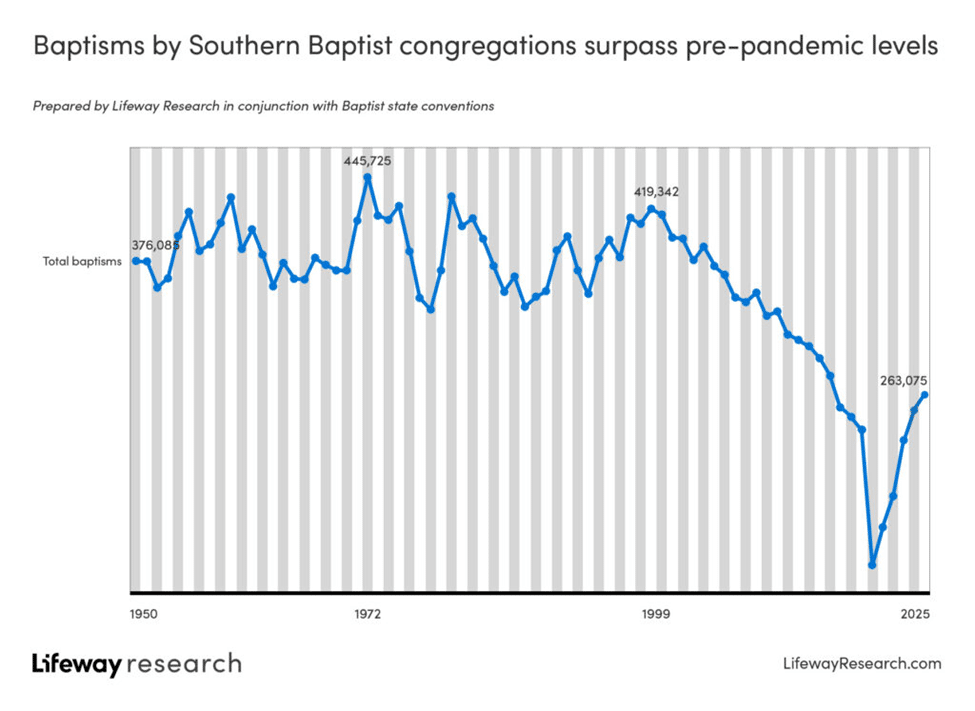
That is good news and should be received as such. Yet the larger conclusion has not changed. The SBC still loses more members than it baptizes. The denomination may be showing some evangelistic improvement, but it has not yet demonstrated evangelistic reversal.
That distinction matters. Baptism recovery can coexist with denominational contraction. In fact, that is exactly where the SBC now stands. The evangelistic engine is not completely stalled, but it is not strong enough to overcome the combined forces of membership losses, demographic aging, transfer exhaustion, and disaffiliation. The uptick in baptisms is a genuine encouragement. It is not yet proof of institutional renewal.
Aging and the Demographic Squeeze on the SBC: The Baby Boomer Tipping Point
The current moment in the SBC is not evidence of sustainable stability. It is evidence of demographic inertia. A large generation is still present, still giving, still volunteering, still occupying pews. When that generation ages out, decline will not continue linearly. It will accelerate, like the gradual erosion of a hill that ultimately leads to a landslide. The Baby Boomer tipping point is already visible in housing markets, entitlement programs, healthcare systems, and charitable giving. The church is not exempt from the same demographic math.
The age distribution data is sobering. Southern Baptists, for example, have only 6% of adults under age 30. The average (mean) age of adults in the SBC is in the late 50s to early 60s. But the modal age—the most common age—falls between 67 and 69 years old.
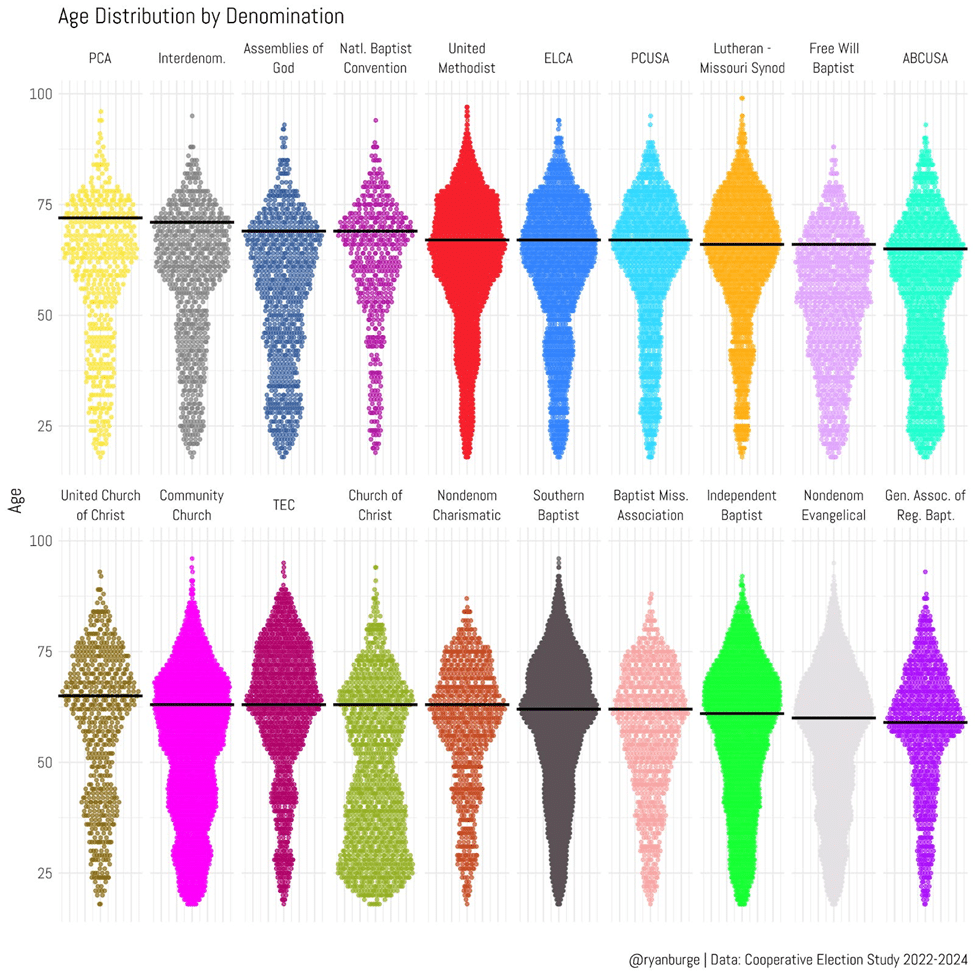
That distinction is crucial. The mean can be pulled downward by a smaller cohort of younger adults. The mode cannot. The modal age represents the largest cluster of people. It signals when the demographic wave will crest. If the modal age in your denomination is 68 and we assume active participation declines significantly after 80, then within roughly 10-15 years, the largest cohort will move through the end-of-life years. When that happens, the decline will not feel incremental. It will feel sudden. Erosion is already evident in the SBC, but the landslide is coming.
The Bigger Problem: Replacement Rates
The future is not just about death rates. It is about replacement. Across denominations, the share of adults in “peak fertility years” (18–40) has declined sharply. Southern Baptists fell from 28% in 2008–2010 to 19% in 2022–2024.
The bottom line is unavoidable:
- Birth rates are too low to offset losses.
- Transfer growth potential is largely exhausted as the median church size is half of what it was three decades ago.
- If current trends continue, SBC membership could decline by up to 50% over the next 15-20 years.
The SBC’s biggest challenge is actuarial. Among Southern Baptist adults, only 6% are under age 30, and only about one in five are under age 45. About 45% of Southern Baptist adults are Baby Boomers, more than double the Boomer share in the general adult population. Across many Protestant denominations, Boomers make up 40–50% of adult membership, which means today’s apparent stability is being temporarily propped up by one unusually large generation.
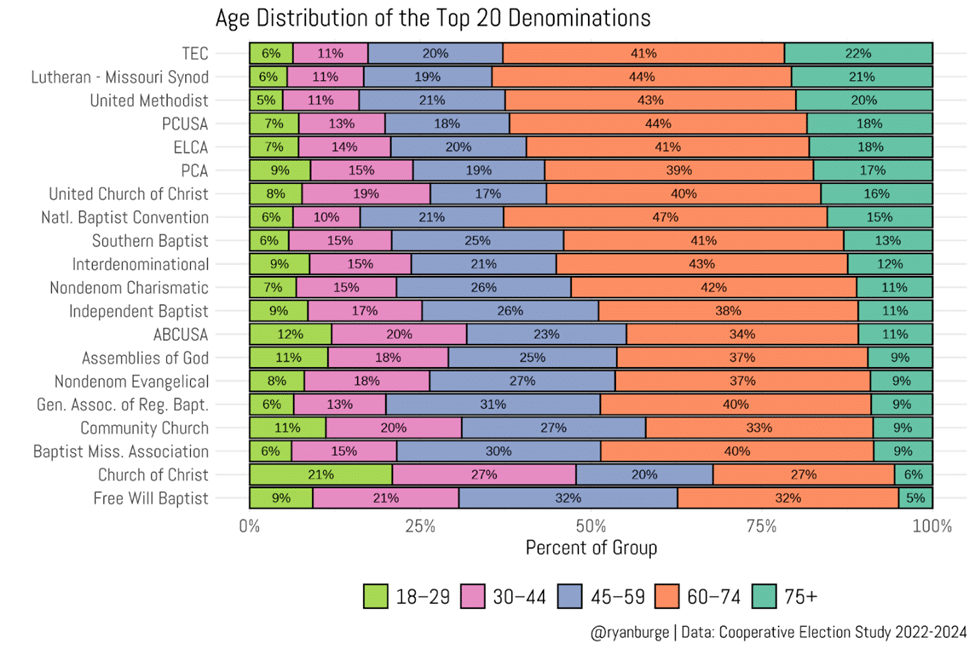
That is not a minor demographic shift. It is a generational contraction. A denomination cannot depend indefinitely on older cohorts while failing to replenish itself through younger households, new marriages, children, and emerging leaders.
This helps explain a longstanding SBC paradox. The convention grew in worship attendance during the 1980s, 1990s, and 2000s, even as baptisms were already declining rapidly. At the same time, it was beginning to age. The most plausible reading is that much of that expansion came through transfer growth—especially Baby Boomer transfers from other churches and traditions—rather than through sustained conversion growth or generational capture. The denomination grew larger without becoming younger. That is one reason the membership decline now feels stubborn and keeps occurring year after year. The inflow that once masked deeper weaknesses has largely run out.
My fear is the SBC runs out of generational fuel while leaders hit the gas. You can press the pedal as hard as you like and try to go that much faster, but you’re not going anywhere.
The Diagnosis of Decline in the SBC
Some Southern Baptists still frame decline as a kind of purification. The story goes like this: the denomination is not shrinking because it is unhealthy, but because it is becoming more doctrinally defined and spiritually serious. That interpretation should be treated cautiously. Similar rhetoric appeared in mainline denominations as they declined. When the instinct to purify exceeds the burden to reach, the inward pull has overtaken the outward call.
A more realistic diagnosis is that several forces are converging at once.
First, attendance frequency matters. People often fade before they formally leave. When once-weekly attenders begin showing up every other week, the effect on actual congregational vitality is severe even before membership rolls catch up.
Second, scandals and theological infighting carry a real public cost. Whatever one’s view of recent controversies, they have damaged trust and lowered the perceived value of denominational affiliation.
Third, the departure or removal of prominent large churches matters more than some admit. The SBC is numerically a convention of many smaller churches, but a disproportionate number of attenders and baptisms are concentrated in larger churches. When those churches leave, so do their people and statistics.
Fourth, the denomination is confronting a demographic cliff. American Protestantism is not in absolute free fall right now because it is being buoyed by Boomers. But when that modal bulge moves through the end-of-life years, decline will not feel merely gradual. It will be sudden. In many denominations, 30% losses within about fifteen years and 50% losses within about twenty years are no longer implausible scenarios.
In short, declining attendance frequency, reputational damage, institutional conflict, large-church losses, and demographic aging have converged to create an atmosphere that is not conducive to long-term growth.
The Continued Slow Deflation of the SBC
The SBC is not disappearing tomorrow. And that is precisely why this moment can be misread. Slow deflation is easier to ignore than sudden collapse. For now, there is enough residual institutional strength to maintain the appearance of continuity. Baptisms are up. Attendance has rebounded from pandemic lows. Giving, where measured, has not cratered. But none of that negates the deeper trajectory. Membership is still falling. The number of churches slipped again.
The more pressing issue is what happens when the current demographic support structure weakens. As Boomers age out, the SBC will lose both members and attenders at rates never seen before. It will lose givers, volunteers, committee members, institutional memory, and leadership pipelines. Program simplification will become inevitable. Financial pressure will rise. Churches that seem stable today may discover that their volunteer systems and revenue models were built on a generation that is no longer there.
That is why I still believe the best metaphor here is not implosion but deflation. The SBC is not imploding. It is slowly losing air. The danger is not that leaders will overreact. It is that they will mistake temporary buoyancy for durable health.
What is happening in the SBC is not unique. Other denominations are facing similar demographic realities. As national institutional influence wanes, state conventions and regional bodies may become more important, functioning increasingly like mid-sized denominations themselves. I still expect more Cooperative Program dollars to remain in the states over time and fewer to flow to national entities. The funding pie is under pressure, and the debate over how to divide it will only intensify. Meanwhile, non-denominational churches will continue to absorb some of the energy that denominations once held, and many SBC churches will quietly downplay their denominational identity even if they remain formally affiliated.
If the SBC—or any denomination—is to experience meaningful renewal, it will not come through institutional preservation alone. It will come through a grassroots recovery of evangelism, discipleship, and generational reach at the local church level.
Posted on May 11, 2026
As President of Church Answers, Sam Rainer wears many hats. From podcast co-host to full-time Pastor at West Bradenton Baptist Church, Sam’s heart for ministry and revitalization are evident in all he does.
More from Sam
About the Author