
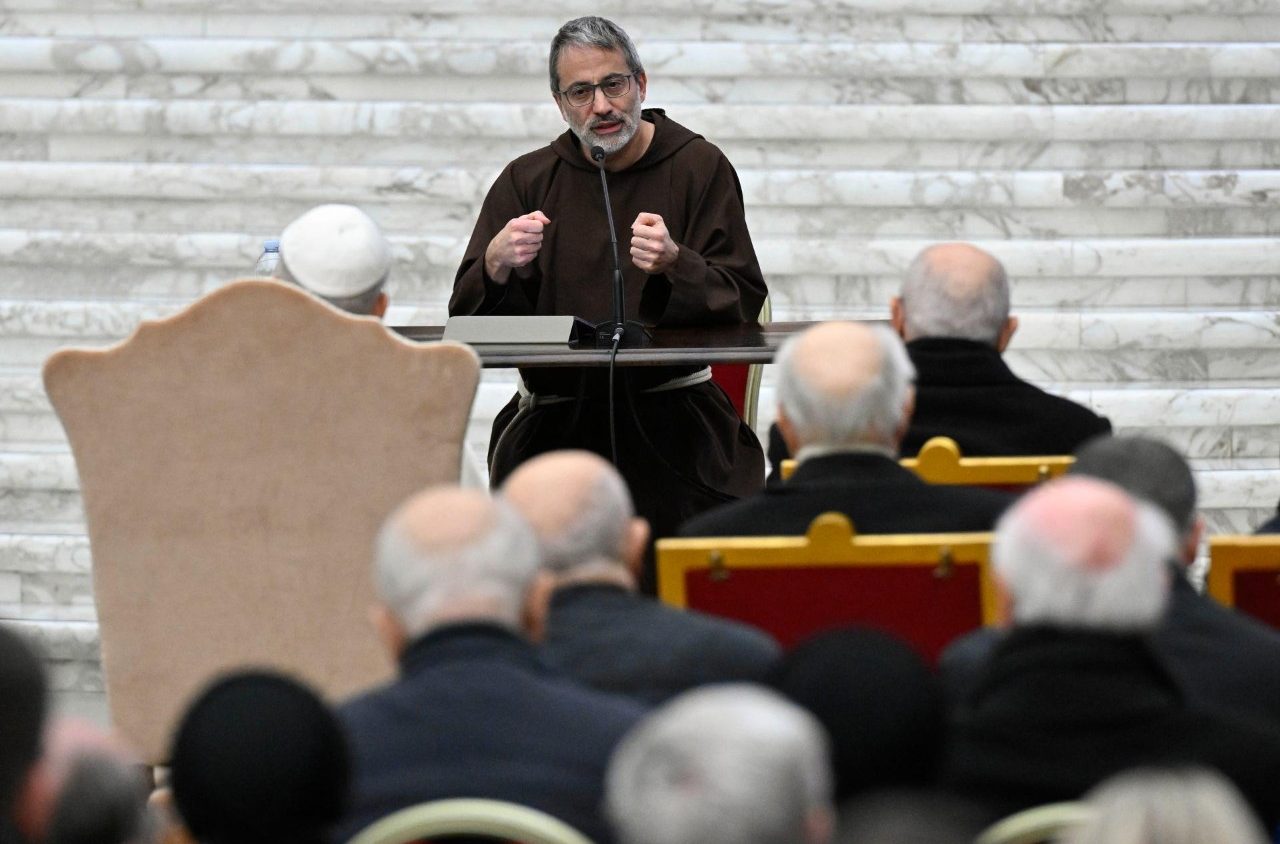
Fr. Roberto Pasolini, Preacher of the Papal Household, delivers his Lenten meditation and reflects on the theme “The freedom of the children of God: Perfect joy and death as a sister,” recalling the final stages of the earthly journey of St. Francis of Assisi, who learned “to accept his own fragility” and smallness.
By Alessandro Di Bussolo
During the fourth and final Lenten meditation, Fr. Roberto Pasolini reflected on the final stages of the earthly journey of Saint Francis of Assisi, who learns “to accept his own fragility” and smallness, and that nothing, not even rejection, illness, or death, can ever separate us from the love of God.
The theme of this morning’s meditation—held in the Paul VI Audience Hall with Pope Leo XIV present—was “The freedom of the children of God. Perfect joy and death as a sister.”
Fr. Pasolini, the preacher of the Papal Household, recalled the four Lenten sessions were guided by the figure of the poor man of Assisi who was “on the journey of conversion to the Gospel.” The most mature fruit of his experience will finally be “the freedom of the children of God.”

Fr. Pasolini is about to begin his meditation in Paul VI Audience Hall (@Vatican Media)
St. Francis guided by God in the poverty of his life
The Capuchin preacher emphasized that Francis became a saint because he learned “to be guided by God in the concreteness and poverty of his existence.” Therefore, as an alter Christus, he was able to welcome the Holy Spirit with openness. Towards the end of his life, Italian Franciscan friar Thomas of Celano recalled, Francis had “transformed into a living prayer,” meaning “his entire way of life had become like a continuous prayer.”
The journey of perfect joy
In those final years, however, Fr. Pasolini continued, St. Francis went through the “greatest temptation”. The Order of Friars Minor “grew and transformed” and he “felt sidelined, almost useless, even considered an ‘idiot.’”
Francis shared with another friar, Brother Leo, who was with him at Santa Maria degli Angeli, the parable of “true and perfect joy,” asking him to list beautiful things “that could be a source of pride for him and for the Church.”
In the end, Francis asked Brother Leo to write that “in all these things there is no perfect joy,” and explained that “authentic joy is revealed when rejection, humiliation, and misunderstanding cannot take away our peace.” True joy, Fr. Pasolini commented, lies in the way “we react in adverse circumstances, when we are rejected and excluded.”
Happiness, he continued, is not about protecting oneself from reality, but about learning to embrace it even when it hurts, without being overwhelmed. It is there that the Christian life becomes concrete, and we learn to hold on to a joy that doesn’t depend on how things go, but on how we choose to live them.
Perfect joy, then, is not the “absence of wounds,” but “freedom from being defined by them. It is a freedom that does not erase pain, but prevents it from having the final word.”
The Beatitudes: The promise of a full life
In the Gospel, Jesus shows how “this way of living – free even in the face of hatred and persecution – is the completed form of the new life in His name.” This is evident at the beginning His public ministry when he preaches the Beatitudes, which are not a law but a promise, “not a program of moral perfection, but the revelation of happiness already at work in the heart of reality.”
The Beatitudes do not invite us to flee from reality nor to postpone happiness to a distant future. They ask us to dwell more deeply in what we live, even when it appears fragile and unfinished. They announce that the path to a full life passes through our concrete experience, through who we are and what we are going through.

A moment from Father Pasolini’s meditation (@Vatican Media)
New freedom is not depending on external conditions
The Beatitudes tell us “that this life, as it is, is already the place where we can taste the fullness of life.” The preacher of the Papal Household emphasized that the Beatitudes do not outline a heroic path, “but enable us to offer a humble consent to what we are given to live, even when it costs effort, loneliness, and persecution.” They affirm that reality can become a place of happiness.
This means that life should not be postponed or idealized, but embraced in its tragic and sublime concreteness. Evangelical joy does not eliminate wounds but goes through them and transforms them, opening us to the greatest love—one that forgives. It is precisely in this adherence to reality that a new freedom is born, one that no longer depends on external conditions.
The stigmata: Consequences of love
The Capuchin preacher’s meditation then touched on the theme of mystical phenomena, in which “the mystery of Christ’s suffering is reflected in the body of the believer,” as in the event of Francis’ stigmata on Mount La Verna.
God does not “need our pain to be satisfied or glorified,” and when “He touches a person deeply, He is not adding pain but transforming and transfiguring what is already present in their story, making it a sign and consequence of love.” St. Francis ascended to La Verna with a tired body, eyes marked by an illness that was leading him toward blindness, and a soul burdened by the “great temptation” of feeling sidelined in an Order that had grown excessively.
And there, God intervenes not “by adding new wounds but by transforming those already present in life.”
The suffering of Francis – the failure of his projects, the misunderstanding of the brothers, the loneliness of one who has given himself unreservedly – cease to be a burden held inside and become a place of relationship. What seemed to separate him from others becomes what unites him with Christ and, consequently, reconciles him with his brothers.
Pain does not have the final word
The stigmata, Father Pasolini recalled, are thus “the visible sign of an inner transformation.” Francis descended from La Verna “with a marked body and a free heart.” Pain does not disappear, but it no longer has the final word. This is good news for us today. Suffering does not vanish, “but it no longer has the power to close us off. In the depths of our hearts, we discover we have a peace that nothing and no one can take away.”
The pains of life leave signs in us that we do not always understand and that we often struggle to accept. They are wounds that remain open to two possibilities: they can close us off in resentment or flight, or they can become spaces of growth and freedom.
The final opportunity for conversion
In the months leading up to his death, Francis “performs the most difficult act: he learns to beg,” not for bread, but “for consolation, closeness, tenderness. He learns to receive.” He accepted being cared for in the palace of the Bishop of Assisi. It is “the poverty of one who knows he needs others to live and to die.” When he calls Death his sister, this word “is not a consolatory metaphor,” but “the fruit of a long journey of reconciliation.” Because, as the Letter to the Hebrews says, the devil keeps us slaves all our lives for fear of death.
But when the love of Christ shapes a new life in us, that fear gradually melts away, and death changes its face, becoming the final and definitive opportunity for conversion. It is the moment when we let go of everything we are still holding on to and give ourselves—without reserve—to the just and merciful gaze of the Father.
Francis, sensing the end near, brought himself to the Porziuncola— the place he held most dear in the world. There he received a visit from his Roman friend Jacopa dei Settesogli, to whom he asked to bring the sweets he loved so much.
This is the final act of Francis’ evangelical poverty, “the poverty of one who accepts being seen in his fragility.” He dies like this, having learned “that receiving is the purest form of giving, and that allowing oneself to be loved until the end is the greatest freedom.”
Naked on the bare earth
St. Francis, Father Pasolini reminded everyone, dies as a man in need, not as a Christian hero. Rather, he is laid down naked on the bare earth. This is the fulfillment of his entire life, because “stripping away had been the red thread of his whole journey.”

Fr. Roberto Pasolini presents his fourth Lenten meditation (@Vatican Media)
When he had removed all his clothes in the city square, “he put on the habit as one wears freedom. Now, at the end of his pilgrimage, even that final garment is no longer needed.” He fought the good fight of faith. He became a true son of God. In the beginning of the world in Book of Genesis, for Adam and Eve, “nakedness is transparency; it is the condition of one who lives without defenses because they receive everything as a gift. It is the serpent who introduces suspicion, insinuating that life must be possessed and protected.” From that moment, nakedness becomes shame.
Christ fulfills this story on the cross, naked, exposed, but all the while continuing to bless. It is there that God reaches man at the most fragile point of his existence and permanently dispels any suspicion about life and death. The antidote to fear is not a stronger defense, but the opposite: stopping the defense, opening your arms, and learning to receive.
For Francis, Fr. Pasolini emphasized, “the final nakedness at the Porziuncola is not just the coherence of an ascetic journey; it is the reconciliation of a man with himself.” This is why the Church recognizes him as a saint.
He learned to accept his own fragility, to live as a son and as a brother, no longer ashamed of his smallness. It is precisely in this accepted littleness that he found the greatest freedom: the freedom to dedicate himself to the Church and the world with generosity, without measure, without calculation, and without defenses.
A journey to the freedom of the children of God
The path of St. Francis of Assisi, the preacher concluded, is not an exception reserved for a few, “but the full form of what the Gospel promises to every baptized person: a free life, capable of loving to the end and of enduring pain without being defeated by it.” A testimony before which the task of the shepherds is very delicate.
We cannot adapt the Gospel to our fears, reduce it to a reassuring proposal, or to a set of religious practices that preserve its appearance but empty it of its true spiritual power. Offering a cheap Christianity, easier but less demanding, means depriving men and women of what they truly need: a journey that can lead our steps into eternal life.
The Gospel proclaimed by St. Francis, Father Pasolini stressed, does not offer shortcuts, but “enables us to embark on a journey of purification and conversion that leads to the freedom of the Children of God.”
It is the task of the shepherds of the Church “to safeguard this truth without watering it down, indicating paths that open the doors to full maturity in Christ.” In this year when we contemplate St. Francis, let us allow ourselves to be “disturbed by the desire that guided every step of his life: to know Christ.”
