
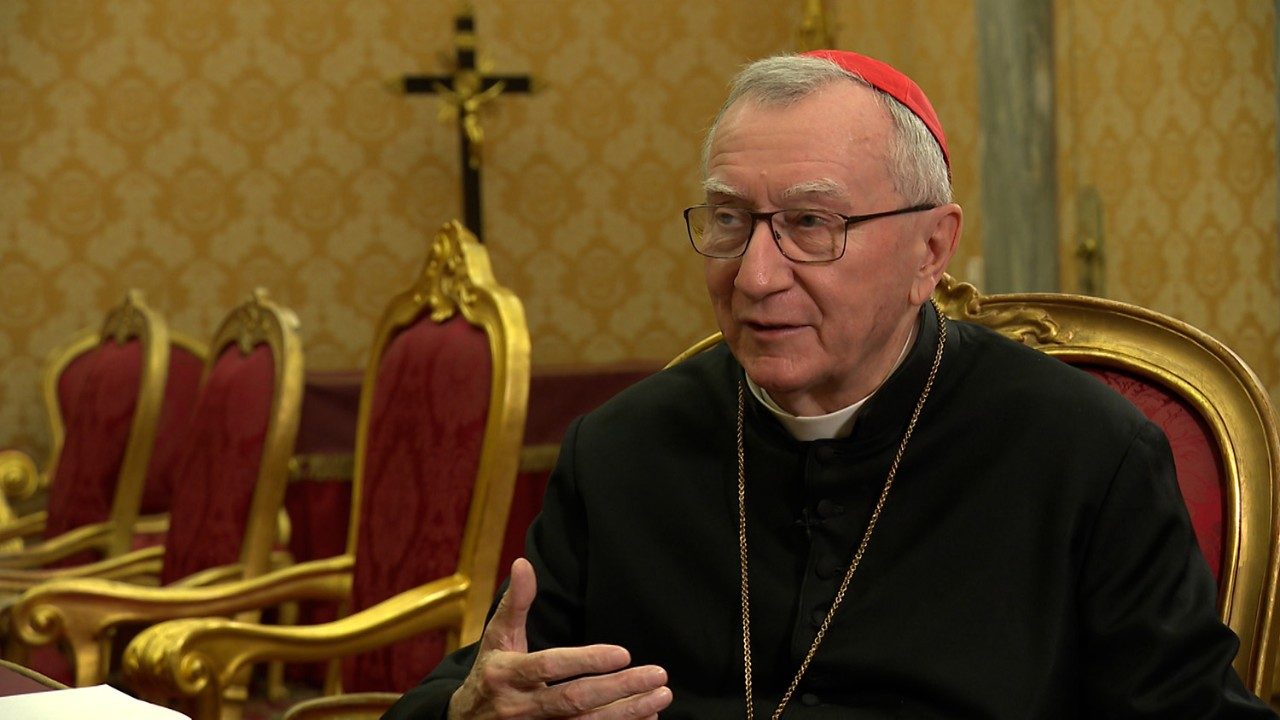
The Principality of Monaco is preparing to welcome Pope Leo XIV. “Small nations,” notes the Vatican Secretary of State, Cardinal Pietro Parolin, “prove to be natural guardians of multilateralism.”
By Massimiliano Menichetti
The Principality of Monaco is awaiting the Successor of Peter. The Pope’s first journey in Europe outside Italy is intended as a concrete sign of closeness and encouragement in faith, not only for the community of this small Catholic State, but for humanity as a whole. Cardinal Pietro Parolin, Vatican Secretary of State, expresses the hope that “this journey will give new impetus to the mission of the local Church, consolidating shared commitment on urgent fronts” such as the protection of creation, the defence of life, and the promotion of international solidarity, without forgetting “the most vulnerable.”
Your Eminence, what significance does the Holy Father’s visit to the Principality of Monaco hold?
As is well known, this is Pope Leo XIV’s first European destination outside Italy, which makes it an original choice. Historically, the visit also carries particular importance, since the last visit of a Supreme Pontiff to Monaco dates back to the 16th century, when Paul III travelled there in the context of peace negotiations between Charles V and Francis I. There are also numerous points of convergence between the Holy See and Monaco, where Catholicism remains the state religion, which is rather exceptional in today’s European context, particularly regarding the defence of life and other bioethical issues. Finally, of the Principality’s 40,000 inhabitants, around 10,000 are Monegasque nationals, who remain strongly attached to their traditions and particular devotions, foundations of their identity, unity, and continuity of institutions; I am thinking in particular of the important celebration of Saint Devota at the end of January. Thus, the institutional visit of the Pope is in perfect harmony with the pastoral visit of the Successor of Peter.
Monaco is one of the smallest states in the world. In today’s global context of tensions and wars, where many speak of a crisis of multilateralism, how can such realities contribute to the construction of a peaceful and just international order?
In an era in which international law appears weakened and at times overshadowed by the “logic of power”, with the dangerous return of theories that justify preventive wars, capable only of setting the world alight and reversing the strength of law into the law of force, small nations prove to be natural guardians of multilateralism. They represent an essential bulwark against authoritarian tendencies because, for a small state, legal norms are not a burden but the greatest guarantee of survival and freedom. Today, international influence is no longer measured solely by military strength, but by moral credibility and the ability to act as neutral bridges for reconciliation. Realities such as Monaco show that authentic security does not lie in armaments, but in the stability of relationships. A lasting peace must be first and foremost “just,” grounded in respect for human dignity and not imposed balances. It is often precisely small states that lead the global agenda on existential challenges such as ocean protection and sustainable development, issues that transcend geographical borders and call for shared responsibility.
The Holy Father reiterates that peace cannot be built using weapons. What message might emerge from this first visit to Europe?
The Holy Father’s choice of Monaco is also part of a strategic logic consistent with the diplomatic tradition of the Holy See. In this journey, one can identify continuity with the previous pontificate, which regarded the Mediterranean as a laboratory of peace in which to develop the “conviviality of differences.” Already in the 1950s, Giorgio La Pira perceived the value and geopolitical role of the Mediterranean space as a pivotal point for world peace, from which “the wave of negotiation and peace will reach the peoples of the whole earth!” The Holy Father, however, strongly reiterates that the prerequisite for peace among peoples lies in unity with God and with ourselves. Only a reconciled person is capable of entering into a dynamic of peace and becoming an agent of reconciliation in daily life.
Monaco lies at the heart of Europe and faces the Mediterranean, a region marked by major challenges: from conflicts to migration. What actions should European countries take in this context?
In the current context of serious conflicts and intense migratory flows, with more than 600 deaths in the Mediterranean in the first two months of 2026 alone, it’s the highest figure since 2014, European countries are called to be a “beacon of civilisation and humanity.” Faced with the threat of endless conflicts and the multiplication of wars, it is necessary to act with “courage and patience” in building pathways of dialogue, avoiding any resort to the logic of rearmament. Europe must rediscover the inspiration of its founding fathers, moving from a logic of narrow national interests and security-driven egoisms to an authentic project of integration and solidarity, placing human dignity at the centre of all policy. In the face of the erosion of global norms, European countries are called to reaffirm the primacy of international law, using negotiation as the only instrument for a just peace that is not merely the absence of war, but the construction of a shared truth. As for the migratory challenge, it cannot be solved through closure or the building of walls, but by addressing the root causes that lead entire peoples to leave their homelands, and by investing in the so-called “right not to emigrate” through stability and economic growth in countries of origin. It is urgent to move from emergency management to a strategic vision that combines reception, rights protection, and integration, rediscovering Europe’s humanist and Christian vocation. True European security is not built in isolation, but in responsible openness, investment in young people, and commitment to shared social justice on both shores of the Mediterranean.
The Mediterranean has often been described as a “bridge between peoples and religions.” Do you believe it can still play this role?
The Mediterranean is not a mere geographical coordinate, but a spiritual and cultural crossroads: this is the vocation history entrusts to us. This vocation is not an automatic inheritance of the past, but a commitment to be renewed daily through a culture of encounter. Since peace is often built starting from borders, the shores of this sea are today called to become permanent laboratories of interreligious dialogue and political cooperation. The aim is ambitious: to transform geographical proximity into true fraternal closeness. Despite tensions, there are already numerous “seeds of peace” – young people, communities, and ecclesial realities – working so that diversity is not perceived as a threat, but as a shared richness. Our effort, which is both diplomatic and pastoral, seeks to rekindle this light: the Mediterranean can still teach the world that coexistence is the only path to a truly human future.
What encouragement will the Pope bring to the Catholic community of the Principality, which lives in a de facto international and multicultural society?
The Holy Father comes to Monaco to confirm his brothers and sisters in the faith, aware that the witness of a strong Catholic community, consistent in its testimony of faith and life dedicated to the service of the common good, can be a source of esteem and, why not, inspiration for other European countries that share the same roots. Concretely, the Holy Father’s visit will be an encouragement to deepen the life of faith through the search for truth and an invitation to renew the desire for interior life. Moreover, the universal dimension of Catholicism gives it a real capacity to open itself to the diversity of a multicultural and international society through encounter.
The Principality of Monaco has a long tradition of relations with the Holy See. What do you personally expect from this visit?
This Apostolic Journey is not only a diplomatic act, but a historic moment of profound ecclesial significance. Pope Leo XIV, the first Pontiff to visit the Principality in modern times, comes to write a new page in the centuries of fruitful friendship between the Holy See and Monaco. The chosen motto, “I am the Way, the Truth and the Life” (Jn 14:6), expresses the heart of the magisterium the Holy Father wishes to offer: to reaffirm the primacy of Christ in an era marked by complex challenges and uncertainties. Despite the brevity of the journey, the presence of the Successor of Peter on the eve of Holy Week takes on a prophetic value. Monaco us shows that the Catholic faith, even when it is the state religion, does not suffocate but enlightens civic coexistence. The Principality thus demonstrates that a “healthy secularism” is possible, where cooperation between Church and State is not only a legacy of the past but a living force capable of engaging with modernity without losing its Catholic roots. The hope is that this journey will give new impetus to the mission of the local Church, strengthening shared commitment on urgent fronts: the protection of creation, the defence of life, and the promotion of international solidarity that does not forget the most vulnerable. Pope Leo XIV comes to remind us that only by walking in Truth can authentic and lasting peace be built.
