
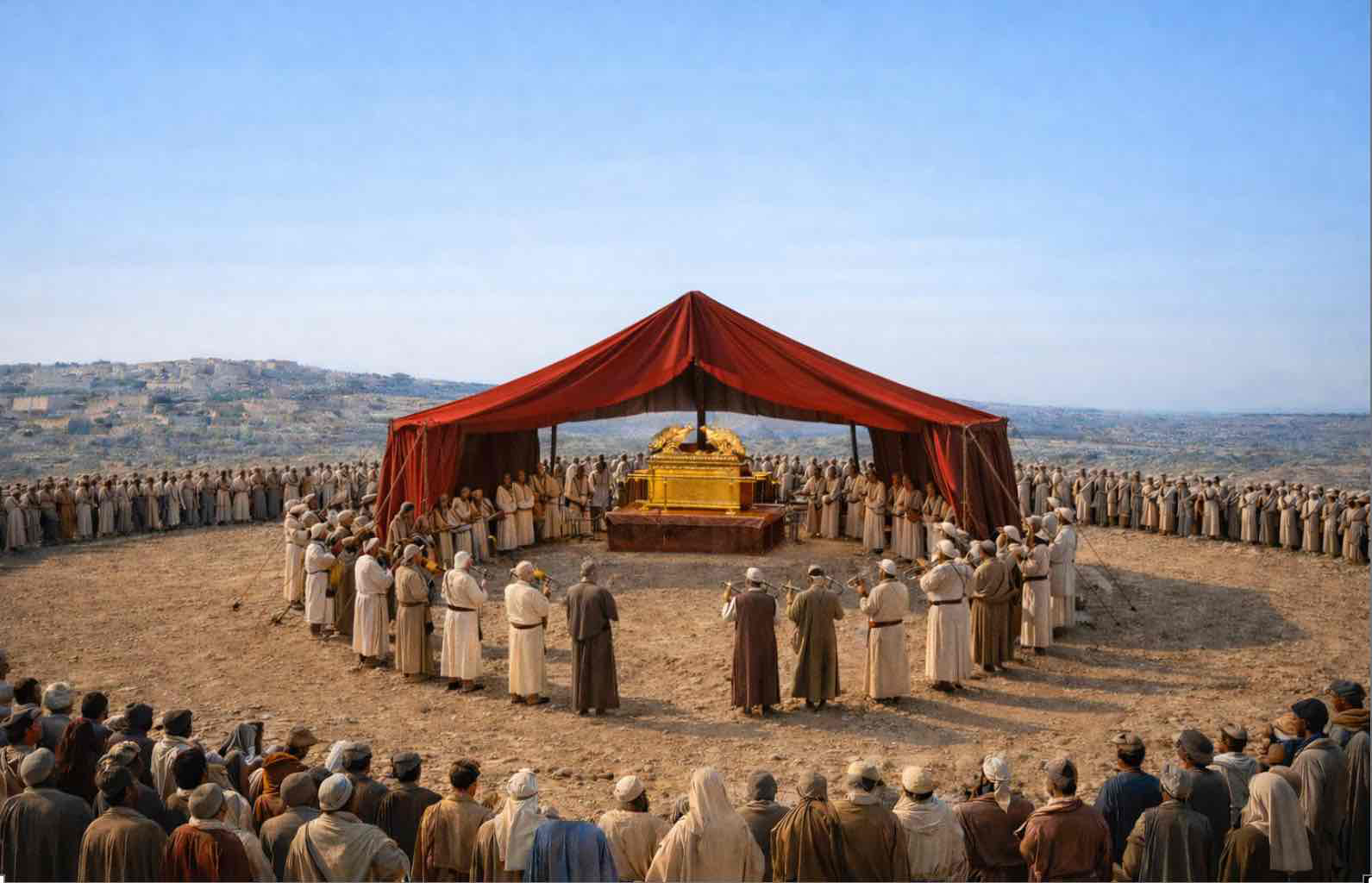
‘After this, I will return and rebuild ‘The Tabernacle of David’ that has fallen, that the rest of mankind may seek the LORD, and all the Gentiles who are called by my name.’
Acts 15:16–17

The Tabernacle of David
Never confuse the Tabernacle of David (I Chron. 16) with the Tabernacle of Moses.
In the Tabernacle of David, we have a foreshadowing of New Covenant worship.
My father, Paul Burleson, made a reputation for his teaching on the Tabernacle of Moses.
In my biased estimation, he was the best teacher in Christian history on that subject.
This post isn’t contrary to any of the truths my father revealed in ‘The Tabernacle of Moses’ (Exodus 25-27), but rather, I write about the little-known or understood Tabernacle of David. (I Chronicles 16) and how it’s different from Moses’ Tabernacle.
What Is the Tabernacle of David?

You might have never heard of ‘The Tabernacle of David.’
Don’t feel embarrassed. Most preachers don’t know about the Tabernacle of David and the differences between it and the Tabernacle of Moses.
The Tabernacle of David, or ‘The Tent of David,’ is the place King David brought the Ark of the Covenant to Jerusalem in 1000 BC after fifty years of neglect.
The Tabernacle of David remained on top of the threshing floor of Ornan (the Jebusite) on Mount Moriah in Jerusalem for 33 years (1000 BC to 967 BC). The only thing in the Tabernacle of David was the Ark of the Covenant.

The Messiah lived on earth for 33 years, as David’s Tabernacle lived on Moriah for 33 years.
Until King David died in 971 BC and during the first four years of Solomon’s reign (971-967 BC), the Tabernacle of David remained on Mount Moriah, with the Ark of the Covenant inside.
During this entire time, the Tabernacle of Moses remained at Gibeon, and the priestly functions, daily sacrifices, and the Jewish festivals occurred at Gibeon:
‘Then Solomon spoke to all Israel—to the commanders of thousands and commanders of hundreds, to the judges and to all the leaders in Israel, the heads of families— and Solomon and the whole assembly went to the high place at Gibeon, for God’s tent of meeting was there, which Moses the Lord’s servant had made in the wilderness.’ — 2 Chronicles 1:2-3
- For 33 years, the Tabernacle of Moses stood at Gibeon without the Ark in it.
- For 33 years, the Tabernacle of David stood at Moriah with only the Ark in it.
This Tabernacle of David is mentioned just four times in the Bible.
I Chronicles 16:1 – ‘So they brought the ark of God, and set it in the midst of the tabernacle that David had erected for it.’ In 1000 BC, King David of Israel brought the Ark of the Covenant to the Temple Mount and placed it under a tent (tabernacle) that David had established for it.
2 Samuel 6:17 – ‘They brought in the ark of the LORD and set it in its place inside the tent which David had pitched for it…’ Samuel gives the contempary account of King David establishes a special tent in Jerusalem for the Ark of the Covenant. I Chronicles is written 500 years after Samuel by the scribe Ezra and he repeats what Samuel records, showing the importance of the Tabernacle of David and the continuous music and praise around the Ark that took place.
Amos 9:11 – ‘In that day I will raise up the fallen tabernacle of David…’ Through the prophet Amos, YHWH promises that after Judah’s judgment (AD 70), He will restore the fallen dynasty of David, rebuild its ruins, and reestablish it as in former days. This Amos prophecy is Messianic and is later interpreted by the apostles in Acts 15 to the Kingdom restored through the Messiah.
Acts 15:16 -17: – ‘After these things I will return, and I will rebuild the tabernacle of David, so that the rest of mankind may seek the LORD…’ James, in speaking to the Jerusalem Council, quotes Amos 9:11 in defense of Paul and Baranabas who were ‘preaching to the Gentiles.’ James said, “The prophecy of Amos is fulfilled through the Messiah and the rebuilding of the Tabernacle of David (His people who continously worship), that ‘All nations (Gentiles) may seek the LORD.’
The First Chronicles 16 description of the Tabernacle of David is the most precise and beautiful typology of New Covenant Worship (post-AD 70) in the Hebrew Scriptures.
The Differences Between the Two Tabernacles

When David placed the Ark in that open tent around 1000 BC, musicians surrounded it, and people gathered in a circle of worship.
One thousand years later, the apostles said in Acts 15: That moment when the Tabernacle of David appeared was not merely history, it was a prophecy.
The church of Jesus Christ in the New Covenant Age comprises both Jews and Gentiles and is the rebuilt Tabernacle of David, gathered around the presence of the risen Christ.
The Tabernacle of David Represents:
- Open access to God
- Continual praise
- The presence of God among His people
- The inclusion of the nations (all people) in this new Tabernacle.
That is why the apostles, in Acts 15, referred to the Tabernacle of David in defense of presenting the Gospel of Jesus Christ as ‘Good News’ to the Gentiles.
The Apostles understood that Christ’s Church was not merely a continuation of Israel.
The Church is the restoration of David’s Tent with the greater Son of David at the center.
Model Your Worship after the Tabernacle of David

1. The Ark (Christ) Was Present in David’s Tent.
A. In the Tabernacle of Moses
- The Ark was always hidden behind the veil in the Holy of Holies.
- Only the High Priest could enter the Holy of Holies on Yom Kippur (Leviticus 16).
- Then, in 1000 BC, ‘the Ark was removed,’ and for 33 years rituals continued at the Tabernacle of Moses, while the Ark of the Covenant sat in the center of the Tabernacle of David.
B. In the Tabernacle of David
- The Ark sat in the open tent in Jerusalem (1 Chron. 16:1).
- There was no veil covering the Ark of David
- The presence of God was visible and accessible at the Tabernacle of David.
- There were no priests between the people and YHWH.
- The people stood all around the Tabernacle of David and did three things;
- Expressed gratefulness and thanksgiving for what the LORD had done.
- Remembered His covenant, lovingkindness, and grace toward His people.
- Declared the goodness of God to each other, and left, declaring that goodness to all the nations around Israel.
The major difference:
➡ Moses’ tabernacle emphasized separation from God.
➡ David’s tent emphasized access to God.
At the Council of Jerusalem, when Paul and Barnabas had to defend taking the Gospel of Jesus Christ to the nations, James (part of the Jerusalem council) cited the prophecy of Amos 9:11:
13After Paul and Barnabas had stopped speaking, James (spoke to the Council), saying, “Brethren, listen to me. 14 Simeon has related how God first concerned Himself about taking from among the Gentiles a people for His name. 15 With this the words of the Prophets agree, just as it is written,
16 ‘After these things I will return,
And I will rebuild the tabernacle of David which has fallen,
And I will rebuild its ruins,
And I will restore it,
17 So that the rest of mankind may seek the Lord,
And all the Gentiles who are called by My name.’
Acts 15:13-17
The ‘return’ referred to is the ‘return of Christ’ to destroy the Temple in Jerusalem via the Roman army (AD 70), and the beginning of ‘rebuilding the tabernacle of David (the church of Jesus the Messiah).
The 33 years of the Tabernacle of David represent the 33 years of the Life of Christ, who died and rose again, conquering sin and death. He returned after His ascension to ‘rebuild the Tabernacle of David ‘as it was in the days of old’ (see Amos 9:11).
What you see in the Tabernacle of David is a beautiful Type of the Church of Jesus Christ.
2. Sacrifice for God vs. Praise for Christ.
A. In the Tent of Moses
Worship centered on constant sacrifices:
- Burnt offerings
- Sin offerings
- Grain offerings
- Guilt offerings
The entire system emphasized atonement through blood.
B. In the Tent of David
At David’s tent, worship centered on praise and thanksgiving. There was no altar, no place for sacrifice, and no priestly system of ritual.
1 Chronicles 16:4:
“He appointed some of the Levites as ministers before the ark of the Lord, to celebrate and to thank and praise the Lord God of Israel.” (NASB)
The major difference:
➡ Moses: sacrifice-centered worship
➡ David: praise-centered worship
3. Priestly Restriction vs. Levitical Participation.
A. The Tent of Moses
Access was extremely restricted:
- Only priests served at the altar.
- Only the High Priest entered the Holy of Holies.
B. The Tent of David
David placed people all around the Ark (a type of Christ), and the Levites led the people in worship, praise, and thanksgiving with their instruments.
1 Chronicles 16:5:
“Asaph the chief, and second to him Zechariah, then Jeiel, Shemiramoth, Jehiel, Mattithiah, Eliab, Benaiah, Obed-edom, and Jeiel, with musical instruments.”
The major difference:
➡ Moses: hierarchical priesthood
➡ David: corporate participation in worship
4. Ritual Structure vs. Continuous Worship.
A. The Tent of Moses
The system was highly structured:
- Morning sacrifice
- Evening sacrifice
- Specific feast days
- Exact ritual procedures
B. The Tent of David
David instituted continual praise.
1 Chronicles 16:37:
‘So he left Asaph and his relatives there before the ark of the covenant of the Lord to minister before the ark continually.’
This implies 24-hour praise.
Major difference:
➡ Moses: scheduled ritual worship
➡ David: continuous worship
5. A Law Emphasis vs. A Covenant Celebration.
A. The Tent of Moses
The Mosaic system emphasized:
- The Law of Moses
- Covenant obedience
- Sin and purification
B. The Tent of David
David’s worship centered on celebrating God’s covenant promises.
1 Chronicles 16:15–16:
‘Remember His covenant forever…
The covenant which He made with Abraham.’
David’s worship was joyful proclamation, not ritual compliance.
You know you’re in a New Covenant church when the emphasis is on God and His promises to sinners through Christ, not on sinners and our performance for God.
The Major difference:
➡ Moses: law-centered worship
➡ David: promise-centered worship

New Covenant worship requires no sacrifice, no priest, no ritual, only Christ.
David’s tent becomes a prophetic picture of New Covenant worship.
The early church recognized this. In Acts 15, the apostles say that the inclusion of the Gentiles fulfills the prophecy:
God will ‘rebuild the tabernacle of David’ through the work of Christ.
The implication is profound. In God’s New Agreement with the world in Christ:
- There is open access to God for people from all nations through Christ.
- Praise for God and His work in Christ replaces ritual sacrifices.
- All nations are invited to participate in the worship, not just Israel.
- Worship is centered on God’s presence and promises, not our performance.
By the way, when David dedicated the Tent of David, he wrote a unique Psalm. Portions of this majestic Psalm are found in Psalm 96, Psalm 105, and Psalm 106.
Below is David’s Psalm at the dedication of the Tabernacle of David in its entirety (see 2 Chronicles 16:8-36).
Before you read David’s Psalm, I want you to recognize that all New Covenant preaching, teaching, worship, and congregational focus should be centered around the truths represented in this Psalm.
- There is nothing in the Psalm about offering anything to God.
- There is only praise, gratefulness, and remembrance of what God has done in it.
- The truth of God’s lovingkindness and everlasting goodness is a message to be revealed to the nations according to the Psalms.
- The centrality theme of the Psalm is the LORD, not us.
- The LORD and His work, His word, and His faithfulness and love are central!
8Give praise to the Lord, proclaim his name;
make known among the nations what he has done.
9 Sing to him, sing praise to him;
tell of all his wonderful acts.
10 Glory in his holy name;
let the hearts of those who seek the Lord rejoice.
11 Look to the Lord and his strength;
seek his face always.12 Remember the wonders he has done,
his miracles, and the judgments he pronounced,
13 you his servants, the descendants of Israel,
his chosen ones, the children of Jacob.
14 He is the Lord our God;
his judgments are in all the earth.15 He remembers his covenant forever,
the promise he made, for a thousand generations,
16 the covenant he made with Abraham,
the oath he swore to Isaac.
17 He confirmed it to Jacob as a decree,
to Israel as an everlasting covenant:
18 “To you I will give the land of Canaan
as the portion you will inherit.”19 When they were but few in number,
few indeed, and strangers in it,
20 they wandered from nation to nation,
from one kingdom to another.
21 He allowed no one to oppress them;
for their sake he rebuked kings:
22 “Do not touch my anointed ones;
do my prophets no harm.”23 Sing to the Lord, all the earth;
proclaim his salvation day after day.
24 Declare his glory among the nations,
his marvelous deeds among all peoples.25 For great is the Lord and most worthy of praise;
he is to be feared above all gods.
26 For all the gods of the nations are idols,
but the Lord made the heavens.
27 Splendor and majesty are before him;
strength and joy are in his dwelling place.28 Ascribe to the Lord, all you families of nations,
ascribe to the Lord glory and strength.
29 Ascribe to the Lord the glory due his name;
bring an offering and come before him.
Worship the Lord in the splendor of his holiness.
30 Tremble before him, all the earth!
The world is firmly established; it cannot be moved.31 Let the heavens rejoice, let the earth be glad;
let them say among the nations, “The Lord reigns!”
32 Let the sea resound, and all that is in it;
let the fields be jubilant, and everything in them!
33 Let the trees of the forest sing,
let them sing for joy before the Lord,
for he comes to judge the earth.34 Give thanks to the Lord, for he is good;
his love endures forever.
35 Cry out, “Save us, God our Savior;
gather us and deliver us from the nations,
that we may give thanks to your holy name,
and glory in your praise.”
36 Praise be to the Lord, the God of Israel,
from everlasting to everlasting.
When worship leaders or church leaders seek to focus on ‘the feelings of the worshipper,’ or ‘the duties of the congregation,’ or ‘the necessary sacrifices for approaching God’ in a holy manner, the Gospel is lost in ritual.
Too many people continue to worship at Gibeon without realizing that Christ’s presence is gone. The evidence of New Covenant worship is our focus on Him.
I once had a mother who said to me, ‘Pastor Wade, we are leaving the church. You never talk about what my teenage son needs to hear. He needs to hear his pastor tell him how he ought to live, how he should shape up, what he can do to become acceptable to God, but all you ever do is talk about Christ and what He’s done.’
I told her she had just given me the greatest compliment I’ve ever received.
Real New Covenant worship and teaching are all about Him.
The Tabernacle of David foreshadows the New Covenant.
