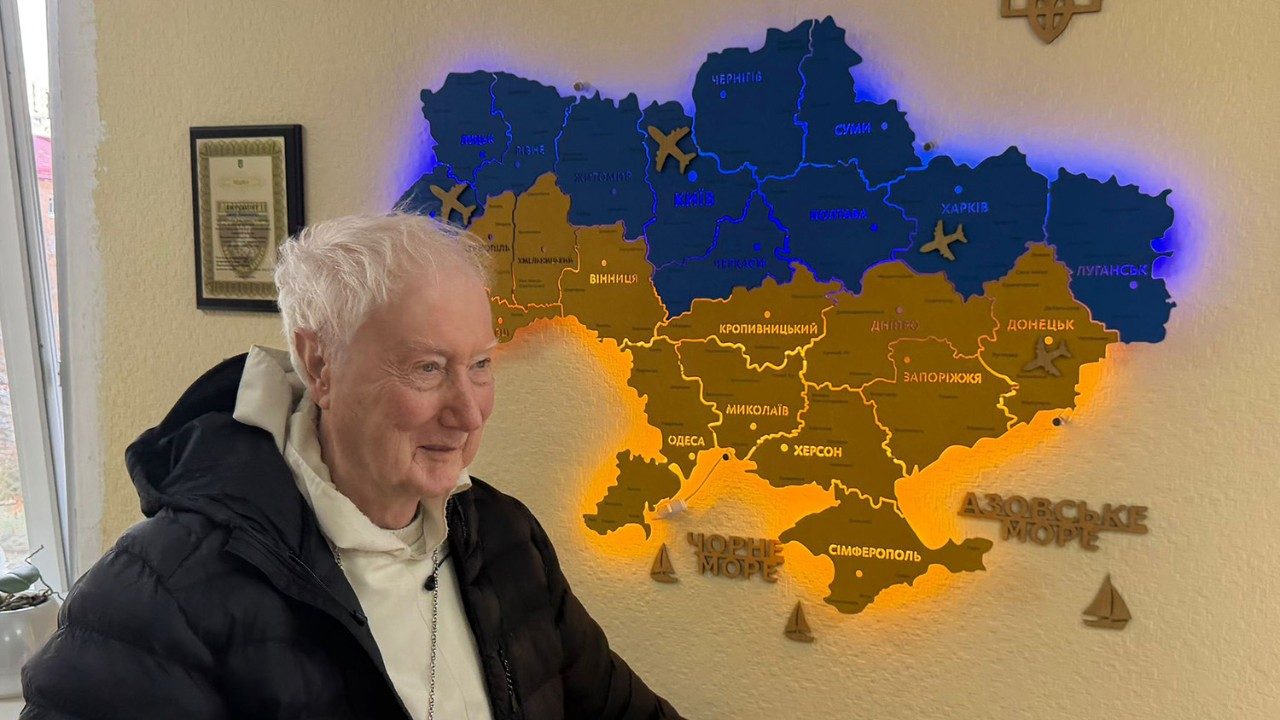
Cardinal Timothy Radcliffe, O.P., concludes his visit to Ukraine and speaking to Vatican News, he reflects on the most moving encounters he experienced in the war-torn country.
By Fr. Jarosław Krawiec, OP and Sr. Alina A. Petrauskaitė, SCM
Cardinal Timothy Radcliffe recently concluded a journey to Ukraine to express his support and solidarity to the local Church and the communities of the Order of Preachers. He arrived in the capital, Kyiv, on February 27 and visited several cities across the country.

Cardinal Radcliffe at the Odessa Cathedral with Bishop Shyrokoradyuk
Reflecting on his experience in the war-torn country, the Cardinal recounted some of the most moving meetings he had during his journey. In the midst of the devastation and destruction, he told Vatican News he “encountered great courage” as people are “determined to stay and do their best to build a future.” Cardinal Radcliffe also stressed that “we must remember that the Ukrainian people who suffer are our brothers and sisters.”
The following is a transcript of the interview recorded by Fr. Jarosław Krawiec, OP.
Cardinal Timothy Radcliffe, you have just returned from a visit to Ukraine. Could you briefly tell us which places you visited and what you did during your trip?
We began our journey in Kyiv, which was a wonderful experience. I was deeply moved when we visited the military hospital and met some of the wounded soldiers, as well as the remarkable director of the hospital, Ivan Yavorskyi. We then went to Fastiv to visit St. Martin’s Mission. It was inspiring to see so many joyful volunteers and the way they care for children and involve local people in their efforts to serve the people of God. Kherson was, in many ways, the most moving place for me. There, you can see how war destroys community life. Only a few elderly people remain.

Prayer at the Parish of the Sacred Heart of Jesus in Kherson
Yet it was also there that we encountered great courage – people who are determined to stay and do their best to build a future. In Odesa, we had a beautiful visit and were warmly received by bishop Stanislav Shyrokoradiuk, the ordinary of the Odesa-Simferopol diocese.
After that, we returned to Kyiv and then travelled to Kharkiv. Kharkiv has suffered greatly, yet once again, we witnessed wonderful signs of hope. We saw the work of the Orionist Sisters with single mothers, a place filled with joy. We also took part in an encounter with the Greek Catholics during their liturgy and met bishop Pavlo Honcharuk, the ordinary of the Kharkiv-Zaporizhzhia diocese, at the Catholic cathedral.

Cardinal Radcliffe at the Odessa Cathedral with Bishop Shyrokoradyuk
Finally, returning to Kyiv almost felt like coming home. When it was time for me to leave Ukraine, I was glad to be on my way home, but at the same time, I was also sad to say goodbye to people whom I had come to admire and love.
You have spent several days in Ukraine and even visited Kherson, which is on the front line, as well as Kharkiv near the border with Russia. What is the most important reflection you take away from this time?
It is still very early. I need time to digest everything and reflect on it. One of the most beautiful images for me in Kherson was seeing bread being baked for people, prepared on the spot by local volunteers. Every day in the “Our Father” we pray, “Give us this day our daily bread,” and there we saw that bread being made. At the same time, we also experienced the presence of drones and sensed how vulnerable people are to attack. One could feel the stress they must live with and the exhaustion of enduring day after day under the threat of violence.
Which encounter made the greatest impression on you during your stay?
One of the most moving encounters was with the children of single mothers in Kharkiv. These children have endured so much. Many of them wonder about their future and where they belong. Seeing the joy that the sisters brought to them was something truly wonderful. I was also deeply impressed by my conversation with Father Maksym Padlevskyi in Kherson, who remains there almost alone, faithfully serving on the front line. For me, that was one of the most moving and powerful experiences.
During your visit, you also met members of several religious communities – the Orionine Sisters, Carmelites, Basilian Fathers, and Dominicans. In your opinion, what is the role of religious people in a time of war?
The great thing about being a religious is that you are a brother or a sister. In times of war, the danger is to think only of yourself and to retreat inward. But Pope Francis calls us to a fraternity that embraces the whole world. Every religious person should be a sign of that fraternity—not only within our own communities or our own countries, but of the fraternity of all humanity united in Christ.

Visit to the bakery in Kherson, which operates under the guidance of the Dominican Fathers
You met many people in need. How can people around the world help and support Ukraine? What is the most important need right now?
I think all of us must remember that the suffering of Ukraine is not only the suffering of one country—it is the suffering of the whole world. The question before us is whether we will remain a world in which freedom and democracy endure. Ukraine is on the front line not only of its own conflict, but of a decisive moment for the world. At this time, we must remember that the Ukrainian people who suffer are our brothers and sisters—what the prophet Isaiah called “flesh of our flesh and blood of our blood.”

Fraternal meeting of the Dominicans and Basilian Fathers in the Kharkiv region
Finally, a new war is ongoing in the Middle East. You have made many appeals for peace; do you have any words of hope for those who are currently experiencing fear?
There is always hope. Every time we celebrate the Eucharist, we celebrate the sacrament of hope, even when hope seems absent. It saddens me deeply to see the same mistakes repeated again and again—the illusion that problems can be solved by killing people. They cannot. But let us hope that, little by little, the world will come to see that peace can only be found when we recognise the stranger as our brother and sister.
About the Author