
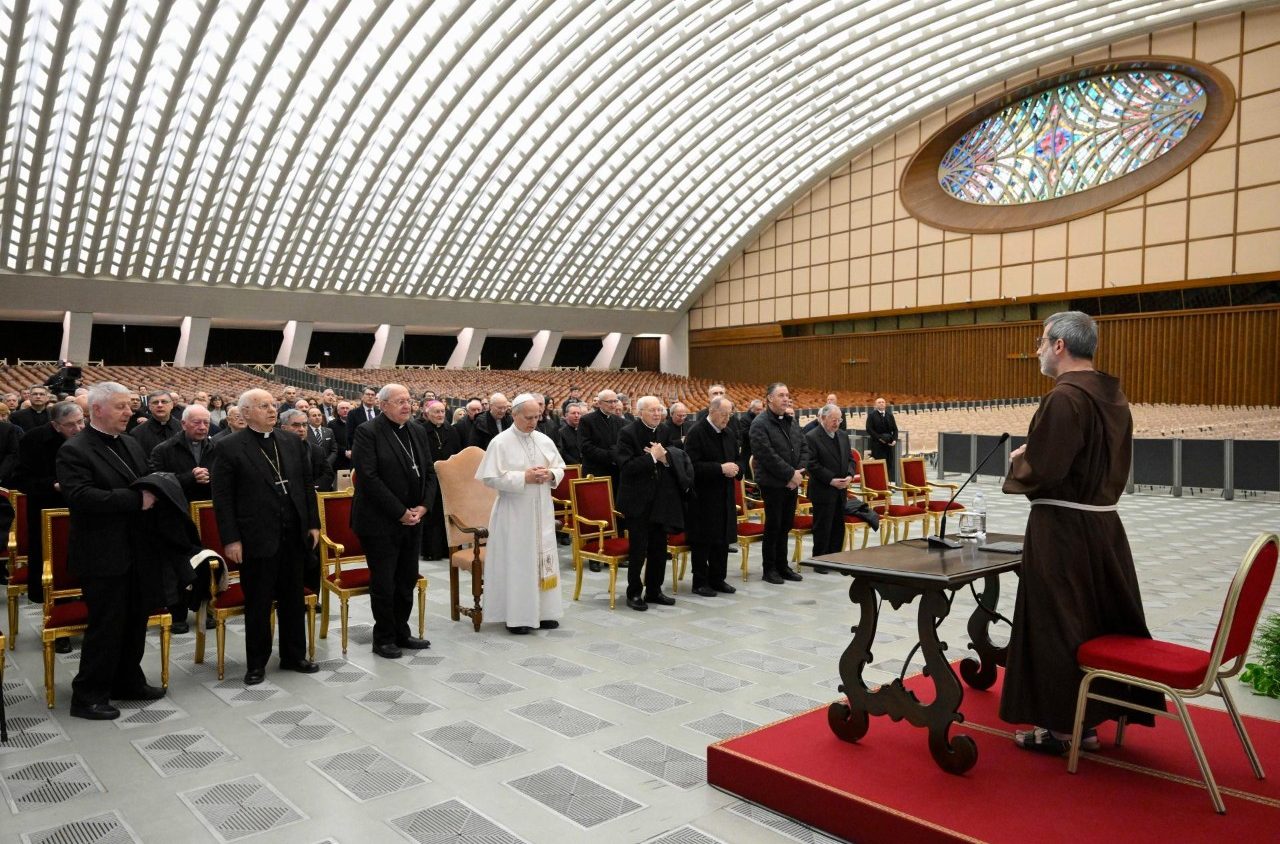

The Preacher of the Papal Household, Fr. Roberto Pasolini, delivers his second Lenten meditation to the Roman Curia, with Pope Leo in attendance, and reflects on the grace and responsibility of communion, drawing on Saint Francis’s insight that relationships with others are an opportunity to learn the logic of the Gospel.
By Edoardo Giribaldi
The Preacher of the Papal Household, Father Roberto Pasolini, delivered the second of the four Lenten meditations in the Vatican’s Paul VI Hall, in the presence of Pope Leo XIV.
The meditations are scheduled every Friday until March 27 and centered on the theme “If anyone is in Christ, he is a new creation”—the Capuchin friar reflected on “Fraternity – The Grace and Responsibility of Fraternal Communion.”
Fraternity, Fr. Pasolini said, is not an accessory of spiritual life, nor merely a favorable context in which one can grow more easily in grace. !It is the place where conversion truly takes place, the most serious testing ground, and, at the same time, the most eloquent sign of what the Gospel can accomplish in our lives”
The example of the first Franciscan Communities
In his reflection, Fr. Pasolini recalled the life of the early Franciscan communities, which Saint Francis of Assisi wanted to exist without relationships of power or superiority, similar to the first Christian communities. The Papal Preacher suggested these were not spaces “to take refuge in order to live quietly,” but contexts that lead people back “into the depths of their own hearts,” with all their shadows and anxieties.
“Brothers are a gift from the Lord,” he said. “But precisely for this reason, they do not simply have the function of helping or supporting us along the journey: they are entrusted to us so that our lives may change.”
“The one who comes from the same womb”
Reflecting on the etymological meaning of the word brother—adelphós, literally “the one who comes from the same womb”—the Preacher of the Papal Household observes that brothers do not merely confirm “what we are,” but call us to transformation.
In their diversity, their limitations, and sometimes even in their struggles, Fr. Pasolini suggested, they become the concrete space in which God works on our humanity, loosening our rigidities and teaching us to live with a truer heart, one more capable of love.
Abel and Cain: a “problem of perspective”
One of the stories that best describes these resistances is the “painful relationship” between Abel and Cain. The Capuchin friar went on to suggest that the fracture arises from “a problem of perspective.”
In the Genesis account, the first brother offers the firstborn of his flock, an offering that God “looks upon with favor,” while the second simply presents some fruits of the soil.
The difference, he said, lies not so much in the quality of the offering as in whether what is offered truly represents one’s life.
“For this reason, God does not accept Cain’s gift, not to condemn him, but to provoke him,” the Papal Preacher observed.
“Accepting that gesture,” he added, “would mean leaving him in the belief that he truly has nothing good to offer. Instead, God seems to want to help him believe that his life too can become a gift.”
“Who is Cain within us?”
From this episode, Fr. Pasolini invites listeners to question themselves, asking “who is Cain within us,” calling on us to ask ourselves how much space resentment occupies in each person’s heart.
The bitterness that arises, he recognized, often is fed by our realizing that “we are not alone” and “we are not everything.”
“When we fail to make peace with this reality,” he said, “the presence of the other can become unbearable.”
The logic of mercy toward those who fail
For Saint Francis, however, Fr. Pasolini reasoned, fraternity was not a problem to be solved but an opportunity to learn the merciful logic of the Gospel toward a neighbor who makes mistakes. A similar dynamic, the Papal Preacher added, can also be found in the brief yet intense Letter to Philemon written by Saint Paul.
“When relationships crack and communion is wounded,” Fr. Pasolini noted, “the Gospel does not first suggest defending one’s own rights. Instead, it urges seeking the greatest and always possible good: the good that allows us to recognize in the other no longer an adversary or a debtor, but a brother loved by the Lord.”
Welcoming amid wounds, disappointments, and hostility
The Papal Preacher acknowledged that this reality may seem distant from everyday life, but it becomes tangible when relationships are based on “a bond of freedom,” not on sympathy or affinity, but on the fact that God has chosen us and called us to live together in the Church as brothers and sisters.
“Easter has begun to work within us the moment we discover that we can welcome others even when they wound us, disappoint us, or behave like adversaries,” Fr. Pasolini marvelled. “Not because we have become stronger or more virtuous, but because something within us has already died and something new has begun to live.”
Not losing sight of the horizon
The insight of Saint Francis, Fr. Pasolini continued, is to see conversion arising precisely from what others do to us, even when they hurt us or put us to the test.
This, he observed, greatly broadens our perspective.
Since the struggles of fraternity in daily life can be heavy, the priest admitted, “Precisely for this reason we must never lose sight of the horizon.”
“When we lose the perspective of eternal life,” he warned, “certain difficulties become completely unacceptable.”
Receiving fraternity as gift and responsibility
Faith, Fr. Pasolini highlighted, does not separate but reminds us that “no one can be excluded from our hearts.” Through the Resurrection of Jesus we are freed, not from the effort required by relationships, but from the suspicion that such effort is useless.
“For this reason, during these days of Lent, while the history of the world continues to be marked by divisions, wars, and conflicts,” Fr. Pasolini insisted, “we Christians cannot limit ourselves to speaking of fraternity as an ideal to be achieved.” “We are called to receive it as a gift, and, at the same time,” he urged, “to take it on as a very serious and urgent responsibility.”
